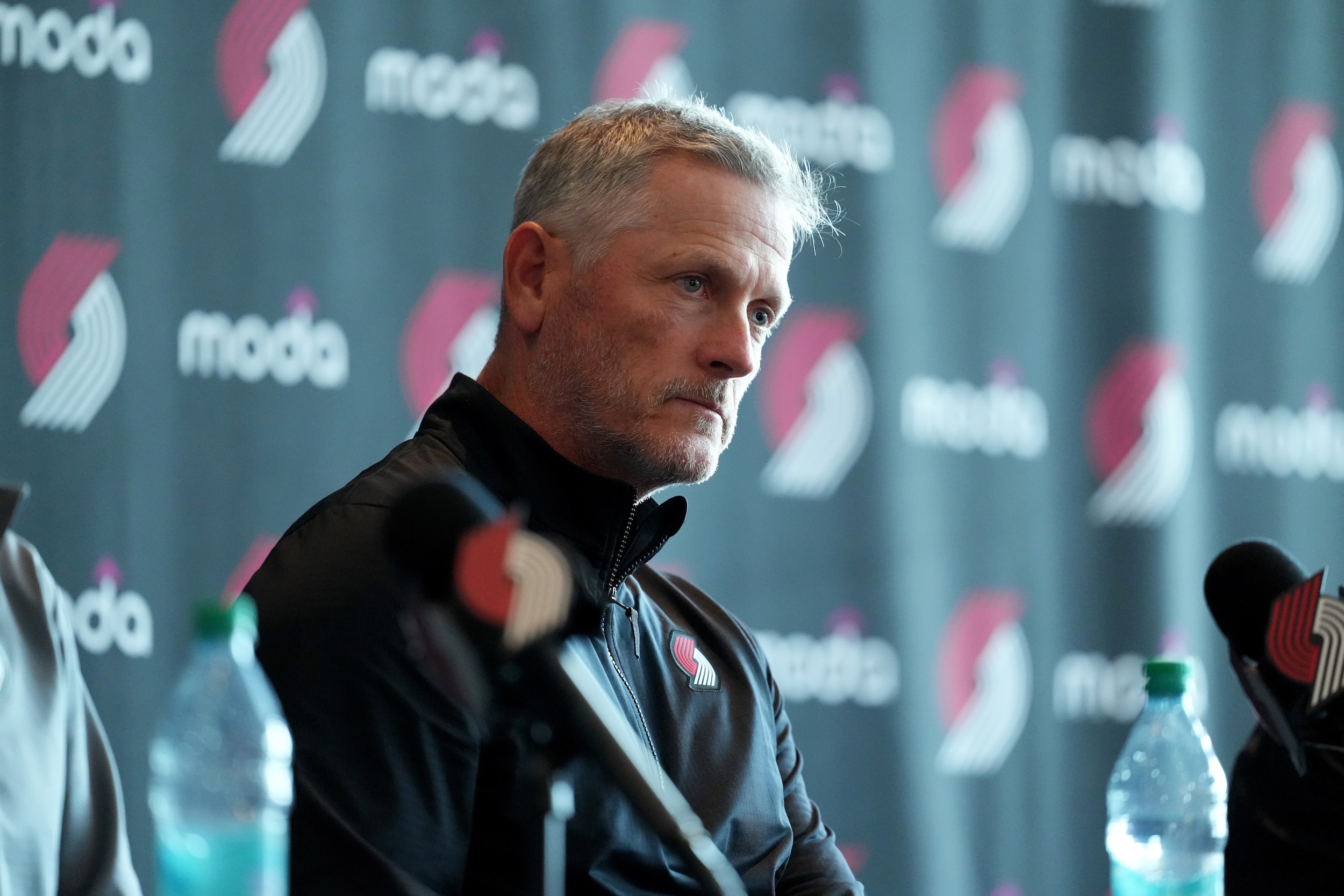
It takes a special kind of creep to stand out for sleaziness among NBA owners, objectively one of the worst demographics our species has ever established. Tom Dundon has been the official majority owner of the Portland Trail Blazers for less than three months, and already he is a standard-bearer. It's clear he doesn't mind being a villain. Having already downsized the organization with layoffs, pinched on travel accommodations, stiffed his team's two-way players, and cheaped out on playoff T-shirts, Dundon is now engaged in brinkmanship with the city of Portland over funding for arena renovations. Even that description is too generous: Dundon told an assembly of Portland businesspeople Wednesday night that he intends to pay a whopping zero dollars of his own money toward a $600 million project.
The Blazers play in one of the league's older buildings. The arena opened in 1995 and was built using, in part, debt financing. Then-Blazers owner Paul Allen refused to back the debt with his own vast personal wealth; in a sort of grimly hilarious coincidence, given that Dundon made his fortune as a subprime lender, this subjected the project to shitty, expensive loan terms, an arrangement that kerploded after a decade and led to the arena being forfeited to its creditors at the bleak end of a 2004 bankruptcy. The building was operated by Portland Arena Management, an entity spun up by the lenders that now owned it, until Allen eventually re-purchased it, in 2007. In 2024, the arena was sold to the city of Portland for the startlingly low price of just $7 million. Perhaps it's cursed. In any case, the arena is now publicly owned, and the Blazers lease it from the city.
The Blazers want the building upgraded, but their new owner, who considers printing and distributing T-shirts for a home playoff game to be an unreasonable extravagance, does not believe that this work should deprive him of any portion of his outrageous and ill-begotten private fortune. The way Dundon describes it, his team is already contributing enough to the pot. The city maintains a Spectator Venues & Visitor Activities Fund, which is funded in part by fees and taxes collected at city-owned venues, including on tickets to Blazers games. A portion of the city's burden of renovation costs would come from this fund. Voilà, says Dundon: Because the Blazers collect these fees and pass them through to the city, they are already paying their fair share. It's absurd and disingenuous on its face, but you really have to hear it in Dundon's own words to appreciate the leverage he is attempting to gain.
"It feels like we’re making a pretty big investment by staying here and paying these tax rates," Dundon told the Portland Metro Chamber on Wednesday, per Front Office Sports. "When you charge an incremental fee on the ticket, we're really just paying it. So we are investing because if you didn't charge that money on the ticket, we would charge more for the ticket. Supply and demand works pretty well. And, obviously, there's lots of places that don't have taxes at the same rate."
Dundon's casual comparison of Portland to other cities is meant as a barb and a warning, as is his not-very-subtle reminder that the Trail Blazers are only so bound to their hometown. The team's lease at the city-owned arena expires in 2030, and the city and state want to include a 20-year extension as a condition of public financing for upgrades and renovations. The state has conditionally committed $365 million; Multnomah County has proposed (but not officially approved) another $88 million. Up for debate is another $120 million, to meet the $573 million figure outlined by the project's boosters.
On the city's published fact sheet—a pretty shameful document, if useful for facts and figures—the most the deal's architects can say about the lack of private financing is that at least they are not paying Dundon directly.
"No money would go to the Trail Blazers or their ownership under this proposal; it would be spent renovating the arena," reads the fact sheet, annoyingly, congratulating those proposing the deal for not just stuffing stacks of bills into a briefcase and handing the case to Dundon. But a new or a freshly renovated arena increases dramatically the value of the basketball operation it hosts, which is why NBA owners are constantly working their host cities for upgrades, overhauls, or replacements. For Dundon, squeezing such a windfall without reinvesting any of his own wealth would be a major personal coup and a victory for NBA owners, who stand united in active opposition not only to the players who make the game, but to the civic priorities of the states and towns that host them, and the anonymous tax-paying plebeians foolish enough to hope for an orderly and functional society.
In the meantime, while he leaves the Portland city council twisting in the wind, Dundon has further kneecapped his basketball operation. He let it be known that he intended to lowball his team's next head coach, a factor that undoubtedly contributed to interim coach Tiago Splitter bolting for a below-average salary with the crummy Chicago Bulls. The Blazers eventually hired longtime assistant Micah Nori, but on what is essentially a one-year contract, a deal so lousy and exploitive that, in an extremely rare turn of events, coaches around the league publicly and forcefully denounced the deal. JB Bickerstaff, head coach of the Detroit Pistons, accused Dundon of "trying to set a precedent that devalues the job of what coaches have done to help grow the NBA and these teams into billion-dollar businesses."
Setting new and more nakedly extractive precedents appears to be Dundon's whole concept of NBA ownership, if not of success itself: As he has demonstrated with each of his acts since purchasing the Blazers—man, that was not even three months ago—Dundon sees room to redefine the financial obligations and commitments of the league's ownership tier. Simply collecting taxes from spectators and then passing them along to the city is the extent of his responsibility. It was already hard to to figure what the actual point is of having rich owners atop a sports league, if they are allowed to pay for all of it, including their own purchases of the teams, in debt serviced by profits taken from the enterprise. Dundon is saying even that is too much: His proper share, by his calculations, is paid via the government's own money.
It's a can't-lose scenario for Dundon. A few skeptical council members notwithstanding, the city government is prepared to fleece itself in order to make him richer; if they do not, he will have a pretext for relocating the Trail Blazers, with painful precedence on his side. Dundon has no connections to Portland: He was born in New York, raised in New Jersey and Texas, made his fortune in Dallas, and owns a hockey team in Raleigh, North Carolina. He doesn't give a shit about Portland or Oregon or the Blazers; if it looks very worryingly like he's trying to force an exit, at precisely the moment when the NBA is talking about expanding to new cities, so well. In the same way that it is not his responsibility to care for the building that hosts his team, it is not his responsibility to notice, let alone assuage, the anxieties of his team's fans. "I think everybody can characterize things however they want," Dundon said Wednesday. "I don't see it the same way, but I'm not trying to get people to agree or disagree with me."