

With the institution of replay review and ABS, it can sometimes feel like baseball is a little too normal these days, that it lacks whimsy or esoterica, or that games can no longer be decided by vestigial rules that were codified during the Hayes administration. This impression, I am happy to report, is false. The sheer number of permutations of bat and ball and player requires a robust rulebook that nevertheless still must on occasion come down to human judgment. What happened Monday night in San Diego is proof that there is still some mystery in the world.
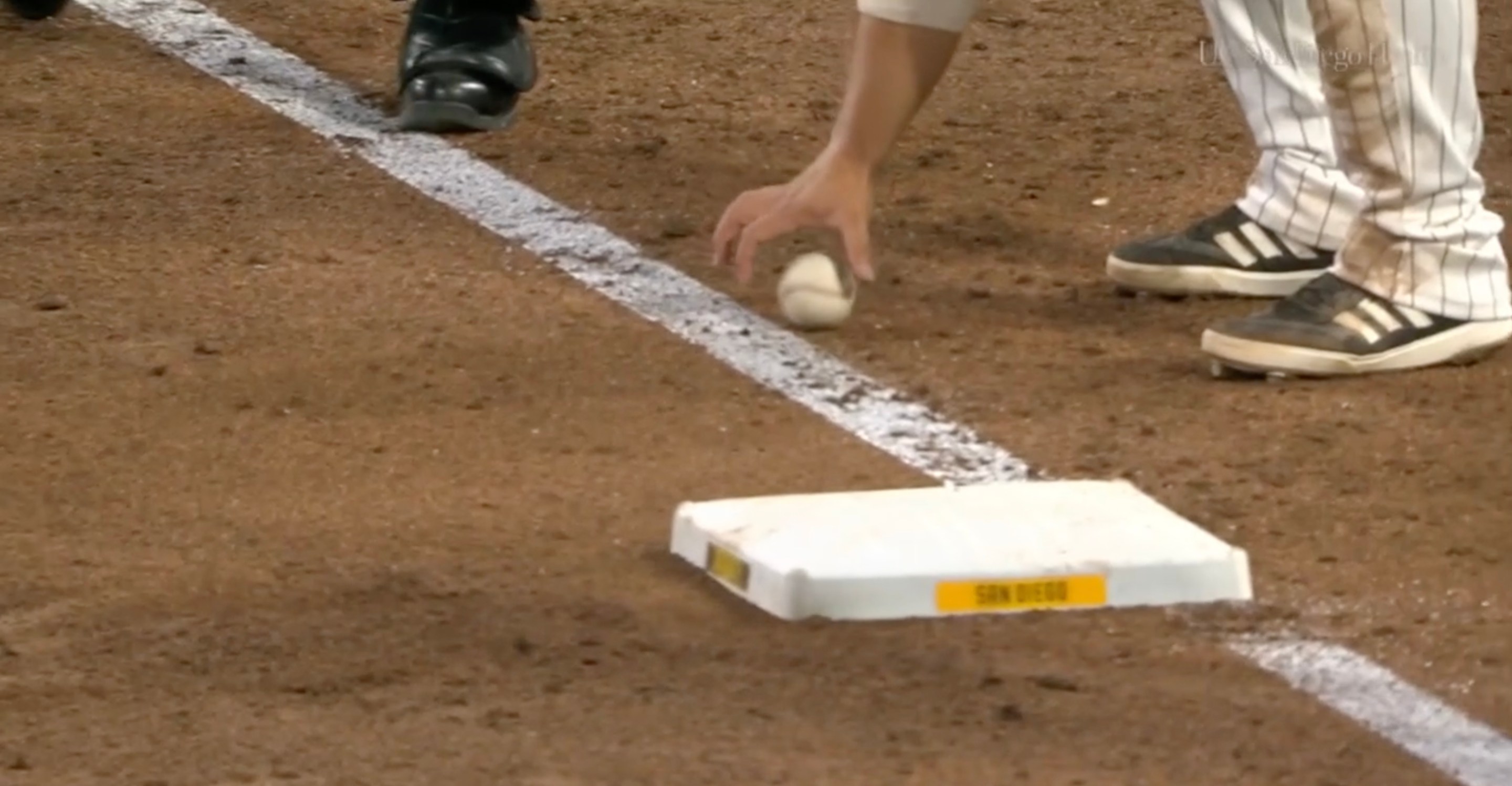
Matt Shaw led off the Chicago Cubs' ninth against Mason Miller with a little squibber down the third-base line, and it appeared to be trickling foul as it ran out of momentum. Just as it came to a stop—just!—Ty France picked it up ever so daintily, perhaps trying a bit of a frame job to make it look even more foul than it appeared on first glance. But it did appear foul.
Home plate umpire Dan Merzel called the ball fair, giving Matt Shaw a single despite it appearing clearly foul pic.twitter.com/yck1JiRPnx
— Talkin' Baseball (@TalkinBaseball_) April 28, 2026
Umpire Dan Merzel called it fair, however, and was backed up by the third-base ump, and that call is non-reviewable. It was the dinkiest of infield singles for Shaw, who would later come around to score to end Miller's streak of 34.2 scoreless innings. The Padres won anyway, 9-7.
It'd be one thing, a boring thing, if this were a simple bad call. But I think they got it right. From the umpire's perspective, looking from directly above the ball, the tiniest little piece of it would have been over the chalk of the foul line. That would've been enough to make it fair. That it didn't look anywhere near the foul line from the TV camera can be chalked up to parallax, familiar to astronomers and Calgary Flames fans alike. Here's a helpful demonstration one fan put together with a baseball and an envelope.
So the ball was touching only foul territory, but a small slice of it was sitting above fair territory. Fair or foul? Does fairness have unlimited verticality, or is contact with the ground what counts? Would you believe the MLB rulebook has different definitions of "fair" for different scenarios? I bet you'd believe it.
From the 2026 rulebook's definition of terms, with relevant parts bolded by me.:
A FAIR BALL is a batted ball that settles on fair ground between
home and first base, or between home and third base, or that is on or over fair territory when bounding to the outfield past first or third base, or that touches first, second or third base, or that first falls on fair territory on or beyond first base or third base, or that, while on or over fair territory
touches the person of an umpire or player, or that, while over fair territory, passes out of the playing field in flight.
Catch that? If the ball settles, it needs to be on fair territory to be fair. But it only need to be on or over fair territory when touched to be fair.
The distinction is likely due to the latter scenario being meant for fielders biffing catch attempts down the line, but it's the closest thing the rulebook has to describing Shaw's grounder last night. It's imperfect, and raises another question: Had the ball "settled" when France touched it?
"It stopped rolling," France said later. "I thought it was foul, but they said otherwise. They said they both had it fair and it's a non-reviewable play."
It was real close. Close enough to be subjective, I'd say. Close enough for gripes to be legitimate, and hadal rulebook depths to be plumbed. God bless baseball, where obscure rules and the human element will never go out of style.