
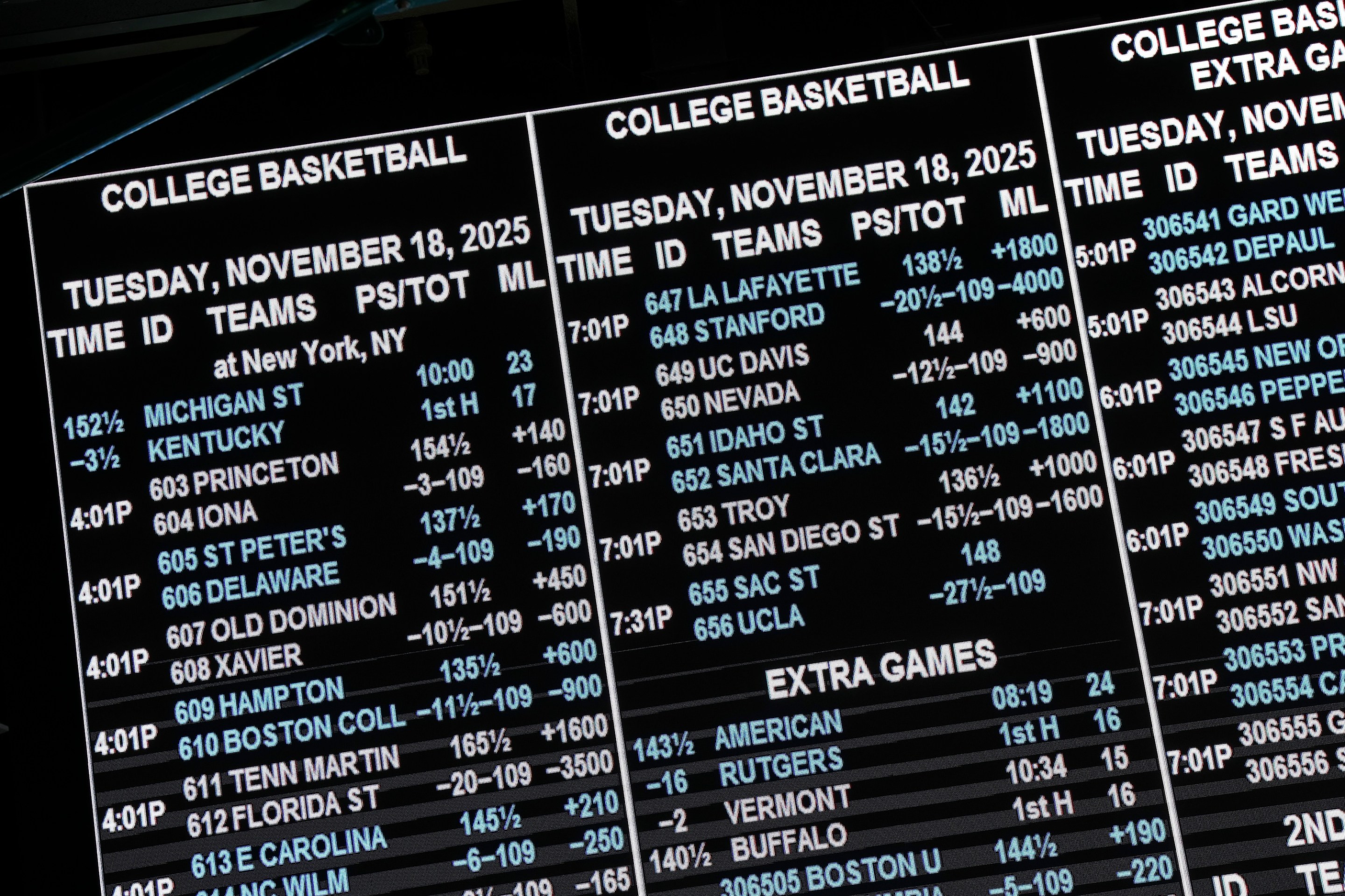
On Thursday, federal prosecutors in Philadelphia brought charges against 26 people they say were involved in a scheme to fix bets on college basketball and Chinese Basketball Association games. The point-shaving scheme, according to a 70-page indictment unsealed that morning, involved at least three dozen players on 17 different teams.
Twenty of the defendants played college basketball during at least one of the 2023-24 and 2024-25 NCAA seasons. Some were already the subjects of NCAA investigations into betting violations this fall and were no longer competing. A few defendants, however, were active college basketball players until Thursday. Carlos Hart, Camian Shell and Oumar Koureissi, who are charged with fixing games at previous schools before transferring to new ones, have played in games as recently as this week. Simeon Cottle, a Kennesaw State player who's now suspended indefinitely, put up 21 points in a win the night before he was indicted. He is his conference’s leading scorer and was named CUSA preseason player of the year.
The indictment refers to the scheme’s ringleaders as “the fixers,” a group of people who started by recruiting and bribing players to fix CBA games during the 2022-23 season. After some success doing that, the fixers decided to try men's college basketball, enlisting NCAA players who agreed to make sure their team didn’t cover point spreads. Among the fixers, according to the indictment, were Marves Fairley and Shane Hennen. Fairley and Hennen were also indicted by a New York grand jury in October for alleged involvement in a similar scheme in the NBA—the one involving Terry Rozier. Where the bets in the Rozier case were player props—bets a single player could conceivably fix alone—the wagers mentioned in the Philadelphia indictment were spread bets and half bets concerning team scoring, which makes fixing a bit tougher. In colorful and depressing detail, the indictment shows just how exhausting it is to rig a team sport.
How does a player be bad enough to throw a game, but not so bad that they don’t get taken out of the rotation and lose their already limited power to throw a game? Some defendants tried to solve that challenge by bringing teammates into the scheme. Shawn Fulcher allegedly participated in the scheme while playing at Buffalo during the 2023-24 season and again when he transferred to Alabama State the following season. In a text he sent to Jalen Smith, a North Carolina-based trainer and one of the fixers, while at Alabama State, Fulcher didn’t seem concerned that his lack of playing time would be a problem. “Bro honestly we need to get this sh*t rolling the right way asap! I ain’t even touch the floor tonight idk why or what my coach on but at this point I don’t even give a f*ck I’m just tryna get paid bro! I got my [Alabama State teammates] on board . . . so we good,” he wrote.
If the game-fixing doesn’t work, you may just be setting your bros up to look like total clowns for no reason. The indictment describes a failed attempt to rig a game between Buffalo and Kent State in February 2024, when Fulcher was at Buffalo. For the last 13 minutes of the first half, when it was starting to look like Kent State would not cover the first-half spread as required for the bets to hit, Fulcher and two teammates in on the scheme “scored a total of 1 point, missing several shots, including layups and dunks, and committing several turnovers.” It didn’t work: Needing nine points to cover the first-half spread, Kent State went into halftime up by eight.
For players involved in the scheme, teammates who weren’t aware of the scheme might as well have been opponents. Athletes who aren’t intentionally trying to lose are usually trying hard to win. In March 2024, the indictment says, four DePaul players agreed to underperform in a home game against St. John’s. Trailing St. John’s by 26 points at halftime, they covered a 15-point first-half spread, but still made their fixer nervous. Smith, the fixer, “texted Micawber Etienne to complain that one of the players who was not involved in the point-shaving scheme was playing well and needed to ‘chilllll [the f*ck] out.’” Etienne, a former DePaul player whom the indictment says is “charged elsewhere” and not in this indictment, texted Smith back mid-game to assure him that the DePaul players in on the scheme were trying to deny that guy the ball.
Opponents don’t always do their part either. The indictment says one Fordham player, Elijah Gray, was offered a bribe of $10,000 or $15,000 to point-shave in a February 2024 game between Duquesne and Fordham. The fixers placed bets on Duquesne, a 3.5-point favorite, to cover the spread. Those bets failed when Fordham came back to win in the second half. Over text messages after the game, Smith and Gray lamented that a Fordham player not in on the scheme had played too well that night. Gray also said that while he’d tried to prevent his team’s comeback win, the Duquesne players were “not hoopin.”
The “not hoopin” issue came up a few times. During an attempt to fix a game between Southern Mississippi and Alabama State in December 2024, Smith texted Alabama State players, “LET [the Southern Mississippi players] LAY IT UP.” An unnamed player in on the scheme responded that Southern Mississippi was “so bad” that the game was hard to throw. In March 2024, the fixers recruited players at Coppin State into the scheme. One, referred to in the indictment as "Person #13," was encouraged by the fixers to underperform in a game against South Carolina State so that South Carolina State would cover the full-game spread. “Wtf u doing[,] it need to be a blowout . . . You hooping yo ass off wtf . . . U supposed to be f*cking losing[,] you costing us money,” Smith texted Person #13 during the game.
It’s sad to think Smith may have thrown away his bright future as a demotivational speaker. “Get yo ass blow[n] out next half bro,” he wrote. But what’s a guy to do when the other team’s not hoopin? “[T]hey [South Carolina State] so ass I couldn’t even keep they lead together[,] im sorry for th[a]t bro[,] swear I tried everything in my power second half,” Person #13 responded.
There’s also the issue of opsec. As Smith texted one defendant, former Eastern Michigan player Jalen Terry, in December 2024, “We gotta stop ta[l]king so crazy on the text.” Plus, you risk being charged with a bunch of federal crimes. The full indictment can be read here.