

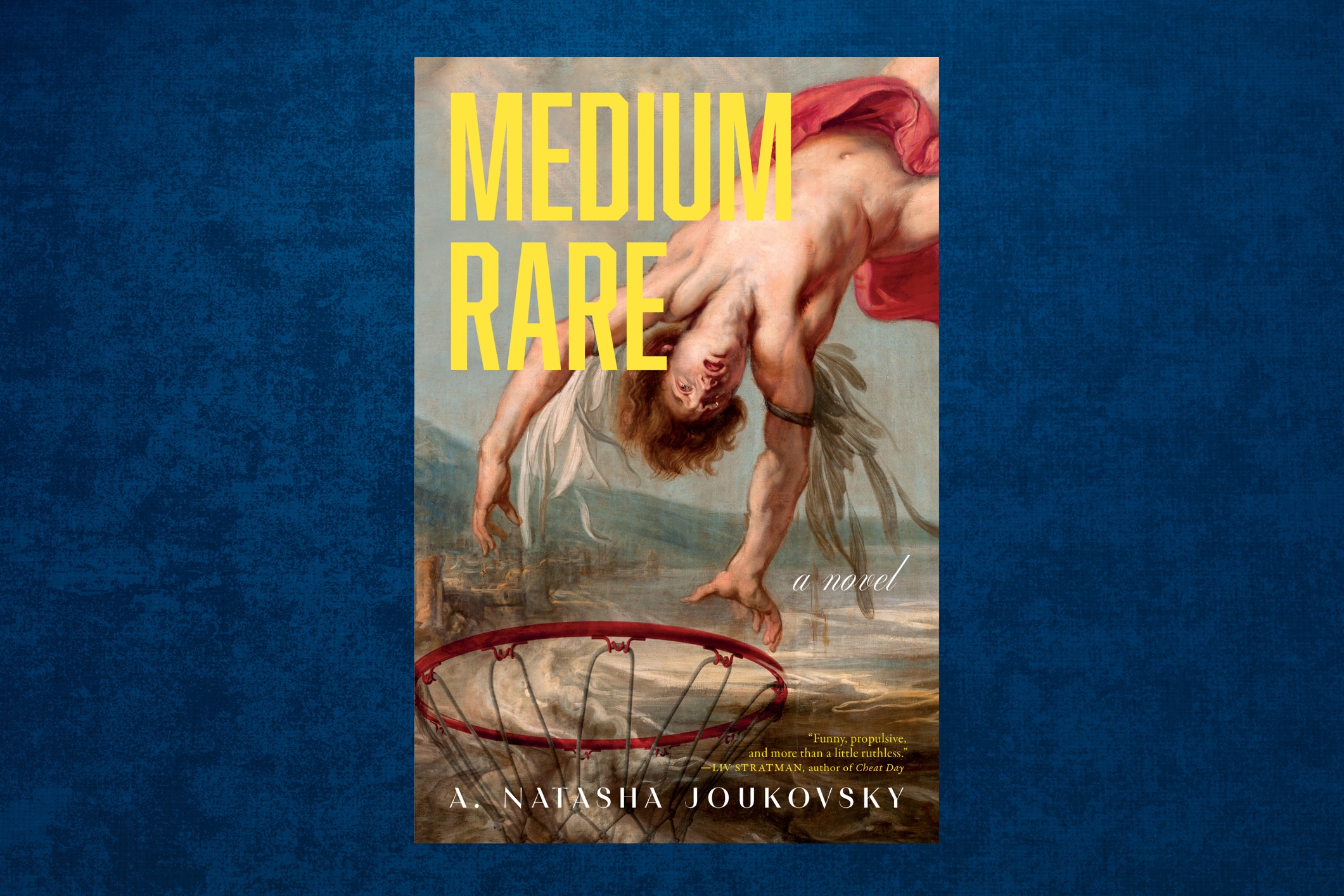
The odds of filling out a perfect NCAA bracket are one in nine quintillion, two hundred twenty-three quadrillion, three-hundred-seventy-two trillion, thirty-six billion, eight-hundred-fifty-four million, seven-hundred-seventy-five thousand, eight hundred and eight. This is according to Phil Fayeton, anyway, the doomed protagonist of the very funny new novel Medium Rare, by A. Natasha Joukovsky. The statistic is a recurring bit—it is what you get if you consider every game a 50/50 toss-up, which is not accurate in a seeded tournament.
“It's just not true,” Joukovsky tells me. “That would be random chance. But of course, brackets are not random chance. The seeding is asymmetrical.” The real odds, she tells me, “can be really different year-to-year,” and they can be debatable. They’re still minute, but significantly more likely than Phil makes them seem.
In the novel, which opens in the winter of 2019, Fayeton is poised to do the highly improbable: predict every game of March Madness perfectly for a billion-dollar prize furnished by a tech mogul. A retelling of the Icarus myth, the book traces his climb, asking not just “What if it happened?” but “What if it happened to the most average guy you’ve ever met?”
Narrated by Cassandra, a sleek political fundraiser who has the mythic curse of prophecy that no one believes, the book also sends up low-level D.C. politics. It’s a basketball novel the way Infinite Jest is a tennis novel: hilarious and exuberantly written, a virtuosic, language-obsessed reimagining of a classic story. On the eve of March Madness, and the book’s publication, I spoke to Joukovsky via Zoom about sports novels, DFW, D.C. bros, and, of course, college basketball.
What was the seed—pun intended—of this book?
It was my husband's idea. He is a much bigger basketball fan than I am, but the second I heard it, I knew I wanted to do it. I was instantly transfixed by the Icarus link. It's like, “Oh, you know Icarus—he's gonna fall, and that's perfect.” I was keen on the high concept after how hard it was to talk briefly about my last book [The Portrait of a Mirror].
This novel was not originally narrated by Cassandra. That was a separate novel idea. I was considering the omniscient millennial narrator separately from the basketball Icarus novel set in the near future, like Infinite Jest. The first idea for the March Madness novel was that it would be perpetually next year. But then the 2019 tournament happened, and UVA won. The basketball was so spectacular, and then there was Covid. I switched my tactic to set it in 2019 instead.
It's interesting to hear that choice was informed by Covid, because deciding whether to include it or not is such a problem for novelists. So you watched the tournament in 2019, and I'm interested in how you wrote those precise scenes. The tournament is very much in the book. There are play–by–plays. Were you writing in real time as you watched?
I was not writing it in real time. I wrote the first bit in the fall of 2019, but not with the tournament that had just happened in mind, except for the fact that 2019 was the year that this guy, Gregg Nigl, came closest to filling out a perfect bracket. It wasn't a perfect bracket, but he got the first 49 games correct. I believe that record still stands, and it was way farther than anyone else had gotten before.
So when you realized that 2019 was the year you wanted to write about, how did you go about it? Did you go back and rewatch the tournament? I know that you wrote a lot of this book on a sort of DIY residency at the beach in Delaware, banging out as many pages a day as possible. Were you sitting there watching games and transcribing maniacally?
Oh, yes. I went full Ahab on those games. I was sitting at the beach in a not particularly comfortable chair, watching them over and over, pausing, going to ESPN and reading the game summary alongside. It was some of the most fun I’ve ever had writing, and came relatively easily because it felt more like translation than ex nihilo creation. But, yeah, I got hard into those games. That's how I came to really like basketball itself. My prior interest in it had been primarily mathematical. The statistics of bracketology are fascinating, and I’d always loved filling out a bracket going back to college.
How do you fill out your bracket?
You know the stupid dichotomy of “plotters and pantsers?” I feel like filling out a bracket is the one appropriate use case for it. I'm a bracketological pantser. It's all just for fun. I'm choosing whichever team I like better on a whim. I do tend to pick higher seeds, except for fives and twelves, because those are frequent “upset specials.” I got second place one year.
The book is conceptually similar to Infinite Jest—a contemporary retelling of an old story with a sports hook—but it’s also stylistically reminiscent of Wallace. I wanted to talk about your sentence structures and your word choices, which I think are pretty different from the pared-down prose that we see in a lot of contemporary fiction. Where does your style come from? It seems like you're having fun, and that you bring a lot of joy to finding precisely the right word.
I'm having the most fun. Stylistically, I'm pretty much always trying to marry the two traditions that I want to be a part of, the psychosocial novelist tradition that most people would say starts with Jane Austen, but I am newly hip to the fact that it really starts with Frances Burney. I am on a mission to get everyone who loves Jane Austen to read Burney, too. So, on the one hand, it's the Burneyesque-Austenian tradition, going into George Eliot, Henry James, Edith Wharton—that classical high prose, high irony style. Lots of free indirect speech. Then the other side is explicitly DFW-coded. I think of him as part of the mythic puzzle narrative tradition more broadly, going back to Joyce. And I studied Joyce a lot in college. I wrote my undergraduate thesis on Ulysses. Ulysses is wonderful in a similar way to Infinite Jest. I was really into those super-hard novels in my youth for their sheer hardness and virtuosity.
By infusing some of the psychosocial tradition into the puzzle tradition, I wanted to make something that is as technically and allusively rich, but more legibly beautiful and accessible to regular-educated audiences. Because a lot of people, let's be real, are not going to slog through Ulysses and Infinite Jest. I’m convinced the greatest novel ever written lives somewhere tucked inside it, but I myself am probably not reading Infinite Jest again in its entirety.
I want to pivot for a second and talk about Phil. Phil is ostensibly the main character—he drives the plot. He has this success and we watch his rise. A lot of funny novels today are about “the problem with men,” and are these dark portrayals of guys stuck behind their computers, jerking off to weird stuff, and so on. But Phil is not that. He’s an everyman. He’s regular. A moderate–Republican–turned–moderate–Democrat with a wife and a job. I wondered where Phil came from, and why you chose to send up a medium dude?
I had the title early, which definitely influenced it. But I also thought that mediocrity was a better foil to an insane rise than great impoverishment or privilege. The average guy is the perfect corollary there. Part of what I'm getting at, with the rarity of the bracket, is that we often use rarity as a proxy for value in and of itself. I have a theory that people often mistake rarity itself for beauty and truth, because beauty and truth are rare. But rarity itself is worth nothing. So I loved this premise, because a perfect bracket is both so rare and so dumb, and I wanted a protagonist who fit with that, a paragon of false exceptionalism.
I also felt that Phil was a recognizable D.C. guy. You live in D.C. (and, like Phil, went to UVA) and I wonder if this is a type of guy that's around.
I am less inundated with that type in D.C. than you would think. I work from home. But he ticks all the boxes I hear about secondhand, and while I don't encounter them often anymore, they were in full force at UVA.
And then Raleigh, Phil’s wife, is a sort of UVA type as well, right? She was probably my favorite character—so specific. Were you in a sorority?
I was in a sorority. But Raleigh is my most purely imaginary character. I have a theory that in many cases, the most fictional characters feel the most real. The prototypical example of this is Anna Karenina, who Tolstoy took from thin air, versus Levin and Kitty, who are heavily based on himself and his wife. Maybe that's part of what's going on.
Raleigh is fun to read. She’s unexpected. The narrator doesn't give her enough credit and comes around on her eventually, and the reader is led around on her as well. It just seemed like you, as the author, had a lot of affection for her, and there's a sweet friendship story between her and Cassandra.
I was playing with this idea of a hyperfeminine friendship novel inside a hypermasculine basketball one. It appealed to me because I wanted to show the unearned significance we often give to small differences. There’s a line in the book where Cassandra, comparing herself to Raleigh, says, “I had made all the traditional choices of the unenlightened women I looked down on; my only distinction was having made them more elegantly.” We tend to put a lot of moral weight on this elegance, more than I think it can bear. Then the difference between Cassandra and Phil is overblown, too. They are more alike as human beings than they differ as an average man and an exceptional woman. I think we underindex on the human level societally, but it’s what I’m most interested in: the human level.
Let's talk about the point of view, which is first-person omniscience. Cassandra can see the future but is also experiencing the story in real time. I was trying to think of similar examples, and I couldn’t think of many. In a retrospective first-person voice, for example, the perspective is usually limited to the narrator. We don’t get to experience the emotions and observations of the other characters like we do in your book.
In one sense, I think the closest thing is something like Nick Carraway, a narrator who eventually gets involved in the story, but starts off more detached. Conversely, Austen qua narrator sometimes slips into the first person. There are places in Medium Rare where it has more of that third-person feel, something close to my straight authorial narrative voice, perhaps because I originally wrote the prologue in third person. And when I realized that, “Oh, Cassandra should tell the story of Phil,” I still wanted to keep some of this detachment. It adds to her prophetic aura.
Something that we’ve seen a lot in the last decade or so is a myth retold from the female perspective. You know, the maiden who was turned into a tree or whatever, and why it was unfair to her. The purpose of those books seems to be to set the record straight. Your book is up to something different, I think. I wondered if you would talk about your approach to using a myth as a scaffolding for a contemporary story.
I get questions about this a lot, probably because you’re right, those kinds of retellings are so popular—and by the way, I think they can be great. I like Madeline Miller a lot. I don't have as much time for a lot of the other ones that are maybe more explicitly trying to pick identitarian battles in BC. But I get why the marketing crossfires, and I've benefited from getting lumped in with them as much as I’ve been punished by readers who go in with those expectations and are then extremely disappointed.
But no, I'm coming at myth totally from the Ulysses/Infinite Jest angle. I'm thinking of it like the scaffolding for literary innovation. That sounds like very high-minded, but the other more tactical benefit is it eases pressure on the plot. Roughly stealing a myth that has worked for thousands of years and is a pretty effective way to have a good one that will grab people without spending all your time plotting. Ultimately, I'm much more interested in the themes and the ideas and the characters.
What are the great sports novels?
So after Infinite Jest, I really like The Art of Fielding with its Melville connection. I don't know if you’d count this as a sports novel, but have you read The Queen's Gambit? I haven't seen the Netflix adaptation, but the novel is fantastic, and it is, to me, a quintessential sports novel. You are all in on what is going on in these chess games. Lastly, though not a novel, Moneyball was a big influence.
So, Natasha, who is your favorite to win the men’s NCAA championship year?
I have no idea. I hope it's Virginia—I am what I would call a “casual fan.” I always hope they do well. But statistically, I’m better off going with Duke.