
It's pretty remarkable to recall today, after the firing of Xabi Alonso and the uncertainty about the state of Real Madrid's star-studded project, that the club is only a year and a half removed from the absolute pinnacle. The 48-hour period between June 1 and June 3, 2024, when the team won the Champions League final and then announced that it had added to that championship group the best player in the sport, Kylian Mbappé, could credibly stand as the very apotheosis of what Real Madrid aspires to be. From those heights, it maybe shouldn't be so much of a surprise that the club had nowhere to go but down.
If Real Madrid's fate since those days stands for anything, it's that nothing can be taken for granted in this sport, and that tomorrow is not promised to anybody, not even those who already appear to possess it. It's not the case that the Blancos' struggles in the Mbappé era were completely unforeseeable, and in fact the risks were obvious from the outset. A team is a delicate mix of synergies, partnerships, hierarchies, and personalities, and it was clear that the de facto exchange of Toni Kroos for Mbappé would fundamentally alter the balances the team had arrived at over the years, and not necessarily for the better. The biggest question for Madrid the day Mbappé signed was how exactly the team planned to incorporate the Frenchman's talents with those of his new superstar teammates, Vinícius and Jude Bellingham, since the three did not seem to be the most natural of fits. A year and a half later, Real is still struggling to figure that out.
When Mbappé first arrived, the Blancos were led by the sport's most brilliant jigsaw solver, Carlo Ancelotti. But not even he could coax any sustainable connections between the trio itself and the mishmash collection of players behind them. When the club's patience ran out with the Italian, they turned to Alonso, the crown jewel of that offseason's coaching carousel, one of the most promising young managers in the game, a man seemingly ideally placed to succeed inside the game's most unforgiving crucible. Like the Mbappé signing, the Alonso hire felt like a coup, a dream. But like with the Mbappé signing, the club was not adequately prepared to make the most fanciful aspects of the Alonso dream a reality.
It's important to focus on the club itself in any discussion of Alonso's ouster, since it is with the club, much more than the coach, that responsibility for the present bad times ultimately lies. Alonso does of course share in the blame, maybe most readily demonstrated in the fact that not a single thing had changed from a month ago, when Alonso was on the verge of getting the chop, to Monday, when Damocles's sword finally came down on him. By swapping out just a few proper nouns, I could write pretty much the exact same lede as then about Madrid's latest loss. At that time, the big bellwether match was a Champions League one against Manchester City. On Sunday, it was the Spanish Supercopa final against Barcelona. Once again, the Blancos desperately needed a galvanizing win that hopefully could jolt this stubbornly snoozing giant awake, and at minimum had to avoid a humiliation that threatened to bring a premature end to Alonso's tenure. And once again, Real did in fact lose, in comprehensive but not quite embarrassing fashion. Whereas club president Florentino Pérez decided to keep Alonso on after the City loss, if only to wait for an even more resolute justification for canning a Madridista icon, Pérez figured that enough was enough after the Clásico defeat and sent Alonso on his way.
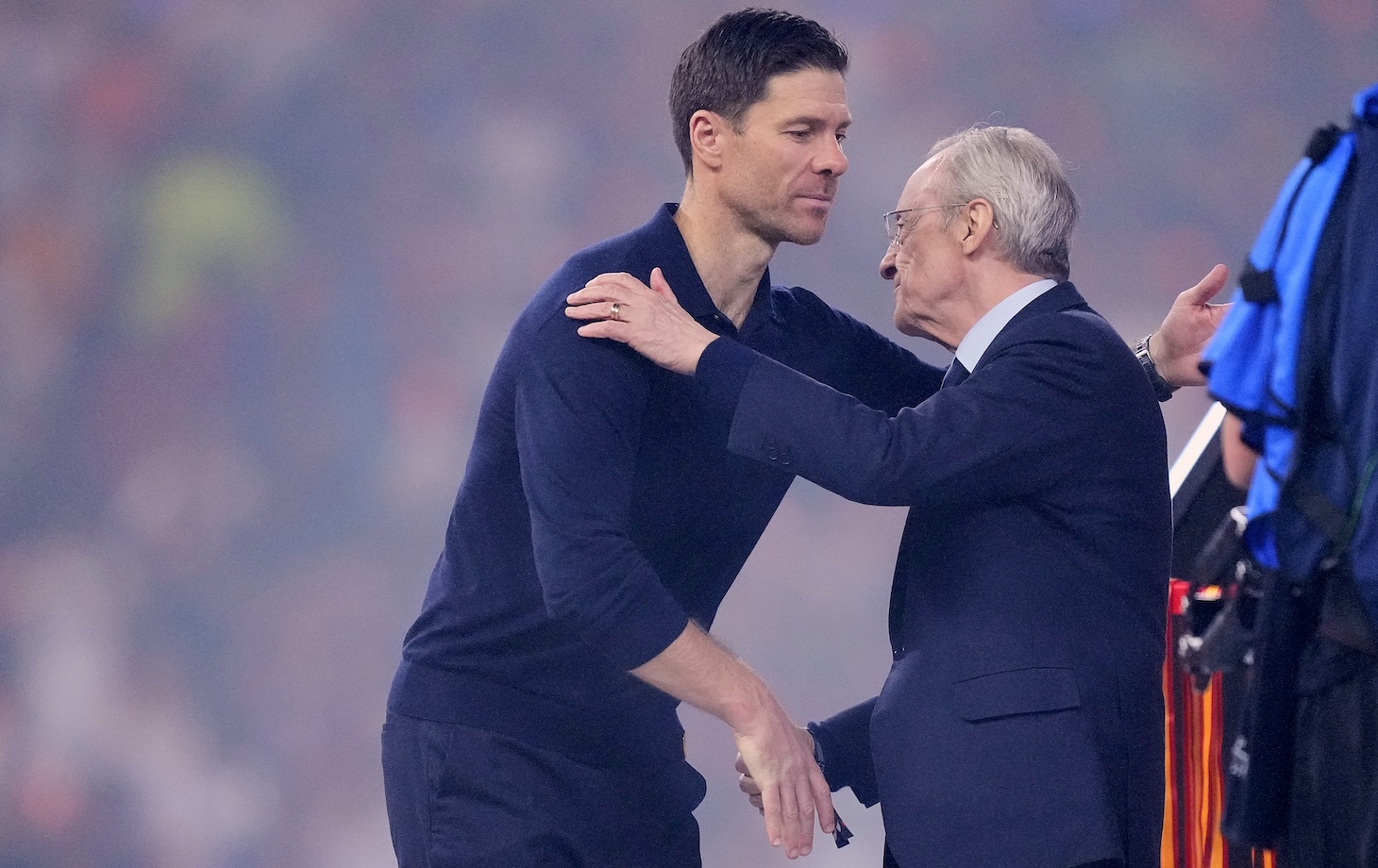
More so than the result or any of the action during the game itself, the moment from Sunday's final that best exhibited why Alonso's position had become untenable came during the postgame ceremonies. After the Madrid team had walked through the guard of honor the Barcelona team had formed on their way to collecting their runners-up medals, Alonso went over to where his team had previously stood in order to form their own guard of honor for the Barça players. But while the manager stood there and gestured for the players to follow him, Mbappé gesticulated at him, seeming to refuse Alonso's direction and telling him and his teammates not to form the guard of honor. After a few dueling hand waves, Alonso eventually relented and followed Mbappé off to the side of the field.
Though a short interaction over an irrelevant custom, the incident spoke to just how little power and influence Alonso held within his own team. The incident echoed another one from the only notably positive result of Alonso's time, when Madrid won the season's first Clásico back in October. Any chances that that game might serve as the galvanizing moment in a season already looking stagnant were ruined when Vinícius gestured angrily while coming off of the field when Alonso subbed him off. It was a blatant bit of insubordination that Alonso clearly didn't appreciate and that, even after the fact, Vinícius pointedly refused to apologize to him for. But the most important part of it all was how the club failed to support their new, young manager in such a crucial moment, declining to punish Vinícius in any notable way—a stark contrast to how Liverpool handled a similar moment between its embattled manager and its star player.
The truth of the matter is that the Xabi Alonso Real Madrid thought it was hiring—the proud, charismatic, decisive, intelligent man he's always been known to be as both a player and a manager—never really appeared in Madrid during these past few months. That's in part on him, but mostly on the club for not giving him license to truly be himself.
It should've been clear that if Ancelotti couldn't solve the puzzle of this expensive but ill-fitting roster, then no manager could. Rather than take this insight to heart and seek to reform the team, Pérez instead hired Alonso and expected him to do better with more or less the same pieces. What's more, Pérez brought Alonso in to crack the whip on this purportedly over-indulged group of players, but when the players stared down the manager when he so much as brandished the thing, Pérez refused to establish Alonso's authority.
The club's failure to assemble a complimentary roster over the years, its resistance to making hard choices about offloading players who don't fit to bring in others who do, its failure to foresee the inevitable frictions when attempting a drastic culture change from the genial and free-flowing Ancelotti to the stricter and more rigid Alonso, and its failure to actually empower Alonso when he sought to do what he was asked, all created the conditions for not only the early end to Alonso's tenure, but to the squandering of the promise represented by those glorious 48 hours in the summer of 2024. (It's odd to see Pérez making so many of the same mistakes as he did back in the Galácticos era.) Absent better decisions in terms of roster construction going forward, there's no reason to believe anything will change. What once, just a year and a half ago, looked like the start of something unthinkably wondrous now looks more like the beginning of the end of something else. Though, it's always worth remembering that the future often winds up looking stranger than you can imagine.