

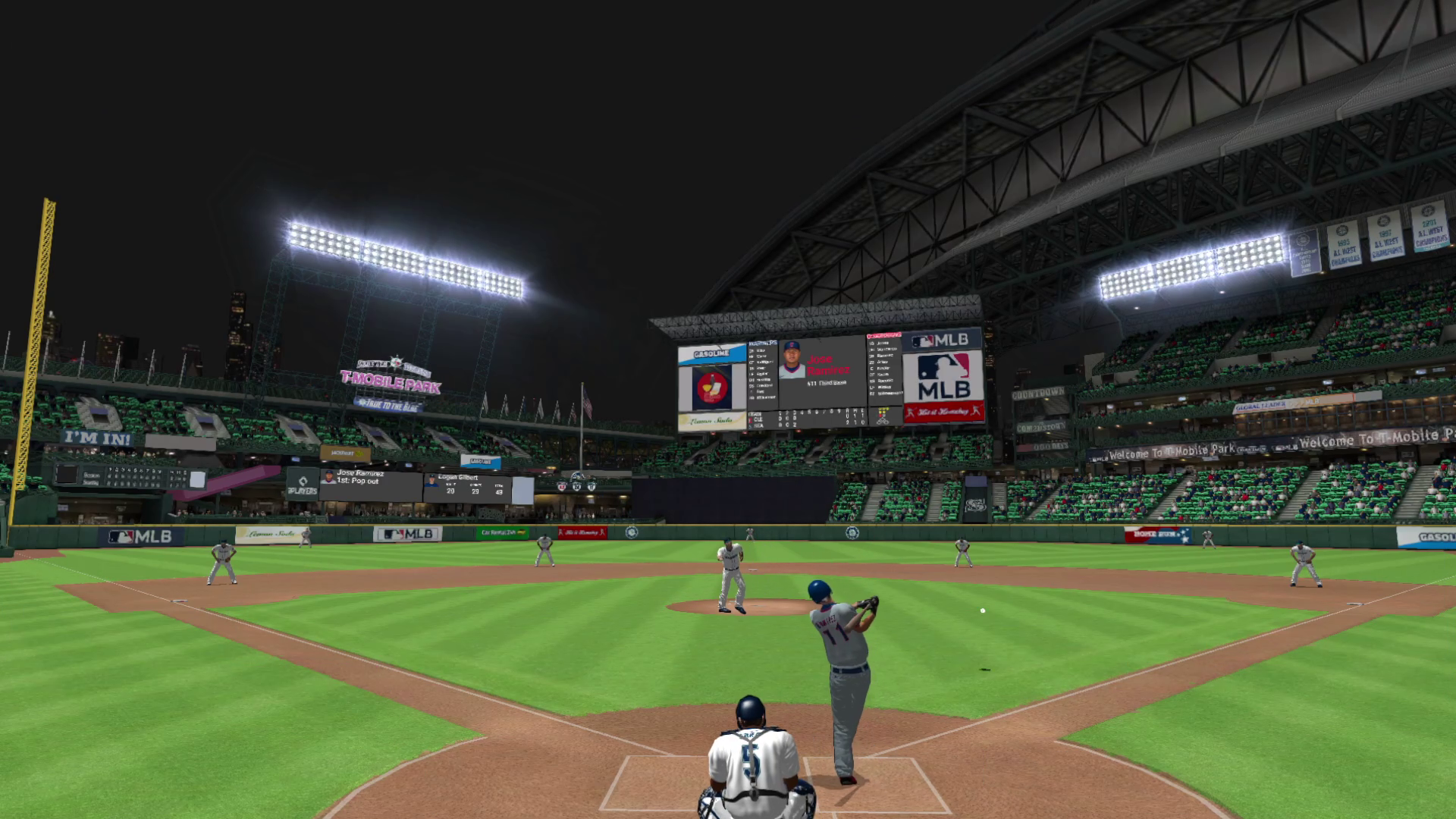
When I was a kid, I loved baseball. I loved playing it, I loved watching it, and I really loved attending games. Some of my favorite memories of growing up in Miami came at the old Dolphins/Marlins stadium, a truly horrible place to watch any sporting event, but also one that was a mere 10-minute drive from my home. I went to countless Marlins games in the summer of 2003, watching them slowly put things together into what would eventually be an improbable second World Series title that fall. (I was lucky enough to attend Game 5 of that World Series, back when tickets were merely expensive and not expensive.) Baseball's constant motion kept me grounded in the rudderless months of Miami summer, when the heat is so stifling that you could get tickets behind home plate for Sunday afternoon games for about $20.
There's another reason that I loved baseball so much, though, and that is that I was in the exact right age demographic for the golden age of baseball video games. My late single-digit years and my early teens coinciding with the releases of such bangers like Major League Baseball Featuring Ken Griffey Jr., Triple Play 2002, and the glorious trilogy of MVP Baseball 2003 through and especially 2005 brought together two of my great loves: sports and gaming. I remember spending a big part of a month in Venezuela one summer just playing Triple Play 2002 for days on end, only coming out for air to eat, and sometimes not even that. I also remember learning every single starting lineup and rotation in MVP Baseball 2004, while trying to keep my defending champion Marlins at the top of the league. I remember all of these things because they made me grow closer with the sport, and made me understand what I wanted to get out of being a baseball fan.
Fast-forward a couple of years, and baseball video games fell off rather quickly, as did, and perhaps not coincidentally, my love of the game. Part of that is that the Marlins did what the Marlins do, and traded away Miguel Cabrera and Dontrelle Willis and a bunch of other stalwarts from the 2003 World Series team, but I also went off to college in 2007 and had other things on my mind. I've tried since then; I briefly got into the MLB 2K series before that went kaput, and once I made the swap from Xbox to PlayStation, one of my first purchases was whatever year of MLB The Show was out then (14, if memory serves). I did love the latter, but it never held my attention quite like the games of my teen years did.
A few weeks ago, while I was in the middle of reading The Universal Baseball Association, Inc. J. Henry Waugh, Prop, a new game finally helped me recapture some of that same connection. It's fitting that the game is Out of the Park Baseball 27, the newest installment in the long-running (first came out in 1999!) baseball simulator from the appropriately named Out of the Park Developments.
I say fitting because there is no "gameplay" so to speak in OOTP; you do not swing the bat or try to paint the corners like you do in The Show. Instead, my aging reflexes are shelved in favor of my obsession with cataloging and spreadsheets. In OOTP, the player takes over either as the general manager or the manager (or both!) of a baseball team and attempts to guide them to glory in much the same ways that those two roles do in real life. You build the team (which can be a current MLB team, or, in a part of the game I have not explored, many teams throughout the history of MLB or other leagues around the world and throughout time), you set the lineups, you pick the strategy, and then you watch as your players do their best to not fuck things up too badly. Along the way, you can call for steals, hit and runs, bunts, intentional walks, and all of the other things managers can do from the dugout.
If that sounds boring, consider the lack of action and gameplay a feature, not a bug. OOTP, like its soccer counterpart Football Manager, lulls you into the rhythm that it requires from you, where one more game becomes 17 more games, and where you end up texting your buddy endless updates about how your rebuild of the Marlins is going. In my save, I am in the offseason before the 2030 season, fresh off a Game 7 loss to the Los Angeles Dodgers (boo) in the NLCS, and I'm now getting steamrolled by free agency. It's great.
It also has helped me become more of an active and consistent baseball fan in my real life. Every MLB season, I come in with a pledge to regain some of my love and passion for following the sport, a pledge that usually falls apart around this time of year, if not sooner. There's just so much baseball, and the best way to keep up with it—following your own team—falls apart in the face of usual Marlins futility. However, this year, I don't feel my interest waning whatsoever. In a broader sense, it's been a fun baseball season, with the rise of the White Sox, the pitching excellence in the National League, and, yes, my Marlins showing some competency. I also have a partial season ticket pack for the second year in a row at the Phillies' stadium, so I have a regular cadence of in-person games to look forward to. It's been a good time, but now, I have something else, thanks to OOTP: I have an emotional investment in players that I had never heard of or thought about before the last fortnight.
For me, sports video games' best value, beyond the moment-to-moment fun of playing them, has been in finding new players to fall in love with, even without having seen them play in real life. It's a ridiculous trait to have and to proudly wave about, but I can't even begin to enumerate how many soccer wonderkids I've become a big fan of after having first heard of them in the FIFA and Football Manager series. (You will always be famous, Stephan El Shaarawy.) Sports video games have always been my gateway drug into a deeper kind of sports fandom, one in which I have a personal connection with more players than any one person should, and that has translated quite neatly to baseball thanks to OOTP.
Did I know the name "Wyatt Langford" before I signed him to the Marlins in the summer of 2028? Maybe I had vaguely heard of him, but now, after he finished third in the MVP race two years in a row and generally carried my virtual lineup, I know everything there is to know about my fellow Floridian. Even better than that, though, is getting to know the prospects in the Marlins system, prospects I would have never known of until they were thrown into a misguided trade a year from now. I was watching a recent Marlins game when the broadcast interviewed catching prospect Joe Mack, freshly called up from the Jacksonville Jumbo Shrimp, and I did the Leonardo DiCaprio meme because Mack had been my excellent starting catcher throughout the entirety of my save. (Sorry to Agustín Ramírez; your digital copy isn't good.) It's a small moment, but that kind of joy, silly as it is, can build upon itself into a revived relationship with the sport.
There are other ways in which OOTP has helped me come back to baseball, too. The game's stat tracking is robust, and as someone who mostly missed the statistical evolution of baseball—the last time I followed a season front to back, on-base percentage was still the new hotness—learning about all of the new stats through the game has helped me to understand what the fuck my colleague Kathryn Xu is ever talking about in her blogs. I also now, barely, understand the various roster construction rules that baseball teams have to deal with; I know what a Rule 5 draft is, and how salary arbitration works. Since OOTP strives to be as realistic as possible, it ends up working as a teaching tool for a baseball idiot like me, and for once, I don't feel like I am 20 years behind the general populace.
Also, it's just fun! Baseball is one of the better sports to translate into a video game, because every at-bat is a puzzle to be solved, either by the pitcher or the hitter. OOTP takes that and zooms out, removing the individual moments from the context in favor of a larger, more comprehensive experience. It becomes frighteningly easy to blow through months of a season in the game—I barely remember the 2028 season, because I played it all in one day while in a bit of a fugue state—and the trends are thought about in weeks and months, rather than by at-bats.
In many ways, OOTP best mimics the languid pace of a baseball season, where any individual game might feel like life or death but where every game adds up into one long narrative. I can barely recall any individual moment from any individual game that I've played in OOTP, but I can tell you all about how my years-long center field battle between Jakob Marsee and Dante Nori has gone, or the (sad!) failure of my trade for Munetaka Murakami in 2027. And, once it happens, and it will happen if only because I will not stop until it does, I can tell you about how my scrappy Marlins, building through the best virtual farm system money can't buy, kicked and scratched their way to the third World Series title in franchise history. My only hope is that, through the power of my renewed interest, the real-life Marlins can do the same.