

Chip-maker Nvidia became a multi-trillion-dollar company the classic way: by selling shovels in the middle of a gold rush. As the generative AI bubble swelled and distended, Nvidia was there to sell the GPUs needed to feed it. Today it owns more than 80 percent of the market for chips involved in AI. This has been great for its shareholders, and less than great for anyone looking to purchase consumer electronics at normal prices.
But Nvidia's roots are in video games, still one of the most processing power–demanding things the average person interacts with on a regular basis. It has supplied graphics processors to Nintendo, Sony, and Microsoft. At a presentation on Monday, Nvidia introduced its newest technology, bringing generative AI to gaming. And it looks mega-butt.
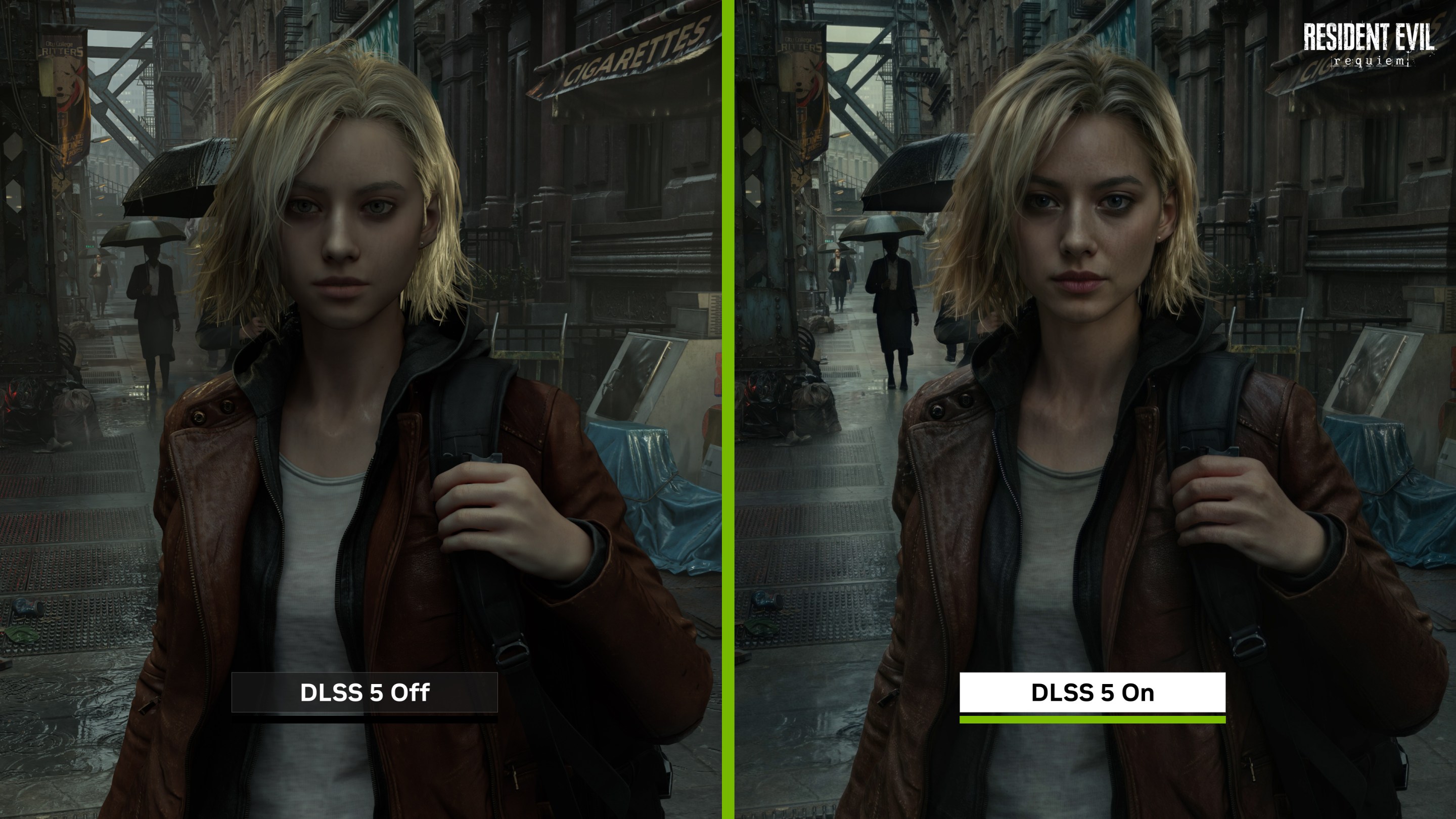
DLSS 5, according to the company, is "a real-time neural rendering model that infuses pixels with photoreal lighting and materials." According to voluble CEO Jensen Huang, Nvidia is "is reinventing computer graphics once again. DLSS 5 is the GPT moment for graphics—blending handcrafted rendering with generative AI[.]"
Previous versions of Deep Learning Super Sampling, first introduced in 2019, used machine learning to upscale resolutions. The value proposition there was obvious. It allowed textures to render at lower resolutions, making for better and faster performance, and interpolated then upscaled those textures in realtime. DLSS 5 extends that upscaling to characters. But inferring and producing a higher resolution for, say, a stone castle floor is a very different beast than doing it for a human form.
The overaggressive sharpness, contrast, and sheen will look familiar to anyone who's seen generative AI imagery online, or even used Facetune to airbrush the shit out of a photo. This is maybe fine if there's an in-game reason for all the characters to be yassified, but mostly it just looks like a cheap AI filter has been applied. Grace Ashcroft is about to scam lonely horny Boomers out of their social security checks; Tamriel's Nords suddenly have less of a case for racial supremacy.
Art has always required a tension between the artist's intentions, abilities, and the tools available to them. This holds especially true for anything not ruthlessly optimized. What would Van Eyck or Picasso be without their specific applications of perspective? Would Yves Klein have mixed a whole new blue if an algorithm could do it for him? Would F-Zero have been as much fun, or feel like such a leap forward, without the need to kludge a false 3D effect out of Mode 7?
So, yes, the DLSS games shown off look bad, but more importantly, they all look the same. Each of the characters inhabits the same uncanny valley populated by blue-check grifters and pornbots. If this technology is widely embraced, it would be a disaster for gaming. Art direction matters. Every game should not look alike. A game should be a cohesive vision, where active human decisions in art direction and character design create a populated world that makes sense on its own terms, not the terms of a pointless pursuit of photorealism.
I like that video games don't look like movies. I have a 20-year gap in my gaming resume, but when I picked it back up, the games I was most taken with visually were the ones that displayed not necessarily fidelity, but a vision. I like that Breath of the Wild's cel shading makes it look hand-drawn; it will stand the test of time. I like that Skyrim's characters are charmingly janky; it feels appropriately like more effort and computing power is being devoted to the game's wondrous interconnected systems. I like Skate Story's abstract wire-frame graphics; they honorably serve a bizarre story and butter-smooth gameplay. I like that Disco Elysium looks like a mental patient's oil paintings; you could yassify Harry Du Bois, but if he looked good, he wouldn't be Harry Du Bois anymore.
According to Nvidia, DLSS 5 will arrive later this year, and be supported by studios including Bethesda, CAPCOM, Hotta Studio, NetEase, NCSOFT, S-GAME, Tencent, Ubisoft and Warner Bros. Games. Here's hoping that today's tech demo remains just that, and actual game developers use the parts that make their job easier while ignoring the parts that make their art worse.