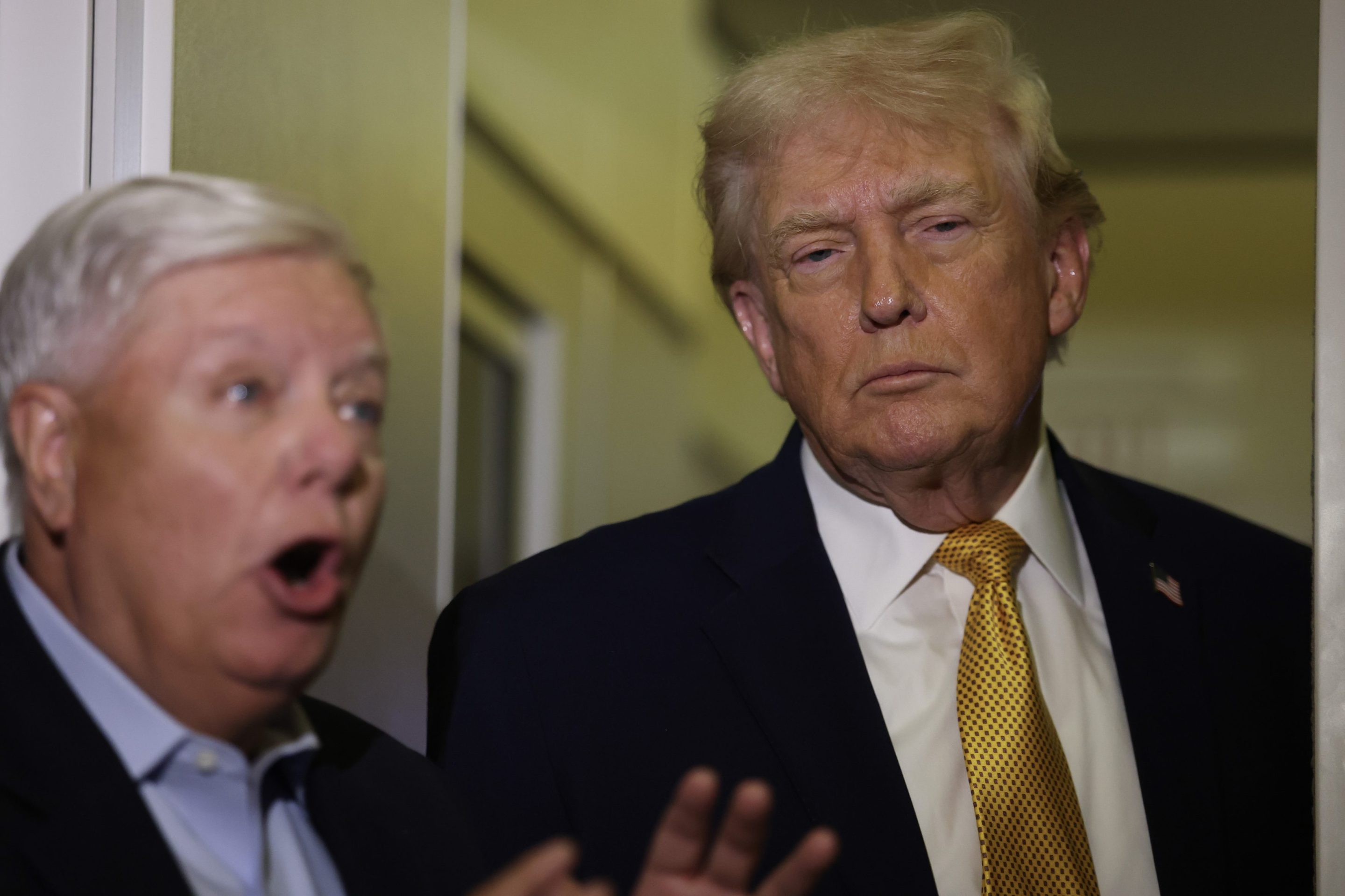
Lindsey Graham has been on a mission from God. The senator from South Carolina said on Jan. 15 that he would take a spontaneous trip to Israel, less than a month after his visit to meet with Prime Minister Benjamin Netanyahu and Ambassador Mike Huckabee to discuss the purported ceasefire in Gaza. This time Graham was here to lobby, as a man alone and a trusted friend, to make sure a devastating war came to Iran’s shores as soon as possible.
Initially, at least, Graham had reason to be optimistic. On Jan. 2, the president promised massive retaliation against Iran for the killing of protesters, but then backtracked, claiming at first that many of the protesters had simply died in a stampede rather than from being gunned down. The same week that he rebuked Iranian security forces, Trump had threatened to invoke the Insurrection Act against protesters in Minneapolis, threatening to send the military to quell demonstrations against paramilitary officers who were themselves killing civilians. He then moved the goalposts again and said if there were mass executions of protesters, he would take action, but claimed he had stopped the mass executions (this was denied by Iran's prosecutor-general). To Graham’s chagrin, the fall of the Islamic Republic would not come that week.
Graham, who had posed with Trump and a "Make Iran Great Again" cap, ended up coming before the assembled press on Jan. 15, now only proverbially hat-in-hand, and spoke in an unusually dejected tone. "There are a lot of headlines out there that are, in my view, not accurate," the senator said. "President Trump’s resolve is not the question. The question is: When we do an operation like this, should it be bigger or smaller? I’m in the camp of bigger. Time will tell, and I’m hopeful and optimistic that the regime’s days are numbered."
Graham, seeing a quick end to the Iranian government slipping from his fingers, did not retreat into the background as many other Trump allies usually do. Instead he went after Gulf Arab governments, who apparently warned Trump off a strike—seeing as they were much closer to Iran and would bear the brunt of any retaliation—calling their intervention "beyond disturbing." Graham said that he would have a "dramatic rethinking" of the "nature of the alliances now and in the future." He then immediately set off to Israel to personally meet with its officials, becoming increasingly unglued as he did. At one point Graham claimed that he was meeting his "good friend," Mossad director David Barnea, just to give him South Carolina real-estate advice, and posted this bizarre third-person dispatch after reaching Jerusalem:
As Trump’s "armada" looms in the region, Graham may ultimately get his wish for a military assault against Iran, if only a little bit later than he would have wished it. But his zealotry on this matter is not, despite his insistence, based on the Iranian government’s response to cost-of-living protests, which by any metric have been the deadliest crackdown in the country’s history. His enmity toward Iran, and seemingly with Iranians in particular, is the product of an obsession cultivated decades ago.
In My Story, his long-forgotten memoir published in 2015, Lindsey Graham writes that on the matter of national politics, he "didn’t have strong feelings one way or another [...] until Ronald Reagan became President." Reagan and his specific brand of charismatic, combative conservatism were the entry point for many into American politics; in Graham’s case, he gave the 40th president’s philosophy an almost divine importance. When discussing the failure of the Green Movement in Iran, Graham remarked in 2011 that both the Pope and Ronald Reagan could use their rhetoric to change the world, that words could be "more effective than any other weapons system," and Barack Obama could have done the same for the Iranians.
This belief in the power of mere words was deceit on Graham’s part: The year before, he had said America should not only "neutralize" Iran’s nuclear program but "sink their navy, destroy their air force, and deliver a decisive blow to the Revolutionary Guard. In other words, neuter that regime. Destroy their ability to fight back." His thirst for blood was keeping in the tradition of Reagan, who also did not actually believe in just using words. While more than happy to sell arms to Iran to fund the Contras, Reagan also authorized attacks on Iranian naval vessels, oil rigs, and military installations in the late 1980s during the Tanker War, a military engagement that led to the USS Vincennes shooting down Iran Air Flight 655, killing 290 people, 65 of whom were children. Reagan never gave a formal apology for the atrocity.
Graham, who in his memoir fondly remembers his time in the Air Force in the 1980s when Reagan visited Europe, believed that the then-president initiated the "final push against the Soviets," and credited him with ending the Cold War and the collapse of the Soviet Union. When Graham was elected to Congress in 1994, he would embrace the Reagan doctrine, saying decades later, "I'm a Ronald Reagan Republican. I would like to shape world events rather than watch the world fall apart. That means you have to be engaged." Graham attempted his own presidential run in 2016, but his low profile and criticism of Trump’s racism meant his campaign ultimately went nowhere with Republican voters. More than any personal aggrandizement, Graham wanted a leader in D.C. like Reagan, perhaps one even greater than Reagan himself.
In the end, concerns about racism and exclusion fell by the wayside. The importance of shaping world events, of American supremacy above all else, proved paramount. Trump understood and embodied that desire perfectly.
If Reagan had seen the Soviet Union as the "evil empire," Graham sees modern-day Russia, China, and Iran as the tripartite, modern-day version. With Iran in particular, however, Graham has been uniquely against almost every instance of diplomacy, only registering his support insofar as it is an implicit threat and a precursor to further kinetic action. On Jan. 21, Graham criticized diplomats in Trump’s own administration who at least outwardly believed diplomacy with Iran to be possible, saying he was "unnerved" by the implication that Ayatollah Ali Khamenei "could change his ways," and that "you cannot do a deal with evil. You have to confront it."
More than anything else, Obama’s diplomacy with Iran, and the nuclear deal that came of it, seems to have driven Graham to the position he is in now. The senator spent those years criticizing Obama as "dangerously naive," that he "wants a deal way too badly," that Iran demanding anything meant Obama must "suspend these talks," and derided the idea that "diplomacy is good and force is bad." Ultimately, when Iran kept to its agreements, and Trump was forced to tear up the deal unilaterally in 2018, Graham leapt to his defense. Ventriloquizing Trump, he would tell Jeanine Pirro in Jerusalem, "I said I was going to withdraw from the Iranian deal because it sucked and he did, and rocket man [Kim Jong Un], I want you to be successful, but if we don't have an agreement, you keep threatening our country, then you're going to be next."
Unlike certain American politicians who have been careful to cover up such feelings, Graham has always approached Iran and Iranians with a marked suspicion and belligerence. Even during his short-lived run for the presidency, when he admonished Trump as a "race-baiting xenophobic bigot," Graham addressed Republican leaders and said, "Everything I know about the Iranians, I learned in the pool room. I ran the pool room when I was a kid, and I met a lot of liars, and I know the Iranians are lying." This sometimes tips into outright racial animus: In 2018, Graham chose to capitalize on a media scandal over Elizabeth Warren’s spurious Native American ancestry by telling those on the couch at Fox & Friends, "I’ve been told that my grandmother was part Cherokee Indian. It may all be just talk, but you’re going to find out in a couple of weeks because I’m going to take this test." Later in the interview, he said, "I’ll probably be Iranian. That’d be, like, terrible."
Graham has shown a willingness to flip-flop on any number of issues, not only going from hatred of Trump to a sycophantic love for the president, but also going back and forth on how much he believes humans influence the climate, abandoning immigration reform to advocate for harsh border controls, and publicly demanding Volodymyr Zelensky resign, after initially portraying himself as the Ukrainian leader’s ally.
Most Republicans in the Trump era would melt back into the crowd after the president grew bored of their interests, knowing when to re-emerge to cheer him on, but unlike so many other issues in Graham’s political career, the senator has remained consistent on wanting a war with Iran, no matter who sits in the White House. The idea that such an opportunity could slip past was unconscionable to the man who had made preparing a future battle with Tehran his political project of the last 15 years.
As tensions between the U.S. and Iran build, Graham has met with the kind of Iranians he would want to see take power. Earlier overtures in 2009 toward a government led by former Prime Minister Mir-Hossein Mousavi were gone, if they ever were honest at all. Graham has focused his attention on Reza Pahlavi, the former crown prince whose father had killed thousands of protesters in his own right, and who himself dismissed mass casualties in recent protests as simply what happens in "war," foreseeing a bright future after a Western military assault where a new Iran makes peace with Israel. Graham also held a public meeting on Jan. 11 with Iranian Americans, having Uber CEO Dara Khosrowshahi and other anti-government Iranians wear "Make Iran Great Again" hats alongside Danny Danon, Israel’s ambassador to the UN. The photo was later deleted from Graham’s social media without explanation.
It is difficult to ascertain what America’s plan is for Iran in the coming days, but one thing is certain: South Carolina's senior senator will accept nothing less than the fulfillment of what those who loved Reagan believe he wanted for the world. Graham has taken to calling Trump "Ronald Reagan Plus," and he demands to see his childlike desire achieved. The Iranians must be freed from their tyrannical regime, no matter how many dead Iranians it takes to get there.