


When I learned that Defector would be running Reds Week for its random annual late-summer theme week, I had one thought: Man, I really wish I had another week of time off to spend. Every year, Tom Ley announces the theme of theme week, and people start kicking around story ideas, and I think to myself, OK, next year, no matter what, I have to remember to leave myself one full week of time off, so that I can skip theme week. And then I blow it. Blowing it is part of the tradition. Anyway, here I am. Let's make some romesco.
By the grace of God, romesco fits not only thematically but seasonally. It is a paste made of roasted tomatoes, nuts, and bread. Here where I am—and by that I mean literally inside of my property line, and possibly nowhere else—now is the very climax of Tomato Time. You see, due to leaving town during optimal planting season back in the spring—this is where I blew it with my time off—I was late getting maters into the ground. And because I was already late, I went ahead and made myself super turbo late by procrastinating further. I did not plant tomatoes in my little stupid garden until mid-June, and at that point only because it was either grow tomatoes or grow invasive weeds, and the weeds were depressing me. So I planted nine tomato plants, a nearly random selection of the last seedlings still to be found at a nearby farm stand. It turns out two of those plants back there are Romas, which are terrific for sauces and for canning but are rather prolific determinate tomatoes, which means that you get a ton of them all at once, and you have to figure out what to do with them in a hurry, which is why they so often wind up in jars and cans and huge vats of Sunday gravy.
The point is that romesco is a great thing to do with a haul of red tomatoes. You could also make it with yellow tomatoes, I suppose, but then you would be empty-handed for Reds Week, and evidently that matters to some people! Your reason for making romesco, of really any color, is not only so that you can justify a blog and thus a paycheck. It is extremely delicious. In my humble opinion there are three things you should ever go out of your way to serve with a really good slab of whitefish, and they are beurre blanc, salsa verde (the Italian one), and romesco. The theory is basically the same for the latter two: You smash things together until you have a luscious and richly colored sauce, and then you dunk your face in there and maybe even paint your upper body in the finished concoction. Where a good salsa verde tastes like anchovies, capers, and parsley, a good romesco tastes strongly of tomatoes and garlic, with the richness and crunch of nuts and the dark underlying molasses-y notes of good dried chiles. There are variations, of course—some are mildly spicy, some are less garlicky, some incorporate red bell peppers, some have clearly been bogged down with ancient paprika—but when romesco is made with really any fidelity at all, it tastes super duper red, and I think you know what I mean by that. Let's make some.
You will need some fresh whole tomatoes. The version I offer here today is not striving for perfect authenticity. Rather, it is just what I think makes the most delicious thing that can be called romesco. I invite you to sue me in federal court if you dare, but I think I am pretty well within bounds when I also include in my romesco a couple tablespoons of tomato paste. You will need at least one head of garlic. You will need dried chiles. You will need at least one kind of nut. You will need a few slices of good white bread. You will need red wine vinegar. And you will need olive oil. A very nice thing about romesco, in particular during a bullcrap editorial stunt, is how easily it can be made from stuff that is floating around in a normal kitchen.
You will notice in that photo that there is a small bowl of paprika. Again: Sue me! Inevitably, each time that I have made romesco in my life, at the end of mixing all of the reputable ingredients together I have tasted the paste and thought, Hmm, that could use a hit of paprika. If what you have in your pantry is something that you purchased God knows when and that is like 85 percent dust, I urge you to skip it. I happen to have a little jar of some pretty good and respectably fresh Spanish paprika, and I simply cannot be prevented from using it.
Start with the tomatoes and the garlic. Get them onto a baking dish of some sort and sock them into an oven heated to 350 degrees. You're going to leave them in there until they are toasty and fragrant, and the tomato skin is lightly charred, which should take at least 45 minutes. If you have room in the oven, cube your bread, as I have done in that photo, and give it 10 or 15 minutes in the heat, to become lightly toasted. If you don't have room in there, it's fine to just put slices of bread into the toaster, so long as you don't lose track of it and let it become very toasted. You want it to be fully dried without being browned. Fully stale would be perfect.
It is time to deal with your dried chiles. Romesco is traditionally made using dried ñora chiles, a squat and good-looking little Spanish pepper that when dried is dark and lightly bitter but neither spicy nor sweet. You could order them from La Tienda and wait around for a couple weeks, or you could use what's available and be eating romesco this very day. In my pantry I pretty much always have some quantity of dried chiles. You would be wandering too far afield, I think, if you went with Árbols or Piquíns, but there's a decent spread of mild, dark, basically fruity chiles that are commonly available, and you would do fine with Guajillos, Californias, Anchos, or Pasillas. This time I used Anchos, which I gather are a reasonable stand-in for ñoras, but so long as you are not striving too determinedly for authenticity I assure you Guajillos, for example, will contribute to a perfectly delicious romesco.
Whatever you choose, the thing to do is to put a handful of these guys into a bowl and then to cover them with boiling water. You're rehydrating them so that you can then scrape the flesh away from the skin. The flesh, you want. The skin does nothing but mess up the texture of your romesco, and though it is an enormous pain in the butt, you are going to put the work in to protect your finished product. It will take 15 or 20 minutes for your chiles to rehydrate to the point where you can use them.
While that's going on, consider your nuts. Romesco is traditionally made with almonds and hazelnuts. For whatever reason, it has become basically impossible for me to purchase hazelnuts. Is this a supply-chain thing? Are hazelnuts piling up on the wrong side of the Strait of Hormuz? It's fine to substitute, or to stick with only almonds. I used almonds and pistachios, and to be extra fancy I tracked down Marcona almonds. Once again I want to assure you that romesco made with, say, almonds and walnuts will be a tasty thing to eat, even if it would taste vaguely disorienting to Inigo Montoya. Toast your nuts in a pan, watching them carefully so that they do not burn, and then, if necessary, shake them around in a Tupperware type deal in order to get rid of the skins.
When the chiles are rehydrated, you will need a little knife to slice them open and gut them, and then to scrape the flesh from the skin. My chiles were precut, which it turns out is a huge annoyance, because they were evidently cut with a lawnmower. I used an offset spatula for the scraping, and it was fine. The process is straightforward: You use two fingers to pin a little scrap of chile to your cutting board, skin side down, and then you run a blade or a thin spatula along the surface, gently but with enough pressure to dig into the flesh and peel it from the skin. It sucks, and it will take a few tries to get the hang of it, and then it still sucks. You only need a couple tablespoons of this stuff. Dig in there, grit your teeth, and do a freakin' job.
It gets easier from here. By now, you can probably haul the tomatoes and garlic from the oven and set them someplace to cool.
While they are cooling, drizzle some olive oil into a pan, set the pan over medium heat, and then plop down in there some tomato paste. A word on tomato paste: If you think of tomato paste as a mysterious red emulsifier used to thicken up a Sunday gravy, and you add it after the tomatoes, and then you stir it in there and tell yourself that it has worked because now your sauce is thicker, you are really letting yourself down. Tomato paste needs to be woken up, and you do it by frying it in oil, and once you have fried it in oil until it is a shade or two darker than it was out of the jar, you discover that it is really a spectacular source of flavor, rich, sweet, vibrant, and lip-smackingly delicious, and that actually its thickening properties are, by comparison, of no value whatsoever. This is another one of those things that people get wrong when they learn sauce-making from watching The Godfather and Goodfellas: The Godfather tells you to add sugar to your tomato sauce and to add tomato paste after tomatoes, and Goodfellas tells you to be conservative in your use of onions. In fact what you should be doing, in order, is cooking tons of onions all the way to sweetness, then frying tomato paste in the pan until it is dark red, and then lifting your middle finger at anyone who tells you granulated sugar goes into tomato sauce.
Wait, where was I? Fry your tomato paste, and then plop it into a bowl or ramekin to cool. While it is cooling, pick the skins off your tomatoes. You are now in the home stretch. Romesco is so close.
I have this big heavy mortar that was bought for me decades ago, and maybe three times a year I haul it out and use it to beat the shit out of some food. Romesco is a good excuse, because everything in romesco smashes up pretty easily. Ever tried to make basil pesto in a mortar? That is a task that will drive a normal person into the wilderness. There are no leaves in romesco, just plump tomatoes, brittle hunks of bread, smooth roasted garlic, and extremely smashable nuts. Still, you are free to use a food processor. It'll be fine!
Start with the garlic. I squeezed the whole head of garlic in there, and then, because I want to live, dammit, I added two more raw cloves. Then I smashed it all to hell.
Then add the bread. It's very satisfying to smash the bread, if it has been properly toasted and is dry and brittle. Plus it makes an excellent sound, crunching down in there with the squished garlic. If the bread gives you any guff, drizzle a little vinegar down in there. That'll show it who's boss.
Next, toss your nuts down in there and go to town. You're aiming for a sort of gravelly paste. I think it's better to underdo it than overdo it, at this stage, because there will be more smashing to come and you don't want your finished romesco to lack texture.
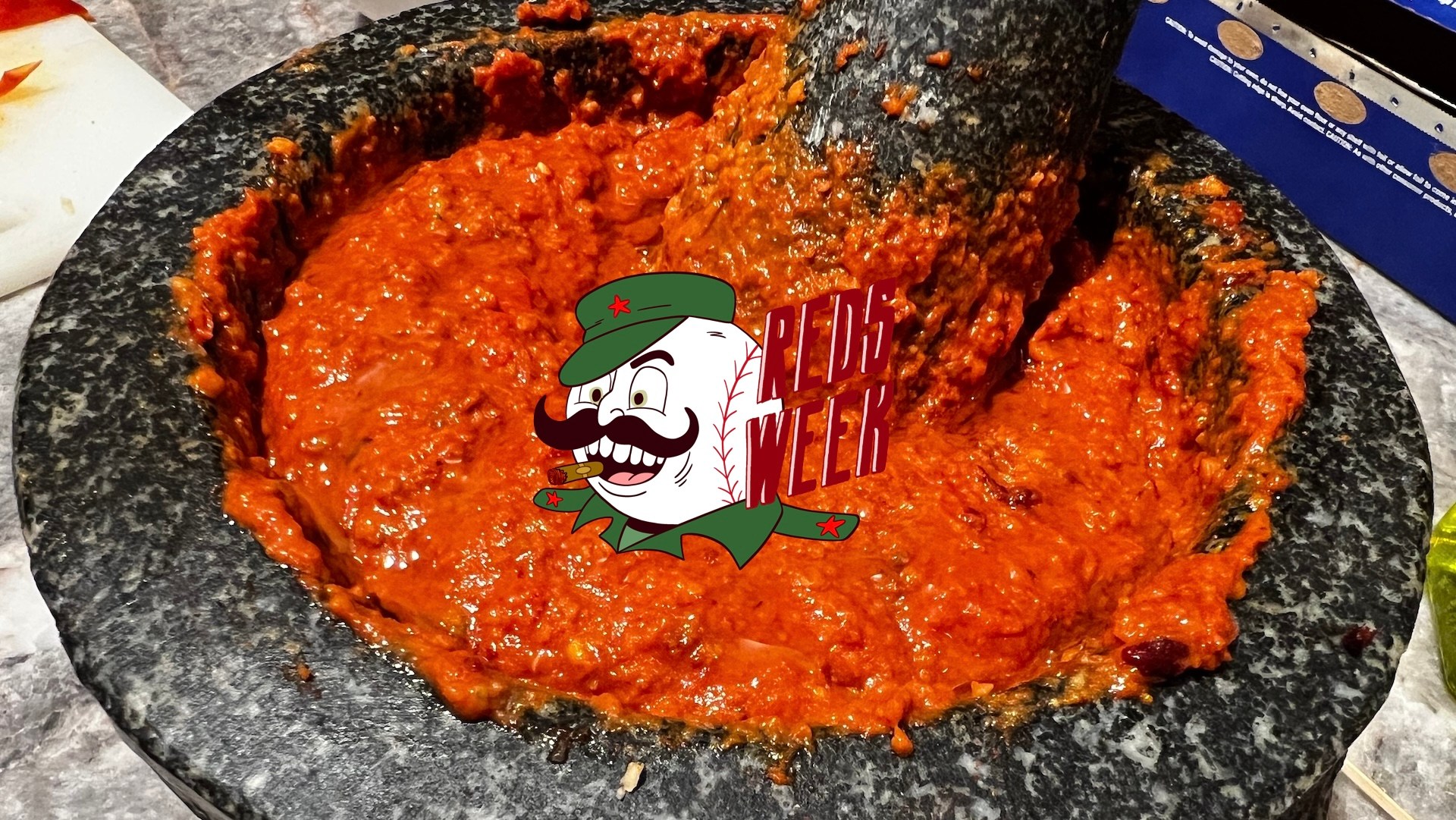
You get the idea. From here you'll add the chile flesh, the peeled tomatoes, and the tomato paste. Do this gradually, so that you can taste your way along, dropping in the occasional splash of vinegar, to keep it bright and lively, and the occasional dash of salt, to bring it all together. I think you will pick up on the essential, spiritual maximalism of this concoction, and in the end I imagine you will wind up using all the chile goop and all the tomato paste. When you've got a very red and very rich and vivid mixture, and a fairly even texture, swirl some good olive oil down in there, to loosen it up a little and make it even more luscious. Blam. You did it.
My romesco is zingy as hell, which is why it is so well-suited to a slab of fish. I really cannot recommend this pairing too enthusiastically. It also does great on a pork chop, and is killer just spread over a thick slice of bread. I don't think you will need to hunt around for uses; it tends to vanish pretty quickly from my refrigerator. My wife does a thing where she just cooks some ground meat, some rice, and some veggies, and then if we have romesco every morning she throws some of this stuff into a Tupperware with a blob of romesco and it's lunch. Man, it's so good.
And red! Boy is it sure red. Wow, everyone's applauding. Have a great weekend.