

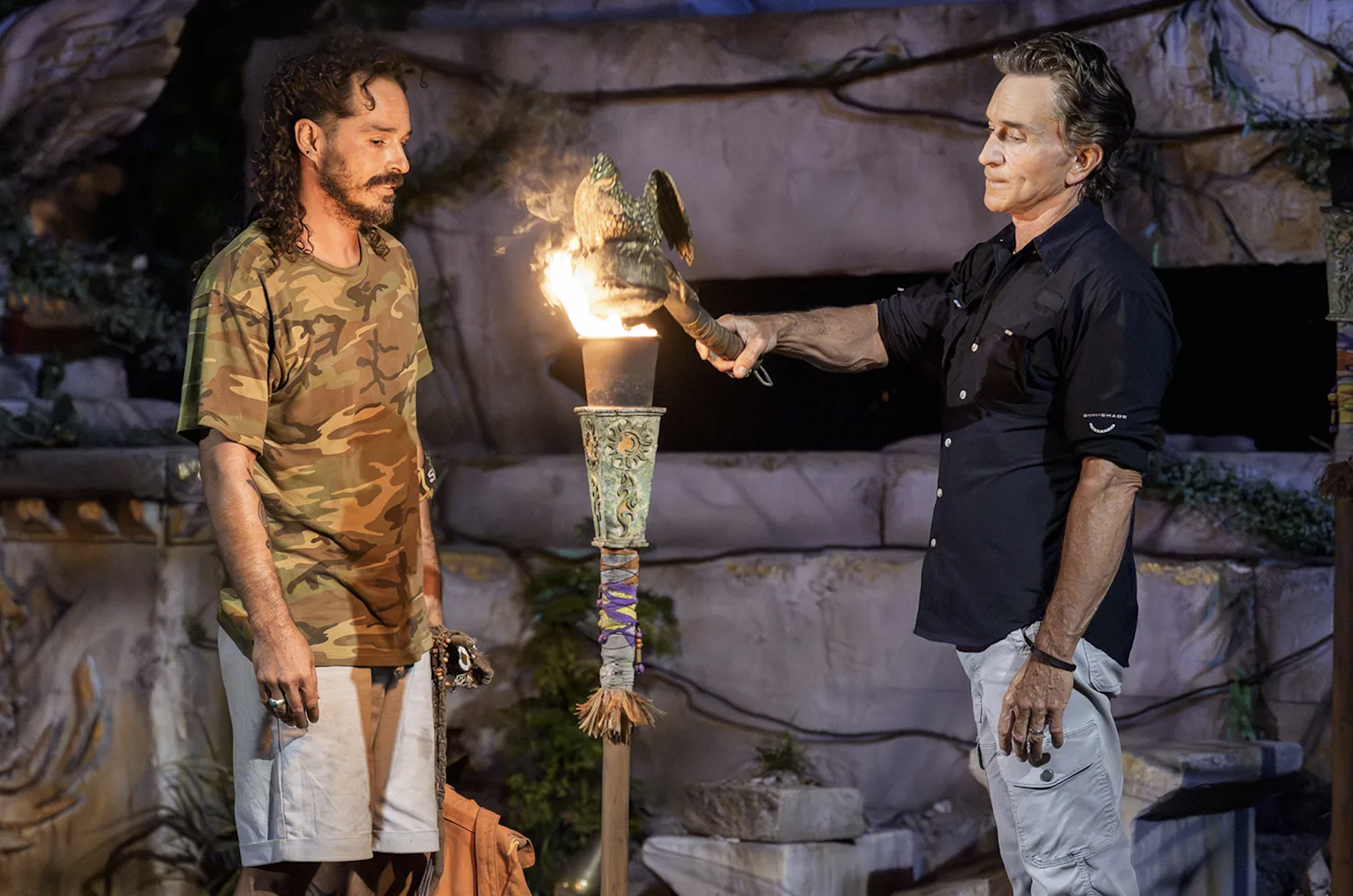
There is nothing that sucks the life out of a good time like someone self-consciously asking whether you are having fun. Maybe a moment ago, you were having fun, but now, faced with their anxiety (or worse, their reassurance that certainly you are having a good time, maybe even the best you've ever had), your attention is diverted to them: the fear in this other person's eyes and their terror that it might not be everything they hoped it would be. Whatever fun was in the air is sucked out by the insistence that there is so much of it. That is how it feels to watch the 50th season of Survivor.
As the first season with returning players in almost a decade, producers for Survivor 50 should be able to rely on the cast to create drama, intrigue, and mess. The players should be allowed to sabotage each other and ruin one another's opportunities. That is, after all, the point of the game. But instead of allowing the players to play, Survivor 50 has become a cautionary tale in over-production.
Take the most recent episode as an example. The players have fully merged into one tribe. They have alliances and plans, hidden idols and secret enemies. If left alone, one assumes they would quickly turn on one another and create sufficient drama. But instead of letting this all play out for the viewer, long-time host and now showrunner Jeff Probst spends every episode insisting we are about to see "the biggest twist in Survivor history" or "the most dramatic tribal council in Survivor history." Maybe, but please ... shut up about it!
Imagine Andy Cohen, at a Real Housewives reunion, saying, "This is the most dramatic reunion in Real Housewives history," or Ariana Madix coining the "most devastating breakup in Love Island history." That kind of opinion on a season of television does not get to be made by a show's production or its creators. The fans who watch the show get to decide whether the season they are watching is good, and whether they find it entertaining.
Take, for example, episode 10 of this season. Jeff introduces YouTube personality MrBeast. He fawns over him for what feels like an eternity before ominously promising the contestants that a MrBeast Beware Advantage (what) will be presented at Tribal Council.
Contestant Rick Devens must flip a MrBeast-branded coin. If he calls the flip correctly, he doubles the prize pot for the season to $2 million, is handed an immunity idol, and is protected from the immediate vote. If he calls it incorrectly, he is sent home without a vote. The twist is fun, if a little overpowered. But throughout the almost 30 minutes of the episode devoted to the tribal council, Jeff explains how the coin flip will work and what its consequences will be no fewer than four times. It feels like more. It feels like the coin has been explained 1 million times by the time Rick actually flips it.
"Biggest stakes ever on Survivor," Jeff says, with a terrifying gleam in his eyes.
When Rick actually calls heads and the coin is flipped, it rolls ominously before spiraling to land on heads. This is a moment of excitement, intrigue, and drama.
"That was an unbelievable moment," Jeff says, immediately undercutting it. This constant breaking of the fourth wall, the constant speaking to the audience as if they need reassurance and reminders, takes away from the actual competition of the show. Instead of being about gameplay, subterfuge, and outwitting/outplaying/outlasting, the show is about out-promoting itself. Even in a season with some of the best players in a long time, the show seems afraid to actually let them play. It might be safer for producers to make Jeff Probst the main character of the show, but it's boring.
Watching episodes of Survivor 50 has felt like watching an advertisement for Survivor 50. Jeff cannot stop himself from yelling, "That's how you do it on Survivor" whenever any contestant does well in a challenge, an annoying new tic he's acquired in the post-pandemic era when the season is shorter and the invasion of production much more evident.
In the most recent episode, Jeff introduced—for the third week in a row—a "stunning" and "game-changing" twist instituted by production. Despite being merged into one tribe, producers decided that after the challenge, they would be divided randomly into two tribes, with one player voting in both tribes. Jeff has continually justified these twists to viewers, as if he is not sure we will like them, by referencing a poll taken of Survivor fans before the season was filmed that found (according to Jeff Probst) that 63 percent of fans wanted twists in this season.
I don't hate the celebrity cameos or the twists as much as I hate the constant reminder by the host of Survivor that I am watching Survivor. I know that I'm watching Survivor because I turned it on! What I don't know is whether I want to keep watching it, when Jeff Probst praising the show he executive-produces gets more airtime than actual contestants.