
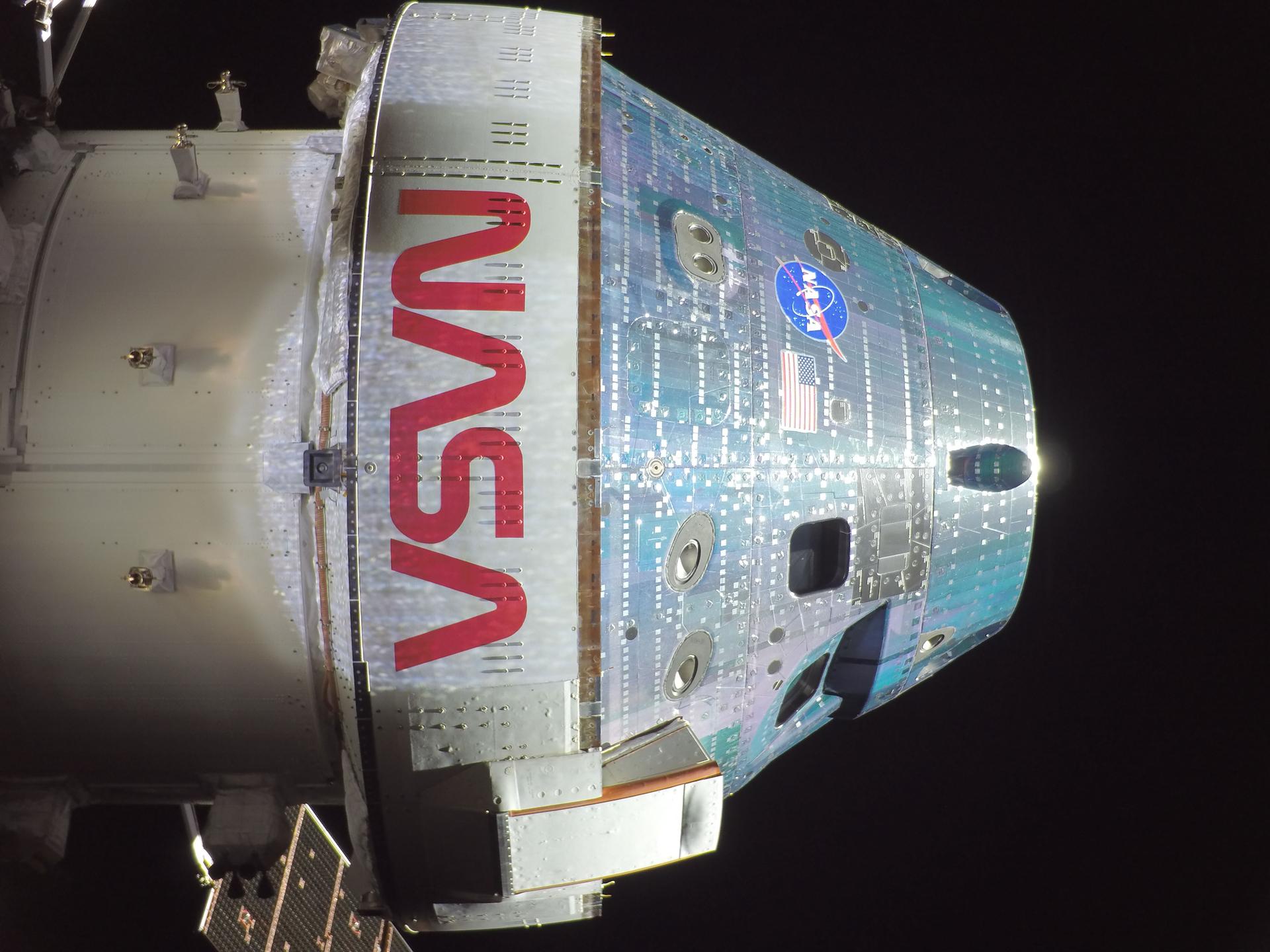

Spaceflight is a lot like airplane travel in that the vast, vast majority of incidents happen on takeoff or landing. More things are happening; more things can go wrong. On liftoff and reentry, specifically, the pressure and heat are a crucible in which the flightworthiness of a spacecraft is violently tested. It's important to remember that this is why these preliminary Artemis missions exist: They are flight tests. But tonight's Earth return for Artemis II will be especially squeaky-bum time, given what happened to Artemis I's heat shield.
After the uncrewed Artemis I splashed down safely in December 2022, NASA was surprised to discover significant damage to its heat shield, with big chunks missing:
It was still within design tolerance, but it was wholly unexpected to NASA scientists, who spent two years investigating the causes before they gave Artemis II the green light to fly. Not everyone thinks they understand it well enough. Former NASA astronaut Charlie Camarda told The New York Times before Artemis II's launch that he didn't think it should fly at all—he estimated a 1-in-20 chance of a disaster on reentry.
At issue is Avcoat, the material that makes up the heat shield on Artemis, and is very similar to what was used for the Apollo missions. (Pointedly, it was not used in the Space Shuttle program; damage to the heat shield is what caused Columbia to burn up on reentry.) More formally AVCOAT 5026-39, it is composed of a bunch of plastics and polymers I can't pronounce, but it is meant to char and flake off as it enters Earth's atmosphere at 25,000 mph amid temperatures reaching 5,000 F. By taking the brunt of the energy, it spares the capsule itself.
What instead happened was that gasses became trapped under the heat shield, and expanded as they heated, blowing pieces of the shield off. Artemis III, scheduled for next year, will use a slightly altered heat shield that is more porous, allowing gases to escape. But when Artemis II comes in over the Pacific Ocean Friday evening, it'll be working with basically the same protection as Artemis I. Hold on to your butts.
It seems counterintuitive at first, but NASA's solution is to have Artemis II come in even steeper and hotter than Artemis I—at an angle that will see it splash down just 13 minutes after entering the atmosphere. The crucial part is that everything will happen faster, allowing less time for gases to build up under the heat shield.
Artemis I used a "skip entry"—skimming off the top of the atmosphere like a stone thrown across a lake, to shed speed before the full reentry. Artemis II will not do that—it will come in steep:
(If this graphic is a little confusing, there's not actually a hairpin turn involved. Orion will be mostly pointed "down," with the Earth spinning under it, which explains the apparently east-to-west motion before it levels out some.)
So, this is it. Artemis II's final exam, after nine days around the Moon and back, and having passed every test with flying colors—except for some still-unresolved toilet issues. At 7:33 p.m. ET, southeast of Hawaii, the Orion crew module will separate from the service module, which has been providing the capsule's power and thrust since it first reached orbit. Thirty minutes later, the crew module will enter the atmosphere at 400,000 feet, and descend rapidly to 200,000 feet within just two minutes. This is the time of peak heating—the highest temperatures the heat shield will have to deal with.
There will be an estimated six-minute loss of communications during this time, as superheated plasma forms around the capsule and blocks all transmissions in or out. NASA will have visuals on the capsule, but that's all. Soon after the blackout ends, Orion's first parachutes will open at 22,000 feet, with several other chutes to follow in succession.
If all goes well, Orion will splash down around 8:07 p.m. ET off the coast of San Diego, where the crew will be retrieved by the USS John P. Murtha, which has already set sail to meet her. These will be tense moments, but they are being managed by the most capable of hands. Doesn't mean I won't still be holding my breath.