The expanded field at the 2026 World Cup is, from a competitive standpoint, a disaster. Upping the team count from 32 to 48 has robbed the best part of any World Cup, the group stage, of its famous intensity and tension. Even an extra round of knockout games won't salvage things, given that eight third-place teams will qualify for that, and there surely won't be eight good third-place teams. The expansion of the field is a blatant money grab by FIFA, and it's a real disappointment to see the way that the World Cup has been warped by greed.
Now try telling that to Curacao, which scored its first-ever World Cup goal in its first-ever World Cup match against none other than Germany. Try telling that team, and that fanbase, that this is all terrible and bad for the sport:
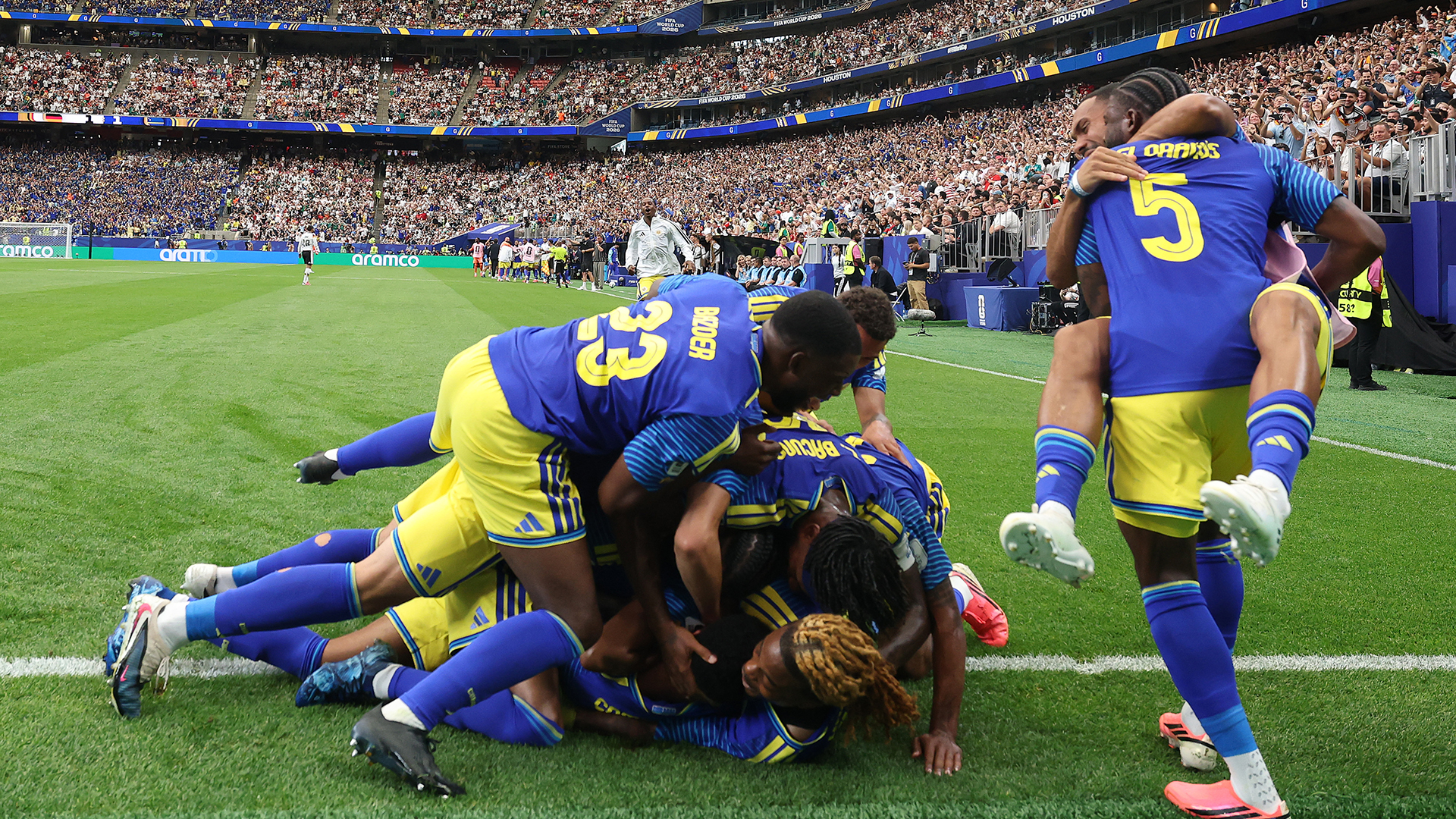
That's FC Zurich's 22-year-old Livano Comenencia, a Netherlands-born defender playing for Curacao thanks to the uhh magic of uhhhhh colonialism, scoring a laser beam of a shot on none other than Manuel Neuer. The defining goalie of his era, and Curacao's Comenencia scored on him. Never mind that the ball deflected off Joshua Kimmich, or that the stunned Germans retaliated with a six-goal barrage to make the scoreline a familiar 7-1 by the time the final whistle blew in Houston. Never mind even that Curacao, the smallest nation to ever qualify for a World Cup, was probably lucky to only lose 7-1. None of that matters in the face of Curacao scoring a goal on Germany with the entire world watching. That is, frankly, an insane thing to have happened, and it's something only made possible thanks to FIFA's unrelenting greed.
There have been other moments like this elsewhere already, moments born of the expanded tournament's lax qualification processes. The crowd-off between Haiti (first Cup since 1974) and Scotland (first since 1998) in Massachusetts on Saturday night was sublime, made doubly so by Haiti, one of the worst teams in the tournament on paper, bringing it to Scotland in a nervy 1-0 win for the Scots. Czechia, back at the World Cup after a 20-year absence, showed up and nearly stole the match from South Korea in Guadalajara on the opening night, in a riveting clash of styles. Thanks to South America getting one more full qualification spot in the CONMEBOL meat grinder, Paraguay was also able to make it back to the World Cup for the first time since reaching the quarters in 2010 and ... OK, that's a bad example.
There's more to come, too. Cape Verde plays World Cup favorites Spain on Monday, and scoring a goal there would be just as stunning and joyous for their fans as it was for Curacao's. Group K sees two teams, Uzbekistan and DR Congo, which likely would not have made it to the World Cup under the previous format, and I'm excited to watch both teams and both sets of fans. (That includes the DR Congo fan who stands all game in a snazzy suit.) Even teams that have made World Cups recently got more assured paths into the tournament and I can't wait to see them; Algeria, Lawrence, Kan.'s new favorite team, will be a lot of fun, as will Norway, which hadn't been in the tournament since 1998.
That's the thing about this World Cup: The "Cup" part might feel diminished, but the "World" part is on full display. It's part and parcel with the surprisingly great experience many of the traveling tourists are apparently having; the United States in its official capacities might be a xenophobic catastrophe, and that has affected the World Cup already, but it's also a wonderfully large country filled with incredible people who are welcoming millions of people in to celebrate soccer. It seems like every host city has had some sort of wholesome visitor content, from the Algerians in Kansas to the Scots singing "Take Me Home, Country Roads" to Freddy, the German tourist whose delight along his road trip across the South has become a symbol for how great this stupid country can be when it opens its doors.
So, yes, Germany beat Curacao 7-1 and it was a painful watch, the stereotypically ruthless efficiency of Germany steamrolling a country of 158,000 people with a land-size equivalent to one-fifth of Delaware. There will likely be other beatings like this in the group stage, mostly depending on how sharp the opponent's aim is when the likes of Curacao, Cape Verde, and even New Zealand come up against the tournament's contenders. Even if expansion has turned the group stage into just another round of qualifying before the real intrigue begins, the onslaught of action and the introduction of teams, players, and fans you've hardly ever heard of still makes the tournament's first stage something special. There's plenty of criticism to be lobbed FIFA's way, but in the moment, it's hard to not get caught up in the joy of a World Cup that feels more global than ever before.
At the end of the day, there are only about six teams each World Cup that can reasonably claim a chance at lifting the trophy, and those teams will almost always go about their business regardless of the quality of the opponent. Is there really such harm, then, in having a moment like Sunday's, where a team like Curacao can equalize Germany and even hold on to a draw for 17 glorious minutes? Is there harm in the joyous spirit of a massive underdog punching the second most successful World Cup nation directly in the mouth? This World Cup will push that feeling to the limits, and it's possible that the novelty will wear off quickly, but for now, I am basking in the chaotic benevolence of this bloated tournament.