It wasn’t much of one, truth be told. It had little range. It was erratic, as all my attempts at prime athletic achievements were. It was not as erratic as my long-iron play, and only a little more erratic than my four-parry with an epee. It was deadliest from straight-on, since I did all my early work with it in my parents’ driveway, when I wasn’t turning my ankle on the raised edges of the driveway’s asphalt. And I realize now that I did more intensive work on my jump shot for a longer period of time than I have worked on anything else in my life.
It began when I abandoned my two-handed set shot, and my two-handed set shot was a weapon. If I had come up in the 1930s, I’d have been something else, boy. I learned its basics out of an old book by Nat Holman, the coach who led City College of New York to both the NCAA and NIT championships in the same year. However, on Feb. 18, 1951, three of Holman’s players—Ed Roman, Ed Warner, and Al Roth—were busted in Penn Station as they returned from a game at Temple in Philadelphia. The CCNY players were the centerpiece of the whopping point-shaving scandal that almost ruined college basketball in New York. District Attorney Frank Hogan set off one explosion after another, ranging as far as Bradley University in Illinois and, most spectacularly, as far as the University of Kentucky, where Adolph Rupp, the lordly racist coach of the Wildcats, bragged that New York bookmakers couldn’t touch his group of noble Caucasian youths. Hogan proved him wrong, arresting several members of Rupp’s most recent NCAA championship teams, including stars Alex Groza and Ralph Beard.
(That Kentucky team, including Groza and Beard, had been the heart of the 1948 U.S. Olympic team in London, where it is not difficult to find bookmakers. The U.S. went 8-0, and won seven of those games by an average of 36 points per game. However, they only squeaked past Argentina, 59-57. I’ve always wondered about that game.)
Anyway, Holman’s book was my bible in all things fundamental. (He is, after all, credited by some historians with having invented the pick and roll.) So I followed the pages about the two-hand set the way Pat Robertson followed Revelations. Feet square. Follow through with hands high. Gradually, however, I realized that an unacceptable number of these relics were getting slapped into next Tuesday, so developing the jumper became necessary.
I never played organized ball. I once was cut by three teams in a week. Part of this was that I was slow, and part of it was that, every time I stepped onto a court in tryouts, I felt like I was shrinking by the second and that everything inside of me was folding into a kind of origami. But damn, I loved to play. And I think I can remember every time my jump shot did what it was told—those golden moments when I spun off a screen, and the power dribble came right into shooting position, and the motion off the floor was smooth and fluid, and the ball felt light on my fingertips as it left my hand, at the top of my jump, which never was high even in my best moments but, what the hell, when it all came together like that, I felt like I could fly. I remember every time that happened. Often it came when I was alone, on an outdoor court, and taking jump shots became a zen-like thing, almost a trance, each bounce of the ball a syllable of a physical mantra. I treasured those moments, and now I treasure the memory of them.
Time passes. You get old. Things happen. For example, you blow out your right patella tendon carrying laundry down to your basement. And you blow out your left quadriceps tendon taking out the trash. And you get hit by a car, concussing yourself mildly, but cracking two vertebrae in your lower back. You get old. Things happen. The amount of time between the things that happen seems to shrink by the hour.
And one day in autumn, you visit the Basketball Hall of Fame and, at the end of your tour, you can take a few shots at a lovely basketball court. So, for the first time in a few years. I decided to unlimber the old jump shot. I took off my coat, rolled up my sleeves, and picked up a new basketball, spinning it in my fingers the way I’d done it a thousand times before. I squared up and ... nothing. I could barely get the ball above my head. With my two dead knees, I couldn’t get any lift off the floor at all. The ball went about four feet in the air and about as far as that toward the basket. It bounced away harmlessly. I found myself looking at it as though it had dropped in from the moon, as if I’d never seen the like of it before.
I miss my jump shot.
Outside of pop music and good writing, there has been no more important cultural influence in my life than basketball. I spent years trying to understand why until I read this passage from the poet-rocker Jim Carroll. (Before his descent into heroin at a young age, famously recounted in The Basketball Diaries, Carroll was a serious New York high-school baller at a time when the ultimate serious high-school baller was a tall kid from Harlem named Lew Alcindor.)
“In basketball,” Carroll wrote, “you can correct your mistakes instantly and beautifully, and in midair.”
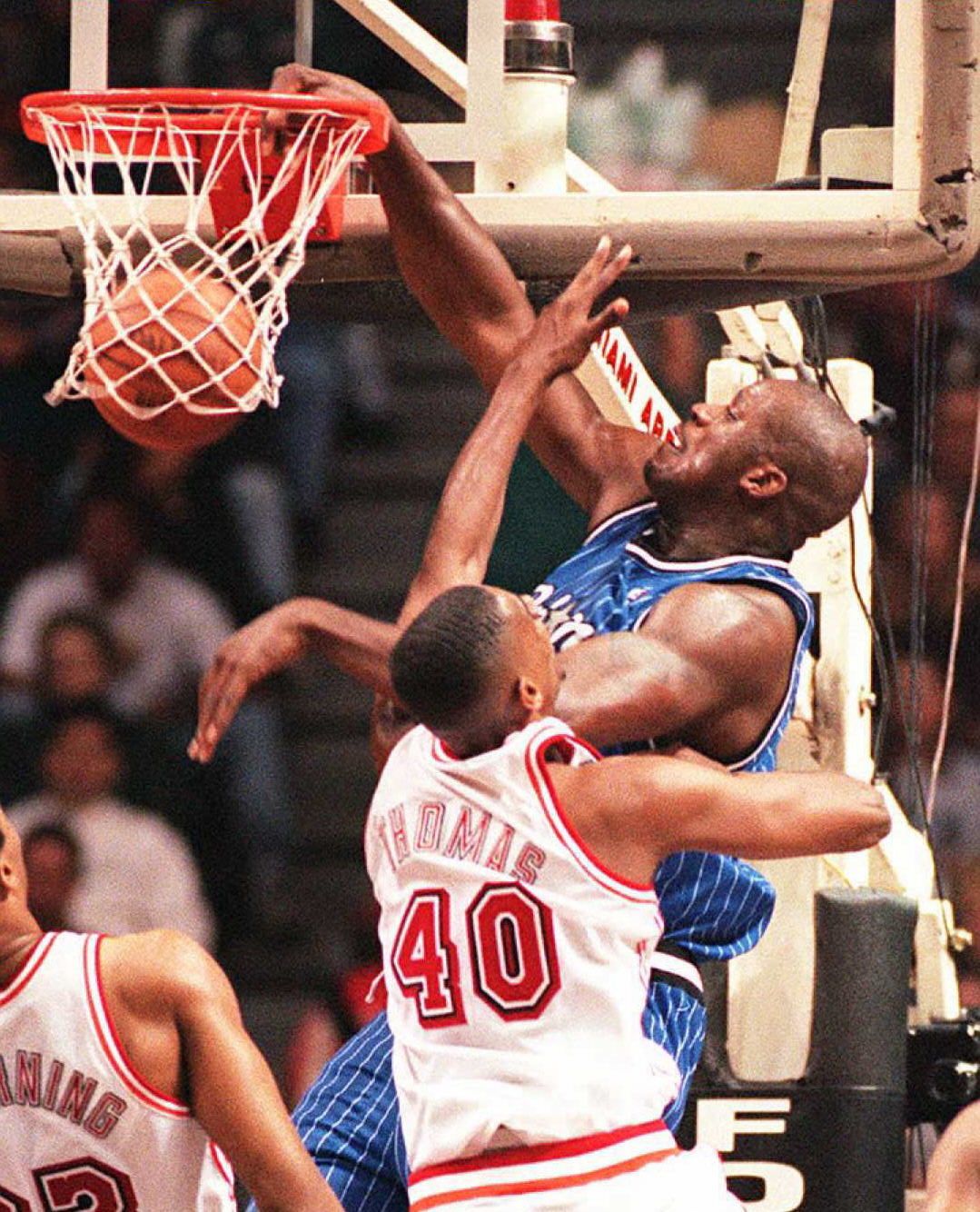
And that was the explanation I’d been waiting for. I remembered watching Elgin Baylor, live in the old Boston Garden. I remembered watching Bill Russell catch Jerry West from behind and block his layup. (There were giants in the air those days.) I remember watching Julius Erving as a sophomore at UMass, doing things that I’d never seen before, and that I’d never see again until one afternoon in 1974, in Greensboro, North Carolina, when I saw David Thompson wait up by the rim for Bill Walton’s hook shot that Thompson knew was coming. I remember watching young Michael Jordan cuff-dunk against Maryland and I remember watching him against the Celtics in 1986, where he put an eventual NBA championship team, and three bona fide Hall of Fame players, through a spin cycle on his way to 63 points. I long ago came to realize that Dr. Naismith’s real genius was putting his goal 10 feet off the ground, guaranteeing that, sooner or later, someone was going to go up to it, instantly and beautifully. I even like the much-maligned dunk contests. When did it become boring to watch human beings fly?
It is watching people do magic off the ground that led me to realize what an ongoing revolutionary athletic exercise basketball also was down on the court. The game’s fundamentals were never fundamental, not for long, anyway, no matter what the geezers still longing for the days of Nat Holman had to say. In 1965, I sat in a crowd that gasped when Providence’s Jimmy Walker dribbled between his legs. Showboat! Playground ball! (No need for the Enigma machine to decode that bullshit.) Now, dribbling between your legs is a fundamental skill for any good point guard from junior high on up.
This season, in fact, it was two college players who gave me solace as I was mourning my lost jump shot. Neither one of them is playing in the ongoing NCAA tournament, which is a shame, because they’d have enlivened the proceedings considerably. The first is a guard from Butler with the improbable name of Finley Bizjack, a wild-haired wild man from Trophy Club, Texas, which is about the most Texas-sounding Texas town I can think of. Finley Bizjack, however, sounds like a character out of Tolkien who’d arrived in Indianapolis by way of the portal from the University of Hobbiton.
I became a fan through a single YouTube video from a game Butler played against SMU early this season. Check out the video at about the 4:40 mark. Watch the replay. That is literally a backhanded pass to an open three-point shooter who splashes the sumbitch, and thank god for it, because he’d never have lived it down otherwise. I watched Butler every chance I got thereafter.
The other was closer to my heart. I had heard through the alumni grapevine that Marquette’s freshman point guard Nigel James Jr. may have been the program’s greatest find since coach Tom Crean took a chance on a non-qualifier from Chicago named Dwyane Wade. I watched my alma mater stumble through a ghastly non-conference season that included a 23-point loss to a mediocre Indiana team, close losses to Maryland and Oklahoma, and back-to-back 20-point blowouts against Wisconsin and Purdue. It didn’t get any better when the Big East season began. Marquette lost its first four league games in a row. It was routed by UConn and by Creighton, and by St. John’s. It lost narrowly to Villanova and Seton Hall.
On Jan. 19, however, after a preposterous loss to DePaul, Marquette hosted Providence and Nigel James Jr. opened up a second basketball season. In truth, he launched the 2026-27 season in the middle of the current one. He scorched the Friars for 38 points. But, then, a month later, against St. John’s, James did … well, he did this.
I came out of my chair. Once again, as I had seen with Finley Bizjack, I saw a player do something I had never seen before. Once again, the game showed me the wonder of the inexplicable. How does James get through two taller opponents in midair and still have enough control to spin the ball up and in off the glass? How did Finley Bizjack know the shooter would be there? Both of them, instantly and beautifully, and in midair.
Damn, I miss my jump shot.