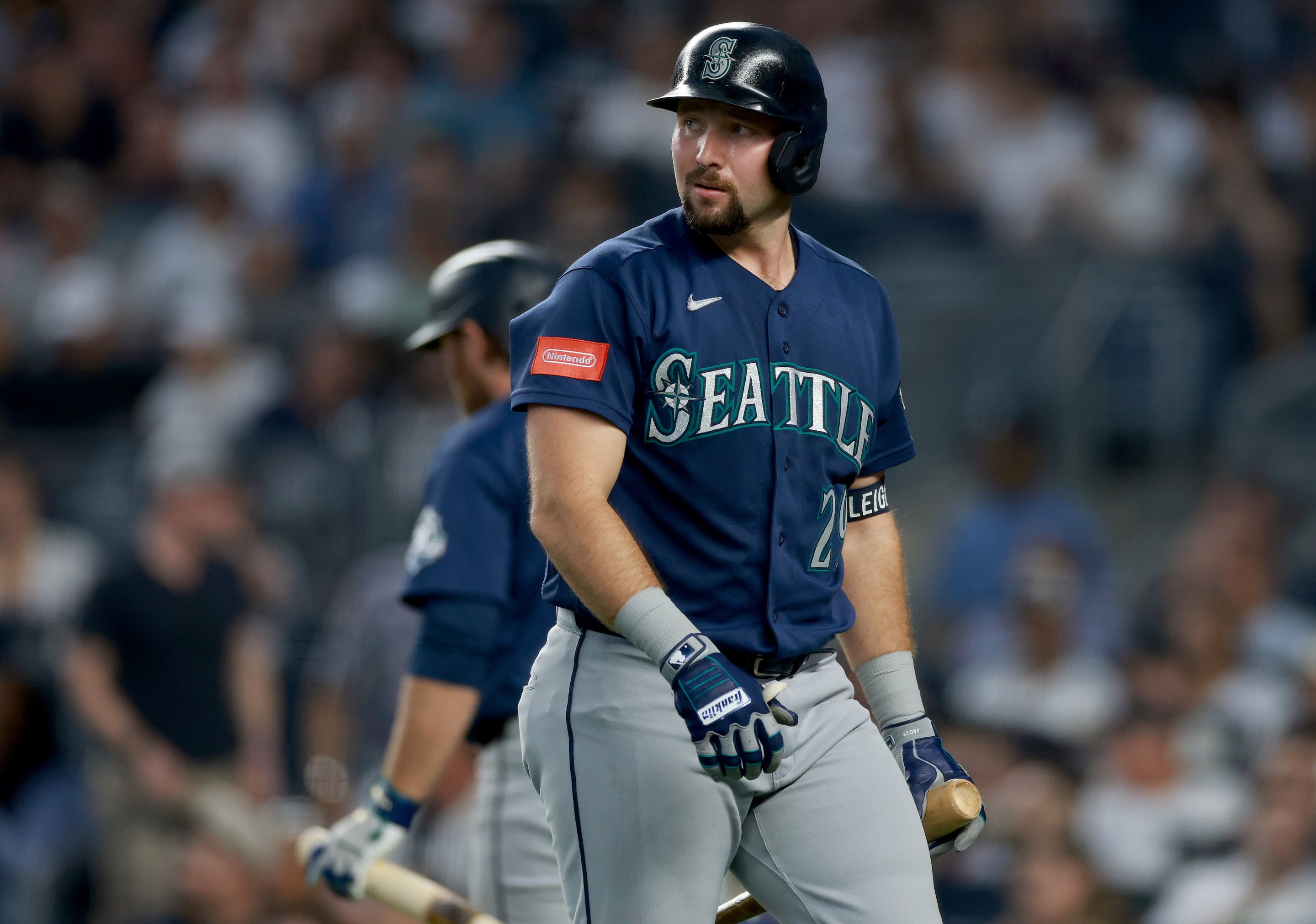
Cal Raleigh got off to a slow start to the year, which was to be expected. It is impossible to follow up a 60-homer season with another of the same caliber, and between instigating teammate beef on the global stage and dealing with an early-season oblique strain which eventually landed him on the injured list, the slugging Seattle Mariners catcher has had much to fight through, even if partially self-inflicted.
Alas, since he returned from the IL in mid-June, things have not gone much better for either Raleigh or the Mariners. Across the second half of the season so far, Raleigh has had a .509 OPS and a 56 wRC+; on the year, he has an OPS of .564 and a wRC+ of 68, meaning he is 32 percent worse than the average MLB hitter. Weighted Runs Created Plus is the most comprehensive catch-all statistic out there but hard to distill in just a few words. Put another way: While Raleigh is not presently qualified for end-of-year statistics because of his stint on the IL, if he were, he would tie for third-worst offensive player in the league with Nasim Nuñez of the Washington Nationals, ahead of only Ezequiel Tovar (of the Colorado Rockies) and Jarren Duran (still, somehow, of the Boston Red Sox).
"We're not playing well, that starts with me," Raleigh said after the Mariners lost 4-1 to the New York Yankees on Aug. 11. "I'm awful." (Since then, the Mariners first extended their losing streak to six games, joining the rarefied ranks of teams like the Los Angeles Dodgers, then promptly snapped their streak with a 1-0 victory in the final game of the series against the Yankees.) Even knowing that Raleigh was not likely to have the same sort of season he had last year, it is difficult to grasp the scope of his drop-off, which is, unfortunately, historic. Per Mike Petriello, Raleigh is currently experiencing the second-largest decline in OPS in baseball history.
This is why I was thinking about this, because Cal Raleigh is having the, uh, 2nd-biggest decline in baseball history (min 350 PA in each year). Hornsby had to deal with his mother's passing and whatever the medical treatment of 1926 was for 'a thigh infection.'Raleigh is hitting 8th tonight.
— Mike Petriello (@mikepetriello.bsky.social) 2026-08-12T19:22:59.301Z
Not all is lost. Roger Hornsby would bounce back quickly and immediately start putting up double-digit WAR seasons again, including an MVP-winning 1929. However, the eye skims over other incredible old-style baseball names such as "Hack Wilson" (a Hall of Famer who also bounced back after his big decline, albeit just for one season) and "Bernie Carbo" (whose big decline came between his age-22 and age-23 campaigns and who never reached 125 games in a season again) and can't help but land on some memorable modern ones. There's Brandon Drury, Adam Dunn, and 2021–22 Yasmani Grandal, who, wouldn't you know it, also happened to be a switch-hitting catcher.
If there is any kindness in the world for people who live in Seattle, Raleigh will not go the way of Grandal. Part of Raleigh's regression (and then some) can be attributed to pitcher adjustments and latent inconsistency; over the phone, Defector's Ray Ratto drew attention to Raleigh's 2025 July and August, which were similarly slumpy in proportion, if not in scope. Being an everyday catcher takes a toll on the body that catches up to everyone. Raleigh was also better batting righty last year than lefty, which was not likely to repeat as it was the only year in his career when that was true, bar his meager 2021.
But trying to isolate what is going wrong for the 2025 MVP runner-up in 2026 is difficult because everything is going wrong. Raleigh's walk rate has dropped since last year, but not precipitously; the strikeout rate is more concerning, as, at 32.2 percent, it is his highest since his 2021 rookie season. Part of what made Raleigh so good last year was his absurd rate of pulled balls in the air, and while that metric has dropped, it is still on par with his 2023 and 2024 seasons, which were nowhere near as concerning offensively as now. Where Raleigh has been going extremely wrong is with the quality of the contact he's made. Per Statcast contact metrics, he is barreling far fewer balls, and though he is generating pulled fly balls, he is also hitting under far more balls.
What is perhaps most alarming, and certainly most baffling, is Raleigh's lack of production on fastballs. Last year, Raleigh crushed four-seamers and sinkers and generated a cumulative 28 runs on such pitches; this year he is sitting at minus-15 run value. The easiest explanation is that the right oblique injury has unfortunately derailed Raleigh's entire season beyond the IL stint. Front toward enemy? More like ass to enemy, ha ha. [I immediately break down into unstoppable tears.]
These are more observations than any diagnostic issues, and are a far cry from providing any sort of solution. I am choosing to view this as a philosophical decision. The Mariners are eight games under .500 and have yet again watched their playoff odds drop precipitously over the course of a season. Barring hiring another Etsy witch, the smart play here might be freeing oneself from the burden of earthly desires, like caring much about the fate of the Seattle Mariners.