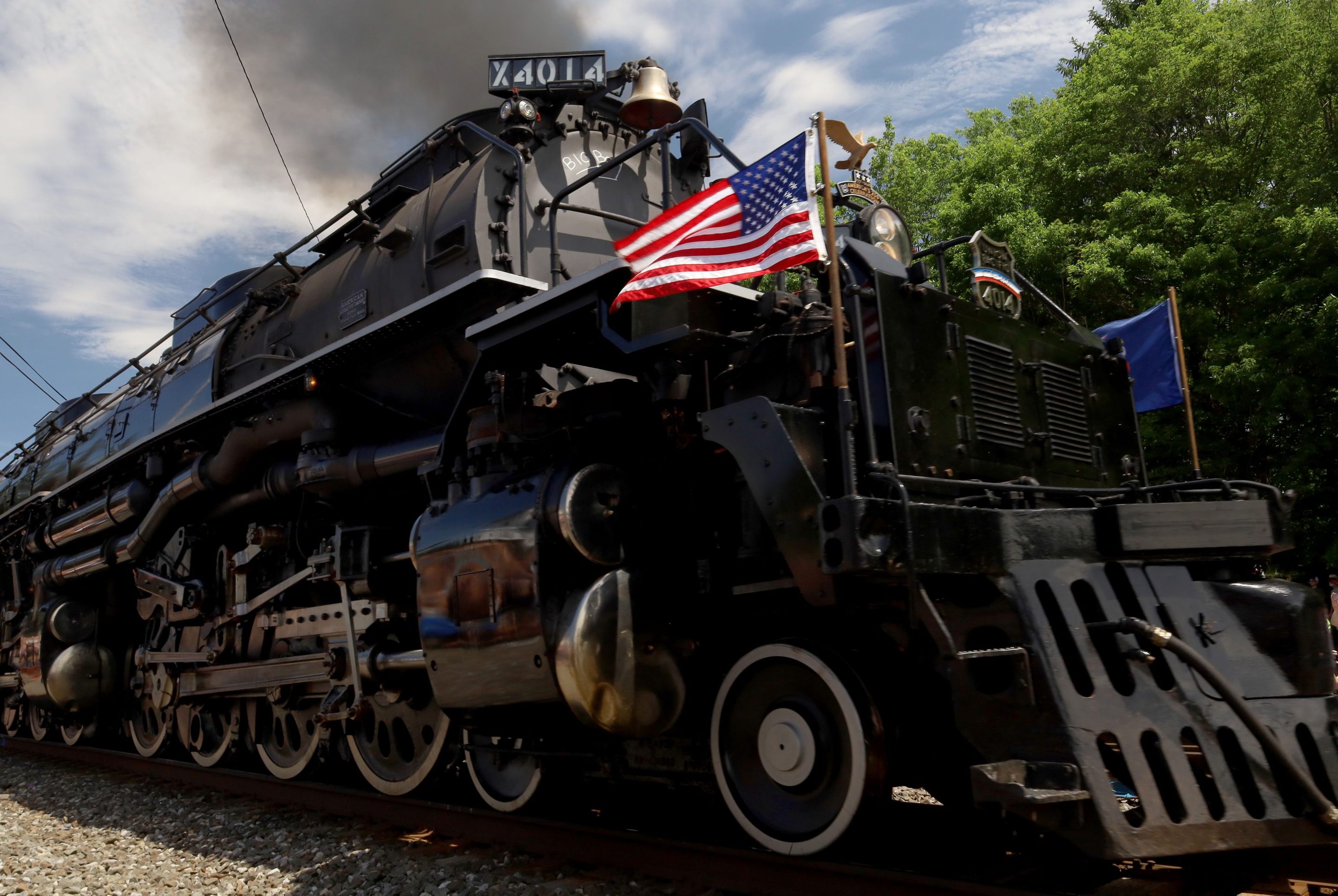
My name is Noelle, and I'm a fan of the world's largest operating steam locomotive. I used to think this was a unique fact about me. But recently our tiny fandom has exploded. Big Boy, as he’s called—Christian name: Union Pacific No. 4014—retired in 1961 when diesel-electric engines made cumbersome steam trains unnecessary. In recent years, he has emerged from hibernation for heritage tours out west, so his fans can see his 1.2 million-pound body and human-sized wheels up close. And this year, Union Pacific announced something unprecedented: Big Boy would travel off his home turf, cross-country, all the way to the East Coast and back.
Officially, this was in honor of America’s 250th birthday; unofficially, people surmised this had something to do with Union Pacific’s intended merger with Norfolk Southern, which owns track in the East. But train enthusiasts—who prefer “railfans” and definitely do not prefer “foamers”—didn’t care why Big Boy was coming. All that mattered was when and where. Every day they flooded Facebook with dozens of fresh, breathless sightings—there he was in Argos, Ind.; Payne, Ohio; Portageville, N.Y.—and every day another tiny, desperate Rust Belt chamber of commerce announced its local Big Boy celebration with an AI slop flyer.
Everywhere Big Boy chugged, people screamed, waved, sometimes cried or took wedding photos or, in one case, tried to climb him and fell and went to the hospital for a spine fracture. On July 2, a police department in Pennsylvania’s Muhlenberg Township declared the Big Boy watch event a “mass casualty incident” after the heat sent 35 people to the hospital.
Inevitably, people got horny. Big Boy’s conductor, Ed Dickens, became a community heartthrob. Someone made a separate Facebook group just to fan out over Ed. “The hottest man alive,” wrote a Debbie. “HubbaHubba!!” wrote a Donna.
I like trains. You could even say I love trains. I wanted to see the big choo choo just like everyone else. But this seemed like a lot. People were risking it all for a locomotive. As he approached my slice of Central Pennsylvania, I wondered: Would I too fall under the collective mania of Big Boy?
You’d be forgiven for assuming that the pinnacle of Big Boy’s tour was his easternmost stop, Philadelphia, on July 4. But Philadelphia gets all sorts of national tours. Philadelphia had a World Cup going on. Philadelphia has PATCO. Philadelphians were not risking life and limb for a glimpse at a train, no matter how large. The real show was 160 miles west, in the Mecca of railfanning: Altoona, Pennsylvania.
Railfans come here to admire trains passing through even when it isn’t a 600-ton steam locomotive. This small city in the foothills of the Alleghenies owes its existence to the Pennsylvania Railroad, which opened the Horseshoe Curve here in 1854. A marvel of 19th-century engineering and now a National Historic Site while still serving as an active freight line, the 180-degree switchback made it feasible for trains to scale the hills on their way west. It slashed travel time between Philadelphia and Pittsburgh, ushered in a new era of trade, prosperity, and even standardized time. Big Boy, reverent of his history, was to be stationed in Altoona for three nights before parading through the Curve, an allegedly once-in-a-lifetime event that, when announced, sold out in hours.
The park at Horseshoe Curve could only safely accommodate 30,000 fans; less than a third of the 100,000 anticipated to descend on the region for Big Boy’s arrival. The rest of us were to spread out across Altoona and neighboring railway towns—Gallitzin, Cresson, Cassandra, Lilly—which together form a corridor of railfan tourism. When I couldn’t get reservations at the premier train-themed bed and breakfast, I simply booked at a second.
I pass by these towns often, driving between my hometown in Central Pennsylvania and where I live in Pittsburgh. To most people, they’re just blips along the highway, but like everywhere in the Rust Belt, historical plaques hint at a more illustrious past. Big Boy’s approach made these towns, which experienced severe population declines after the passing of America’s railroad age, swell back to their glory-day size. When I checked in at the Tunnel Inn in Gallitzin, pop. 1,400, a newspaper on a lobby table had a headline reading "Big Boy rolls into town." The subhed could have been written in the 19th century: "Crowds delighted by train’s arrival."
At the Railroaders Memorial Museum—whose own name seems to suggest railroaders are extinct—historical exhibits show a frenzied public reaction to steam’s arrival. For all of human history, man had only ever been able to travel as fast as a horse could run, and suddenly he could zoom across the countryside. People screamed the first time they saw a train. Pastors called them unbiblical. Per the museum, critics “condemned railroads as a societal evil, but their calls went mostly unheeded as the public got used to traveling at the dizzying speed of 30 mph.”
Nothing was natural about trains. Before railroads, every town had its own time, based loosely on sunrise, sunset, and the big clock in the town square. Rail schedules gave man a reason to wrest time away from God and create time zones. And then, at the dizzying speed of 30 miles per hour, society chugged into the era this allowed—capitalism, Westward expansion, industry. Steam locomotives got bigger and stronger until Union Pacific manufactured Big Boy, during World War II, to haul freight over the Wasatch Range, and then all of a sudden progress progressed so much that it left steam behind entirely. Altoona’s bright future eventually calcified into its own past.
The day Big Boy arrived in Altoona, the museum held a benefit dinner at the local convention center to celebrate. In the parking lot, I saw a tall, silver-haired man whose denim overalls implied “conductor.” Was this Ed, the hottest man alive? I walked behind him, observing from a tasteful distance until I could be sure. As soon as we entered, a woman grabbed him and asked to take a selfie. It was definitely Ed. I watched my chance to speak to him slip through my fingers as he was rushed by other fans. A queue formed of people who wanted photos or for their tiny sons to shake his hand, rivaling the length of the line for the make-your-own-sundae bar.
Attendees at the dinner were a combination of corporate railway professionals and utter train freaks. Some people wore Norfolk Southern merch like band T-shirts, a sartorial choice I’d notice throughout the weekend; there appears to be no similar taboo to wearing a band’s merch to its shows. I sat down next to a woman who was reviewing the photos she’d taken of Ed on her phone. “I’m starstruck,” she gushed. “I’m such a fan.”
After the buffet line slowed and the crowd settled into their seats, the speeches began. The director of the museum introduced Robert Van Camp, host of the PBS show Great Scenic Railway Journeys. “I don't think I have been in a bigger room of people that just love trains so much,” Van Camp said. I know I hadn’t.
He pressed play on a video clip he’d dug up for the occasion. What followed led me to question my own level of train devotion. Here I was, thinking we were all more or less the same kind of history buff. But the video Van Camp played seemed to suggest railfanning is a form of animism charged with metaphysical juju.
Between gorgeous B-roll of trains chugging through valleys and over bridges, a parade of talking heads waxed poetic, at times to the point of eroticism, about steam locomotives. As a train crawled through a wooded valley, one man said: “A steam locomotive almost seems to be alive, to have its own personality.” As a train pulled into a station, another: “At the end of the day, a diesel locomotive does not have a soul like a steam locomotive.”
As a train emerged from a roundhouse: “It’s a thing of beauty. It's gorgeous, a princess.”
As a woman in overalls stared into the camera: “They're just machines, but most of us like to think of them as ladies.”
The following speakers carried on sensibly about railway restoration and preservation funding as if we hadn’t all just lusted openly about the sensuality of steam. Eventually, the museum director retook the stage to remind us about the night’s silent auction, where the highest bidders could win books signed by Ed. The woman next to me, who had rushed Ed when he walked in, won.
After dinner, I returned to the Tunnel Inn (slogan: When you stay at the Tunnel Inn, only the engineer is closer to the train!), which sits directly beside the track two miles from Horseshoe Curve. The inn’s common area has a TV showing a livestream of Horseshoe Curve, and a sign in the stairwell reading, "Warning: The Light at the end of the tunnel is an onrushing freight train." When I looked down from my hotel room, I could see two tracks emerging from the stone mouth of the Gallitzin Tunnel, flanked by steep grassy hillsides.
Guests gathered around a campfire on the inn’s lawn. The tracks were quiet; in the absence of trains, two men were using the Flight Radar app to track planes across the sky. “Atlanta to Portland, Maine,” said one with a thick New York accent, pointing upward.
The inn’s owner, who goes by Stationmaster Bob, apologized for the heightened security. He normally leaves the main entrance unlocked but couldn’t that weekend, due to Big Boy spillover crowds. His partner Debi gestured toward the other side of the tracks. “We normally get people who stop by and stick around for an hour, but these people have been camped out all day,” she said. This was especially surprising, given Big Boy wasn’t even slated to use these particular tracks. Any train would do, I guess.
The sky was deep indigo with milky splotches of clouds. Debi pulled out a mini speaker and the fire crackled to classic rock. One Tunnel Inn regular wore a Norfolk Southern T-shirt. He asked one of the other regulars if they had any good stories lately.
With a Don’t make me sing kind of flourish, the man pulled up audio files on his phone that he’d recorded during his job as an FDNY dispatcher. We listened as he sent fire trucks across the city, and then he passed around his phone, where we could see an image of a building on fire.
“And you sent the trucks there?” I asked.
“Yeah,” he said, clearly proud.
“And the people were fine?”
“Well, they had injuries and shit, but they didn’t die.”
“Oh, OK.”
We reverted to our default state, starting silently into the fire. My body sunk into my lounge chair and my eyelids grew heavy. “You’re probably like, ‘Who are all these weird people I don’t know sitting around the fire?’” Debi said to me. But I found their presence comforting. Here we were all free to be the most eccentric version of ourselves. My fellow guests were talking shit about the Horseshoe Curve event—everyone here was planning to see Big Boy from their own special, secret spots.
There was a rumble. Someone mumbled, “Could be the road.” Then Bob stood up, and the dispatcher said, “This guy knows.”
We left our lounge chairs to stand at the ravine’s edge. The sound was indeed coming from the tunnel; Bob had known. We stood at attention, reverently, as the rumble grew. The tunnel was a black abyss and then suddenly it was a glowing portal. The train rumbled until it roared. Two blinding white bulbs appeared, and our collective yearning drew the train forth.
I spent the next day stewing in anticipation. A stationary Big Boy was on display until 2 p.m. at Altoona’s Rose Yard. There wasn’t enough parking for the tens of thousands of people who wanted to see it, so you had to park at the stadium of what I presume is the only professional baseball team named for a feat of 19th-century railroad engineering, the Altoona Curve, and take a shuttle from there. I arrived at 1 p.m. and was turned away because the line to board a shuttle was more than an hour long. Bummed out, I decamped to a local microbrewery to try the Big Boy Brown Ale. I ordered it because I like Big Boy and forgot I don't like brown ales. I didn't finish it. The microbrewery was overwhelmed by visitors; my panini took over an hour to arrive. The next morning, Big Boy would roll out of Altoona toward the Curve, then on to Gallitzin and Cresson. I vowed to get my start extra-early.
At 6:30 a.m. the following day, the gas station attendant looked down at my liter of water, large coffee, and three Clif Bars, and said, “So are you going to work, or …?”
“I’m going to see the Big Boy train,” I said.
“Huh,” he said, apparently the only man in Pennsylvania who hadn’t heard of it. “What’s so big about it?”
This was an odd question to ask. “Its size?”
I had chosen to view Big Boy from Cresson for a few reasons. Cresson, pop. 1,500, was expecting 10,000 people. Its “downtown” is a single, long road that runs parallel to an elevated train track, meaning you could be several rows of railfan deep and still see the train. And Cresson is also home to the original train-watcher’s hotel, the Station Inn.
Five hours before Big Boy was scheduled to pass through, several hundred people and I had arrived. An ice cream store in a renovated caboose was open early for the occasion, selling breakfast specials like the Big Boy Sammy and the Gravy Train. Food trucks and T-shirt stands were parked by the tracks. I thought interviewing a concession stand employee might offer a compelling contrast to the throngs of railfans—as I imagined it, a worker gesturing at the crowds and saying, Isn’t this all crazy? I approached an old man stacking cups on the counter of his lemonade truck and I said, “Do you mind if I ask what you think of all this?”
Actually, Tim Padlick had seen Big Boy twice already, once on business with his lemonade truck in Tyrone, Penn., and once purely for pleasure, in Litchfield, N.Y. His son was a railfan who had gotten married at the Horseshoe Curve. Tim waxed poetic about Big Boy with no additional prompting for several minutes. His eyes grew misty.
“I've watched this man. … He's the head engineer. He's so humble.”
“Ed?”
“Yeah,” he said. “He’s become an icon! He’s become a superstar!”
All day long, I would not find a single person slandering or even skeptical of the chaos.
"What is it about trains, for you?" I asked everyone. I heard dozens of variations of “I’ve just always liked them,” until someone said something specific. Darren had driven three-and-a-half hours from Washington, D.C.
“I watched Thomas & Friends when I was little,” he said, before adding in a stage whisper, “and I kind of still do."
“It's such a beautiful show, and the way it doesn't talk down to kids, the score, how they, like, really tell stories without always telling the moral at the end of everything, so that the kids actually have to think about it, versus being told what to think.”
I asked his friend why he was into trains, and he affirmed, “Also Thomas.”
Though Thomas the Tank Engine was perhaps a specific cultural reference, it’s representative of a real trend among railfans: People who love trains tend to fall in love with them as children. Darren was standing with Gary, whose model railroading hobby was inspired by a childhood growing up in Gallitzin. Now 70 years old, Gary said he remembered when steam trains still came through the valley.
“So what’s a moving steam train like?” I asked.
“The way that I view it, it’s like it's almost a living being,” he said.
An Abraham Lincoln impersonator walked through the crowds with his decidedly 21st-century wife. I asked him what Lincoln would think of all this. “The railroad really connects the country, and that goes along with my desire to keep the Union together,” he told me.
The Station Inn isn’t normally guarded by bouncers in headsets, but it wasn’t a normal day. I flashed my wristband, and with the great privilege of media access I abandoned the huddled, camp-chair-toting masses to join the elite squad of diehards on the veranda. The Station Inn’s porch is known widely as a haven for discerning train tourists. Radios allow you to listen in to what nearby train conductors are saying—usually reading off milepost markers and trainspeak too specific for the non-head to understand, but the lingua franca here. The average age on the porch was older than it was in the wider crowd below, thus implying a great accumulation of railway wisdom.
The hype was unreal; I turned to an old man and asked him if he thought seeing Big Boy could live up to it. With a gruffness meant to convey that nothing could possibly impress him anymore, he said “No way!” then showed me a series of photos he’d taken of steam locomotives with impressive backdrops in a recent trainspotting trip to the West Coast.
The hour was approaching and a man with a radio hollered out, “BIG BOY JUST PASSED THE CURVE.” A shudder of excitement rippled across the porch. Next stop: Cresson. By now the street in front of us was thronged with people. From the porch we could see a length of track, with crowds on either side, stretching nearly a mile. Opposite the track from us a group of Amish men were hanging off a yellow construction vehicle in the hopes of getting a better view.
To my left were Eddie and Teresa Fazzalaro, who had driven in from Delaware. Eddie is a steam guy. He told me he was intrigued by the cantankerousness of early steam engines—the crazy temperatures people operating them had to deal with, how often workers had to stop and feed them coal. I thought about how many people had told me steam engines are like living, breathing creatures, and how weird it was to say this in 2026, a moment when technology companies are trying harder than ever to infuse their products with soul.
Chooooo. A multichordal woodwind noise pierced the valley, prompting a flood of visual imagery in my brain: old-timey trains in cowboy movies, the Hogwarts Express, Thomas the motherfucking Tank Engine. We were really geeking now.
And then Teresa said something I’d been waiting all weekend to hear: “It’s sad that we don't have the ability in the United States to travel like they do in Europe.”
Finally! All this time waxing poetic about locomotives, and no one had even mentioned the irony. We had all driven here, overcrowding parking lots and lining up for shuttles.
Beyond a vague patriotism in the wake of the country’s 250th, the politics of it all were strangely absent. A love of trains is really a love of power, an admiration for huge machines carrying heavy payloads across great distances. In practice, that means hauling the raw ingredients of the American economy, and anyone who’d done even a little reading knew this spectacle was about the intended merger of two giants: When combined, Union Pacific and Norfolk Southern would collectively run nearly half of all railway track in the U.S. Both companies are partly why high-speed passenger rail is such a pipe dream here: large, private freight companies own our tracks, prioritizing cargo over people. And that’s in more ways than one—today, railroad workers are some of the unhappiest in the country, as companies are running trains with fewer workers, increasing the risk of safety incidents like the 2023 derailment in East Palestine, Ohio. Railway unions strongly oppose the intended merger, suggesting that the light at the end of the tunnel is actually an onrushing freight train.
“Look at the size of the United States,” Teresa allowed, a common excuse for why the U.S. doesn’t have Europe’s passenger rail network. “You know, Italy's the size of Texas. So when you put it in that perspective, we understand.”
But the U.S. is crisscrossed with tracks. In Pennsylvania, you can hardly take a walk in the woods without passing an abandoned rail grade. Railways once connected small towns that could never dream of an Amtrak station today. Big Boy represents a long-ago era of relevance for places like Cresson, and his return offered the chance to relive it, if only for a day.
Big Boy’s steam plume came into view, and then the train itself, dark and dashing. From the veranda I watched as everyone lifted their cell phones in unison. Handsome Ed stuck out his handsome arm, and waved. It really was spectacular, and the wheels are really very big. But what made it feel so special wasn’t the locomotive itself, but the 10,000 people there to cheer for it. And then it was gone. The people the train had brought remained behind and, in the long tradition of steam trains, Big Boy headed west.