A couple of blocks from my office is a steep hill. Sometimes at lunch I go out into the sun and walk up the hill. The hill is very California: asphalt so newly laid that it looks AI-generated; a handful of wheeling turkey vultures; golden dried grass edging up to fortress-like new construction. I usually march up the sidewalk, but there’s also a path that winds through blackberry vines and over the creek, past where people without other places to stay have been sleeping. It’s a Diebenkorn painting; it’s the place he runs to at the opening of The Beginning Place. Walking up the hill restores me to myself when I am tired or cranky or worried about something I have done or failed to do at work.
The only problem is that I have to face down death. At the end of the first block is a stoplight. If you turn right at that stoplight, you find yourself in a shopping center with a Lucky and a Home Depot. This shopping center is used a lot while the sidewalk that goes up the hill is used significantly less. Drivers are always turning right to go to the shopping center, or turning right as they come out of the shopping center, and often they make those turns without regard to whether or not there is a pedestrian about to step into the roadway.
This is galling, especially because it’s one of those California intersections where in order to cross legally I, the pedestrian in question, have to hit a button before the light turns green in the direction I want to go, or else I am stuck there first watching the traffic stream in my direction, then the traffic making the protected left, then the traffic going in the opposite direction, then the traffic making the protected left in the other direction. This probably takes a minute and a half—it feels like a lifetime.
Still, I am very disciplined about waiting for my walk sign to be activated; I have a natural deference to authority and a fear of being hit by cars. And so I wait patiently through all these cars for my walk signal and I am about to step into the roadway and here comes some jackass roaring around the corner, confident in their natural right and correct in their legal right to turn right on red. Or, and in some ways worse, here comes someone who may or may not see me creeping into the intersection and I have to guess at whether or not they are aware of my existence, a problem I resolve with pointed and hostile eye contact that I resent having to deploy.
The drivers, meanwhile, mostly seem irritated. I am slower than them and smaller than them—why should they have to wait for me? What are they getting in return for not hitting me?
It is surprising that right on red is not already the subject of moral panic—existing as it does in the overlap between urbanism and altruism debates, it fits so many of the criteria for a culture war. It started in California. (The Annie Hall line is obviously not even in the list of top 10 reprehensible things about Woody Allen, but it does make my personal list of the most wrong things people have said about Los Angeles, right there with the perfectly nice person who said to me 20 years ago that Silver Lake was the part of Los Angeles most like New York.) At one point, the federal government intervened to bully the states into adopting it. Yet we have all just sat here and let it happen, although I am pleased to note there is a small but vocal resistance.
One of the oddities of the American cultural conversation is that the same people who talk about our beautiful personal liberties are the most determined to snuff out any hint of actual liberty or personal idiosyncrasy. A selling point for the car is that it supposedly allows the driver to go anywhere they want at any time; in practice it creates an uneasy mass of cars squeezing along the same highways at the same time, headed for the same destinations. Any Greyhound Bus terminal at midnight offers more personal liberty than that. The only personal liberty really left to drivers is the personal liberty to be assholes to one another, and we cling to it desperately.
I am now someone who drives a car; for the last 13 years I have driven almost every day. I commute in rush-hour traffic and honk at other drivers and have my phone hooked up to my car so that I can, if the spirit moves me, talk hands-free. I take road trips through giant trees and along stretches of coast as though I were in a car commercial. I take people to the airport. But I did not drive regularly until I was 35 years old, and I still think of myself as a pedestrian rather than a driver. I honed my identity as a non-driver in Los Angeles, a place not ideally suited to being a pedestrian, especially in the pre-smartphone era where you had to look up directions in the Thomas Guide, before Uber and Lyft poured massive amounts of money into convincing people that there was a quiet dignity to being a passenger. When I talk about being a pedestrian in Los Angeles I get very insistent about two things that are not entirely logically consistent, the first being that actually Los Angeles has a pretty good public transit system and whole swathes of people that rely on that system to get around, and the second being that the psychic challenges of existing as a non-driver in Los Angeles leave a permanent imprint: streets not meant for pedestrians to cross; explaining to kindly hosts that I was in fact able to get home on my own; feeling, anytime I went anywhere in the hills, that the cops were about to be called on me; my grandfather, the psychiatrist, casually telling me that not driving was a pathology.
It’s possible he was right, at least about me. I found driving terrifying. I believed then and still believe that operating a car is too difficult for human beings. This is obviously not true at the level of making a car move. Making a car move is easy. A rat can make a car move. But the level of skill involved in driving really well is not dissimilar from that required to be a concert pianist, if the pianist-centered movies I’ve watched are to be believed. Now imagine that in most parts of the country, leading a normal life required more or less constant piano playing. Now imagine that playing the piano badly killed people.
In this light, the ease of driving on a physical level turns sinister. During my first driving lesson I rounded the narrow hill by my house, and it came to me all at once that with just the slightest pressure on the gas pedal I could set this enormously heavy hunk of metal hurtling in any direction at all, the same way I would later be stunned at a firing range by how little effort is required to fire a gun. It shouldn’t be that easy to do something that could kill someone. And a species known for its refusal to take any route other than the shortest to a particular destination, in defiance of all advanced planning, is probably not ideally suited to maintaining the kind of focus required by driving. Our easily agitated animal brains cannot stand the thought of exerting more effort than necessary, and they are not that great at understanding a version of “necessary” that extends beyond the immediate horizon.
These are all beliefs that I still hold, but that I have had to put in the back of my head. The practicalities of maintaining the life I wanted overcame my convictions. There has been no reconciliation. I drive the same way the Road Runner runs off a cliff. When I drive I have only ever been a driver; I set aside my pedestrian past. I have always been at war with Eastasia. I am not aggressive with pedestrians—I like to think of myself as a benevolent driver. But my benevolence has nothing to do with seeing myself in them. It is sheer noblesse oblige.
You might expect then that as a driver I would cherish right on red, removed by my metal shell from the threat of death, set free to zoom around, set free to turn into the Home Depot without having to watch my life dribble out for a minute and a half. But it is as a driver that I hate it most of all. And what I hate the most about right on red is the explicit sanction it gives drivers, myself among them, to use their own judgment. It is a zone of permitted lawlessness relying on the ability and morality of the average driver.
It is not the only such zone—the laws of driving are continually juxtaposing the subjective words “reasonable” and “safety” in a variety of grammatical constructions in hopes that this incantation will transform people into reasonable and safe drivers. These hopes are in vain; every morning on my commute in suburbs that have achieved the glory of a rush hour, I see evidence that these hopes are in vain. But there’s not a better option. There is no way to allow people to drive without the exercise of individual judgment, even if that judgment is bad. And that judgment probably is bad.
Driving creates an illusory self-sufficiency that already invites anti-social behavior. When you don’t drive, you are always reminded of how dependent you are on other people. I once had to use a taxi to visit a jail. I could not take my cellphone into the jail and there was no locker where I could leave it, so I had to rely on a pay phone to get a different taxi to go home. It worked out, but at every step I had to continuously confront the possibility that it would not, the fact that without other people and their labor I would find myself stranded miles from anywhere. Driving’s self-sufficiency is only an illusion because all these roads and stoplights and traffic laws and gas stations also rely on other people’s labor and good faith, but like so many illusions our belief in it has brought it into glimmering semi-reality. Driving persuades the driver that all destinations are open by pure exercise of the driver’s will.
This false belief spawns other false beliefs, leads drivers on to believe that they are the one competent person on a road full of idiots, that their urgencies are greater than the urgencies of other people on the road, that their causes are righteous. In other words, their judgment may or may not have been good before they got behind the wheel, but it is assuredly bad now.
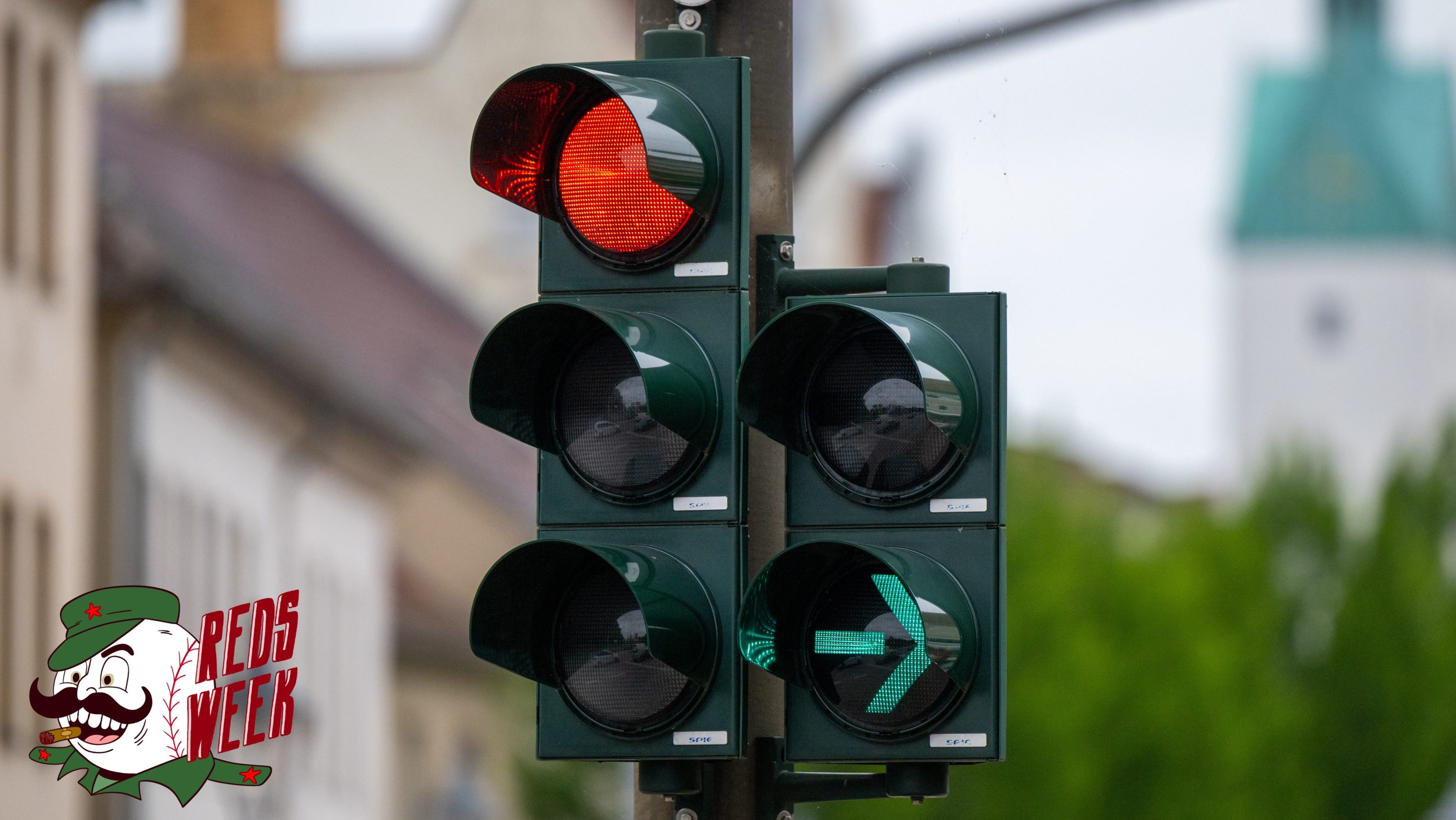
And the only things holding back these perfectly nice people hopped up on the false whispers of the society-wide Wormtongue that is driving are the simple absolutes of traffic laws. Especially that most absolute of the prohibitions, the red light. Even Go, Dog. Go!, as pro-movement a title as you could hope to find, contains a page where an endless stream of dogs in cars is forced to wait for the changing of the red light and be lectured by a small bird. Red means stop. It means don’t go. Unless you’re turning right, and then, mostly, it means something else.
To allow drivers any evidence at all that traffic laws are supererogatory is to abandon all hope of order; to allow them this evidence in the face of the sternest prohibition traffic control has to offer—a red light—is to welcome carnage. Anyone who has ever been faced with making a right on red with someone impatient behind them understands that principle. In the absence of Leviathan, you get the war of all against all.