

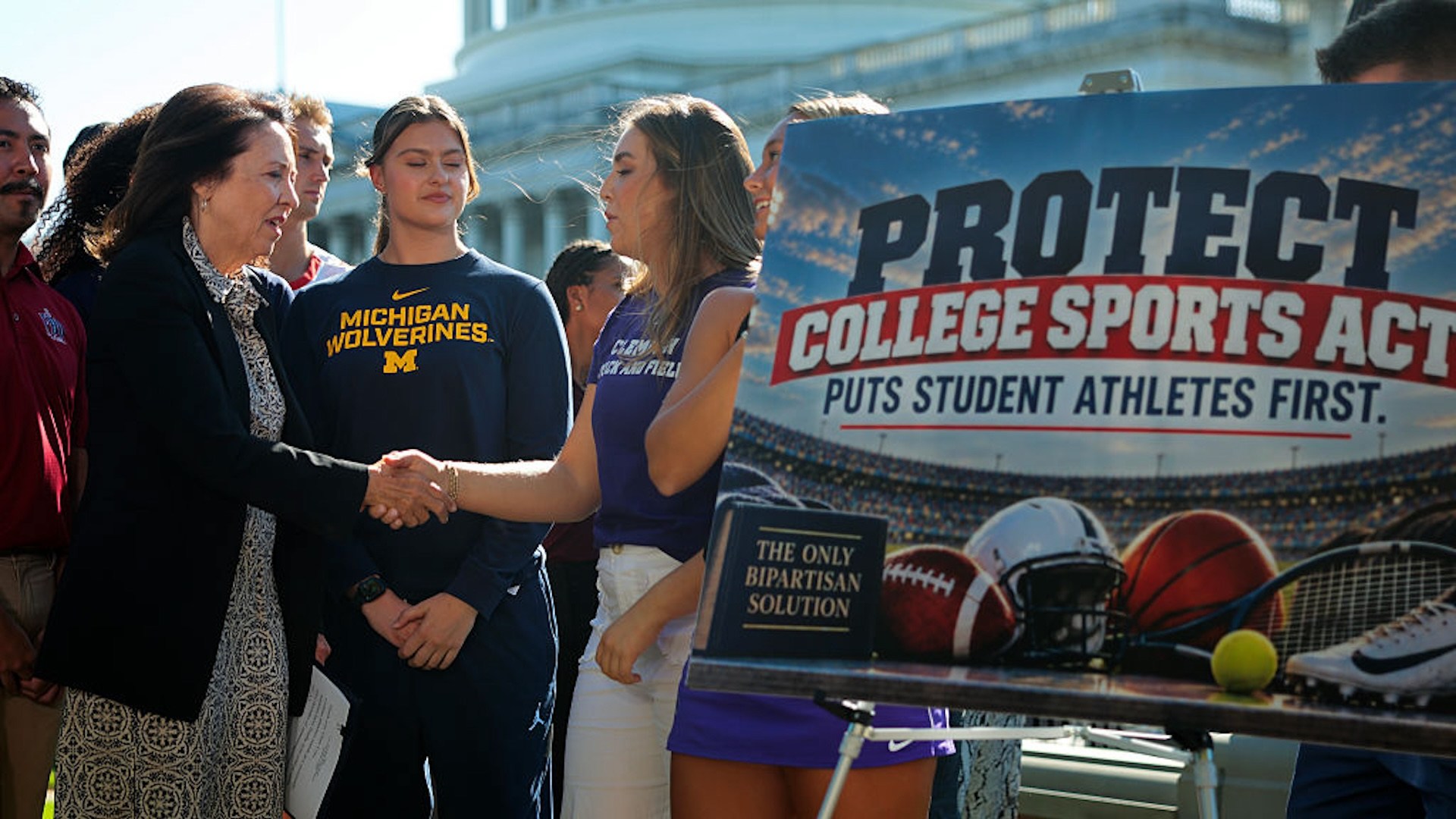
On July 10, University of Oklahoma President Joseph Harroz Jr. emailed Southeastern Conference Commissioner Greg Sankey and leaders of the other 15 SEC universities, urging the conference to prioritize stripping protections for Olympic sports from the Protect College Sports Act. “The current restrictions on Olympic sport sponsorship, funding, and scheduling should be removed,” he wrote. Schools needed flexibility to “respond to consumer demand.”
If the conference could not resolve the issues together, Harroz said he would address them “from Oklahoma’s perspective.” Action was necessary, he warned, as schools should expect “another unbudgeted increase of $10+ million” in football roster costs next year.
University of Mississippi Chancellor Glenn Boyce responded the next day, saying he agreed with Harroz.
Sankey sent SEC presidents an updated talking points memo on July 13. Co-authored with the Big Ten and titled “Common Sense Improvements for the Protect College Sports Act,” it was already being shared with Senate offices, he told them. The memo called scholarship and roster requirements for women’s and Olympic sports “unfunded mandates.” Schools, the conferences argued, needed “flexibility to preserve opportunities across all sports while remaining financially responsible.”
These documents, obtained by Defector through public records requests requests to the University of Texas, Texas A&M University, and the University of Washington, show that while the Big Ten and SEC had previously argued in public for congressional intervention in order to preserve athletic opportunities in women’s and Olympic sports, they were seeking in private to have requirements for funding those sports stripped from the final version of the PCSA.
David Bassity, the Big Ten’s Senior Vice President of Communications, responded on behalf of the Big Ten to Defector. The Big Ten said its objection was to having scholarship and roster decisions “micromanaged in federal legislation.” The conference said its schools had added hundreds of scholarships outside football and basketball, mostly in women’s sports, and reiterated its support for the PCSA.
Harroz and the SEC did not respond to Defector’s request for comment.
Months before Harroz, Sankey, and Boyce sent those emails, the conferences had repeatedly made protecting non-revenue sports part of their case for Congress to intervene on college sports. After a White House roundtable on March 6, Sankey and Big Ten Commissioner Tony Petitti joined their ACC and Big 12 counterparts in calling for policies that “protect women’s and Olympic programs.” They endorsed the SCORE Act, a separate college sports bill that originated in the House of Representatives.
Petitti made the point again on April 3. Responding to President Donald Trump’s executive order on college sports, he praised the SCORE Act for “protecting academic and athletic opportunities provided through women’s and Olympic sports programs.”
House leaders pulled the SCORE Act from a vote on May 18. The bill has since stalled in the House. Nine days after it was pulled, Sens. Ted Cruz (R-Texas) and Maria Cantwell (D-Wash) unveiled the PCSA.
The June 15 update to the PCSA added Section 125, which set out protections for women’s and Olympic sports. Schools with at least $80 million in annual athletics revenue would have to maintain scholarship levels in non-revenue sports at the 2024–25 baseline.
Chad Hawley, the Big Ten’s senior vice president for policy, asked universities in states with senators on the Senate Commerce Committee to send a template letter on June 17. The letter said they could not support the June 15 revision.
It called Section 125’s scholarship protections “an unfunded mandate that removes institutional decision-making authority” and warned that the provision would have “a disproportionate negative impact on institutions like those in the Big Ten that have provided the most opportunities and support in women’s and Olympic sports.”
On July 13, the NCAA urged its members to contact senators in support of the bill. Hawley forwarded the message to university government relations officials with instructions to “disregard the NCAA office’s call to action for now.” The conference’s position remained unchanged, he wrote: “the problems with the bill are such that it cannot be supported in its current form.”
On July 26, Brad Grantz, the Senate Commerce Committee’s Republican staff director, sent an email to Sankey and Petitti outlining concessions Washington had made to garner support from both conferences. Grantz called it a “substantial package” and said he hoped the conferences would now be “part of the solution.”
The material Grantz sent specifically listed “Flexibility on Mandate for Olympic and Non-Revenue Sports” as a request from the conferences. It outlined the concession this way: “Institutions can modify or substitute the sports that are sponsored or the number of roster spots and scholarships provided for each sports [sic], provided that the total number of scholarship and roster spots remains at or above the baseline.”
In other words, schools could now use an aggregate number of scholarships to satisfy the PCSA’s mandate, rather than having them be tied to individual sports.
The conferences’ own documents suggest why the bill sponsors thought the change would appease the SEC and Big Ten, even if the larger ask of getting rid of the mandate entirely wasn’t met. A co-authored document specifically mentioned the conferences were looking into adding flag football as a new sport to sponsor in the future.
Flag football could offer a considerably cheaper option. A study commissioned by the University of California, Davis, projected first-year expenses of about $316,000, including scholarships and coaching. Georgia’s financial report for fiscal year 2024 listed annual operating expenses of $3.6 million for gymnastics, $3.4 million for equestrian, and $2.3 million for women’s swimming and diving.
Even this concession wasn’t enough for the Big Ten and SEC.
Hawley told Big Ten campus lobbyists on July 29 that several of the conference’s most important issues remained unresolved in the revised bill. Among them: “There also was no substantive change to the roster spot/scholarship mandate.”
The next day, Hawley sent conference presidents and athletic directors a summary of the bill. Under “Roster Spot/Scholarship Mandate,” it noted that schools would have to maintain at least their aggregate 2024–25 roster spots and scholarships for nine years.The document ended with a summary of “Wins and Losses.” Under “Losses,” alongside the lack of protection for rule-making authority and the lack of a hard cap on name, image, and likeness compensation, was this: “Unfunded mandate to return to 2024–25 roster sizes.”
Bassity, responding on behalf of the Big Ten to Defector, stated the provision remaining in the bill was characterized as a “loss” because “we advocated against its inclusion.”
On July 31, hours before the conferences announced their support for the bill, Grantz had a blunt message for SEC leadership who remained unhappy that not every requested change had been added to the bill.
“It is the political limit of what can be enacted,” Grantz wrote. “There is no legislative alternative that gets better for the SEC. The longer this bill sits out there, the more vulnerable it becomes to changes on the things you care about.” That night, the SEC and Big Ten publicly endorsed the bill.
The Senate passed the bill on Sept. 28 with Section 125’s language intact. The bill would bar conferences and the NCAA from reducing the minimum sport-sponsorship, participation, and competition requirements for Division I or Football Bowl Subdivision membership. Schools with at least $80 million in annual athletics revenue would have to keep their total scholarships and roster spots in non-revenue sports at or above 2024–25 levels for nine years.
On Aug. 3, Hawley emailed federal relations staff at every Big Ten school a revised version of the Big Ten’s bill summary, which had previously included the “Wins and Losses” section. The revised version was being forwarded to Senate offices. It did not include the “Wins and Losses” section that described the protections for women’s and Olympic sports as a loss.
The conferences had spent months promising to preserve athletic opportunities. In the Big Ten’s accounting of the legislation it endorsed a day later, a requirement to keep those opportunities was a loss. It just couldn’t tell that to Senate staff or the public.