


While there are many fantastic Japanese role-playing game (JRPG, for short) series out there, and with apologies to Dragon Quest and Persona, Final Fantasy is the biggest and most important of them all. Every numbered entry in the main series is an event, and since almost every game is its own story (to date, there have been two main games to get direct sequels: X got X-2, and XIII inexplicably got two sequels), there are swaths of new gamers dipping in every time a new game releases.
Despite that, it's safe to say that Final Fantasy has somewhat lost its way, or at least what was once its identity. What started as a turn-based RPG has evolved, first into a more active-style combat system and then more recently into something bordering on an action game. This makes sense for Square Enix, the series's developer, as turn-based combat has mostly, though not entirely, slipped from an important game genre into something more niche. Chasing the action trend that took over turn-based RPG's spot with the Soulsborne games made financial sense, and it kept Final Fantasy from growing stale.
That said, there's still a hunger for turn-based RPGs, and especially turn-based Final Fantasy games; the last mainline game to be strictly turn-based was 2001's X. With that in mind, we arrive at Final Fantasy Resonance, the recently released (and relatively successful) spin-off that is a sort of remake/re-using of assets of Final Fantasy Brave Exvius, a mobile gacha game. Resonance is not asking the player to part with any money besides the initial price tag, and instead is a fully fleshed-out 30-to-40-hour turn-based RPG adventure through time, space, and Final Fantasy history.
As a Final Fantasy devotee, I (Luis) was beyond hyped to play Resonance upon its release, but I also knew that this would be the type of game that I could convince people to play if they had any passing interest in JRPGs. Enter Barry "Baby Gamer" Petchesky, who has grown into quite the Real Gamer since he first blogged his post-pandemic gaming habits. I knew that Barry had played and enjoyed another Square Enix JRPG series, and I knew that he appreciated the HD-2D style of visuals that Resonance would employ. (For those who do not know, HD-2D visuals utilize 2D character graphics within fully 3D environments.) Since Resonance takes a journey through Final Fantasy games past, I was curious how someone with no relationship to the series would experience the game compared to someone like me, who has played almost every game in the series. As it turns out, we had very different experiences playing Final Fantasy Resonance, but somehow arrived at very similar conclusions about what the game actually felt like to play.
What's your previous experience with JRPGs broadly, and Final Fantasy specifically?
Barry: I was never a JRPG guy. As a kid, and also as an adult but slightly less so, I was a very impulsive gamer. I didn’t have the patience for a game where I might have to strategize ahead, or would need to “waste” a turn on healing my party when I could just attack again. So I would just not ever heal. As you might imagine, this made turn-based RPGs far more difficult for me than they needed to be, so I didn’t enjoy them, so I didn’t play them. I think I brute-forced my way through Secret of Mana and Super Mario RPG and that’s about it. And then once I left for college I stopped playing games altogether until I picked it back up during the pandemic. Several whole generations of game design came and went without me paying attention.
From what I’ve played/observed as an adult, JRPGs have largely felt like they are Not For Me. I’m still not a strategy guy, and the conventions of the genre—what I once referred to as “anime bullshit” but have come to understand is actually better termed “JRPG bullshit"—are a big turn-off. You know the stuff: template character designs, crude sexualization of female characters, irritating English voice acting, disjointed plotting, and the fact that seemingly every game’s story does in fact come down to “using the power of friendship to kill God.”
I am still not a JRPG guy. But what I am is an Octopath Traveler guy. I was convinced to try it by reading one particular review of OT2, which raved about its HD-2D art style (which is indeed beautiful), but more importantly mentioned how the eight different plots run the gamut from traditional JRPG god-killing to lower-stakes quests. Lower stakes is what I want! That felt new and appealing to me, and yes, I found myself most invested in the characters who had the least on the line. Agnea, my queen, I’m so glad I could help you succeed in your quest to become a famous dancer. Ultimately, OT2 won me over by being gorgeous to look at, requiring zero grinding (a non-starter for me), and having combat mechanisms that were simple enough for me to grasp yet rewarding to nail.
Luis: I am on the complete opposite side of the JRPG spectrum. Ever since I played Final Fantasy IX on my cousin's PS1, I have been obsessed with the series and with the genre as a whole. I've even written about it deep in COVID quarantine psychosis. The things that you say are Not For You—buffing, healing, strategy, anime/JRPG bullshit—all hit the spot for me. I wouldn't call myself a connoisseur of the genre, as there are so, so, sooooo many series I haven't even dipped my toes into (I will get to the Trails series before I die, though). But I think I can call myself an expert on Final Fantasy at least.
It's interesting to me that it was Octopath Traveler that hooked you. I've played both OT1 and OT2 and I found them both to be ... fine. The lack of interconnectivity in the first one put me off; it just felt like eight separate stories were happening in orbit with each other and nothing more. The second one improves that, but I still found it exhausting to have to do eight semi-tutorial introductions before moving on. (I know I could have done them in a different order, but I am a completionist.) The combat was also acceptable but nothing spectacular; we'll get to it, but I much preferred Resonance and its stagger mechanic to the break system in the Octopath games. If there's one thing that I do love about that series, though, it's the HD-2D look; after playing the first one, all I wanted was for a proper Final Fantasy game in the style, and here we are.
How did you feel about the combat in Resonance?
Barry: I played on normal, because I read beforehand that “normal” was pretty easy. And it was. Not so much that I could get away with not having an active healer in my party, but that’s OK; I’m an adult now and can pass the marshmallow test. It was, however, easy enough that I could mostly skip using buffs. I used Nichol for the chapter he was introduced, then never used him again. I could see, vaguely, how there were possibilities in there to break the game, but I don’t really consider video game combat a puzzle to be solved, like I know some people do. Maybe because I fear that if I solve it, it’ll remove all drama from the game going forward.
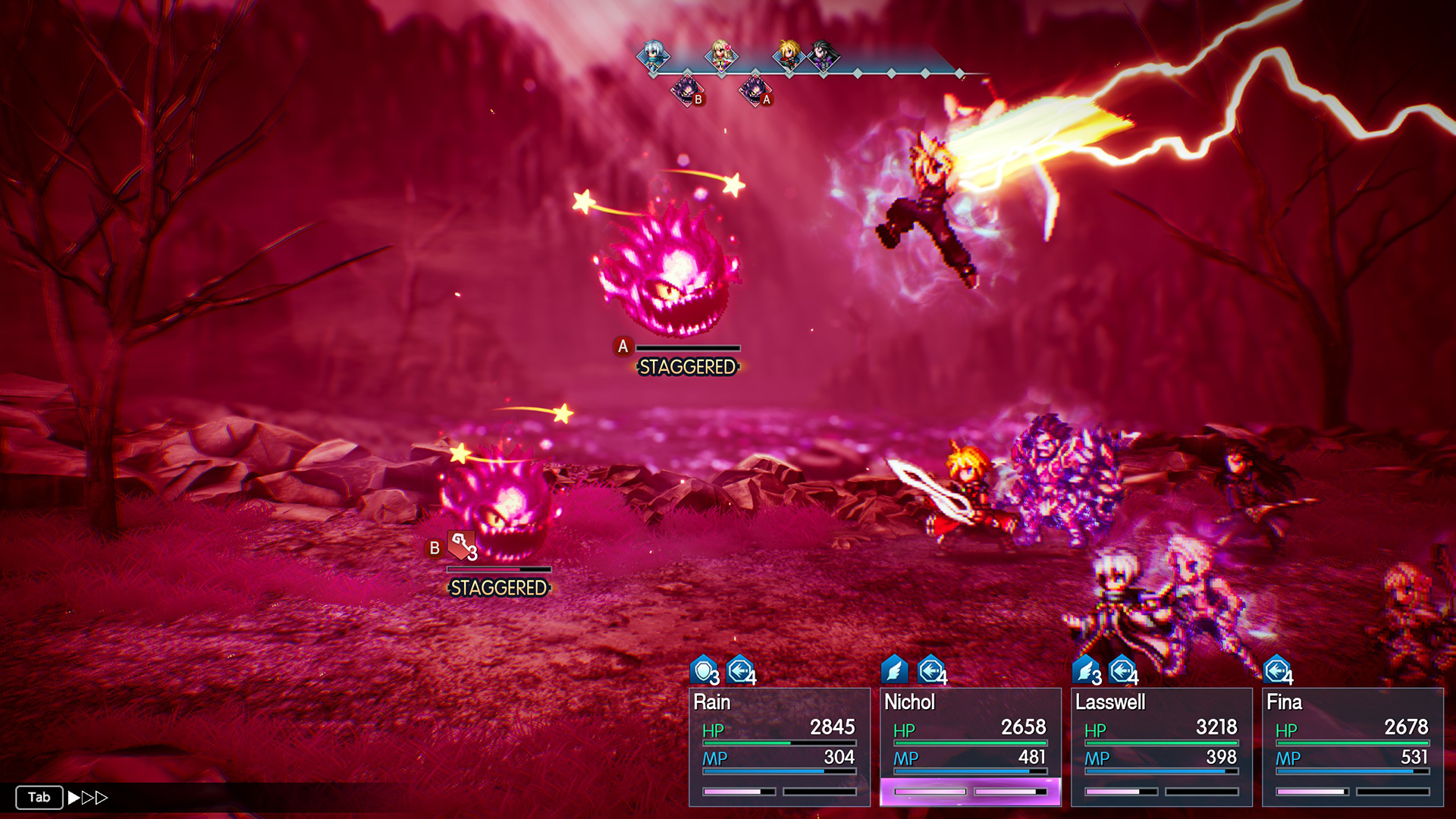
On the whole, the combat was a satisfying loop. I liked having to figure out an enemy’s elemental weakness (something I assume is common in JRPGs but which I have only ever personally encountered in the Octopath games), using that weakness to whittle down their stagger bar, and then unleashing hell on a defenseless enemy (another Octopathian rhythm, to me). But I did miss the “boost point” system from Octopath which added a third variable to combat, in letting you save up what are effectively damage multipliers. Sorry, I know I sound like the guy who has only ever seen Boss Baby.
But a funny thing happened about halfway through the game. By then I had leveled up enough, or maybe just gotten the hang of things enough, that combat had become too easy. This is counterintuitive, but it made me turn the difficulty down even more, to the easiest setting. I wasn’t in danger of dying to anyone, I figured, so the fun had gone out of the thing and by making it even easier I could get through the combat as quick as possible and get on with the story.
Luis: Once again, we show our differences here. While you may have benched Nichol, I figured out pretty quickly that his toolkit was absolutely busted. I think action economy is always the most broken part of JRPGs; if you can act more times than your enemies, you are going to have a good time. His ability to act after buffing was really good and it also opened up my third eye to a really stupid possibility that sort of ruined the back half of the game for me.
Allow me to explain. There is a way to get two abilities via visions (more on them in a bit) that allow you to act twice: Arms Akimbo lets you get two turns, and then Double Action lets you combo that with two actions in a single turn. If you add in Nichol's ability to act twice when he buffs, you can see where I am going with this.
I started pretty much every fight, no matter how trivial, with a full suite of buffs and attacks from my little water mage guy, allowing the rest of my team, also decked out with the extra action abilities, to annihilate most bosses in two turns. As long as they weren't immune to physical damage, Lasswell, my best attacker, would just destroy them. I figured this out around chapter five and promptly hit the grind until my main team of four had all of the abilities to make their damage as strong as possible.
"But Luis," you might ask, "wouldn't that just make the rest of the game boring?" Well, kind of. Like Barry, I figured out that the combat eventually gets easy enough on normal difficulty that I had to find my own fun. Breaking the game is always fun to me in Final Fantasy games; I spend a lot of time grinding Grand Dragons in IX to power up my party, and don't get me started on the auto-leveling trick from XII. I still get dopamine from blasting through the game, it's just more of the satisfaction of a job well done. Resonance passes the Final Fantasy test for me by letting me do this quite early, and my team of murderers became a rolling deathball on the monsters and evildoers of Lapis.
What about the story and the characters?
Barry: Oh boy. I found the story pleasant enough but somewhat incoherent. This is likely my own fault, as by the time it was about three-quarters through I was constantly mashing “continue” on dialogue. But it’s never a great sign when you’re confused who a game’s final boss is. Not in the sense of “I don’t know if there are more bosses after this guy,” but rather “Who the hell is this?”
In my defense I swear we had not met or even heard of him until like 10 minutes beforehand. This is a perfect example of “JRPG bullshit,” where an initially straightforward story mutates and twists and turns and only ever escalates, to the point where it’s unrecognizable from how it started. And it started so simple! A knight trying to stop six evil armor guys from destroying some important magic objects. I could have fucked with that. But no, there had to be reveals and betrayals and so forth.
I did like the characters. Lid had a low-stakes story and was easy to root for and her interactions with Jake were charming. Fina had a rewarding arc even if it did feel like they were making up the rules of magic as it went along. Rain (it seems like Final Fantasy games love naming their characters after weather?) was a pretty standard protagonist but he was likeable.
Luis: My favorite game of all time is Final Fantasy IX, and that game drops its final boss literally seconds before you fight it, with no preamble. It's hilarious and stupid, but since I grew up with that, Resonance couldn't faze me. In terms of series stories, I'd put it somewhere near the middle-bottom. It was fine, and I love a good crystal story, hence why I love Final Fantasy, but like Barry, I found the dialogue unnecessarily obtuse and confusing. Also, time travel sections are never all that fun to me, even when they are simply memories. It's a passable story as a whole, but I was playing more for everything else the game had to offer.
The characters, though, I actually found pretty fantastic. As Barry mentioned, Lid and Fina have good stories, and I'd go as far as saying that Rain is better than standard; he reminded me a lot of Zidane from IX (I'm sorry, I can't stop talking about the GOAT), in that he just wants to help his friends and make the world a better place. It's charming and a needed departure after recent Final Fantasy protagonists, who are mostly brooding and angry. Elsewhere, Nichol was boring as a character, but his aforementioned combat prowess saved him for me. Sakura was fine enough for an important role, Jake's flirting was a better take on the scummy playboy archetype than Final Fantasy has had, and Lasswell handled the brooding so Rain didn't have to. I don't know, I really liked them all, and would be happy to spend more time hearing them yap at each other, even if the overarching plot lost me at times.
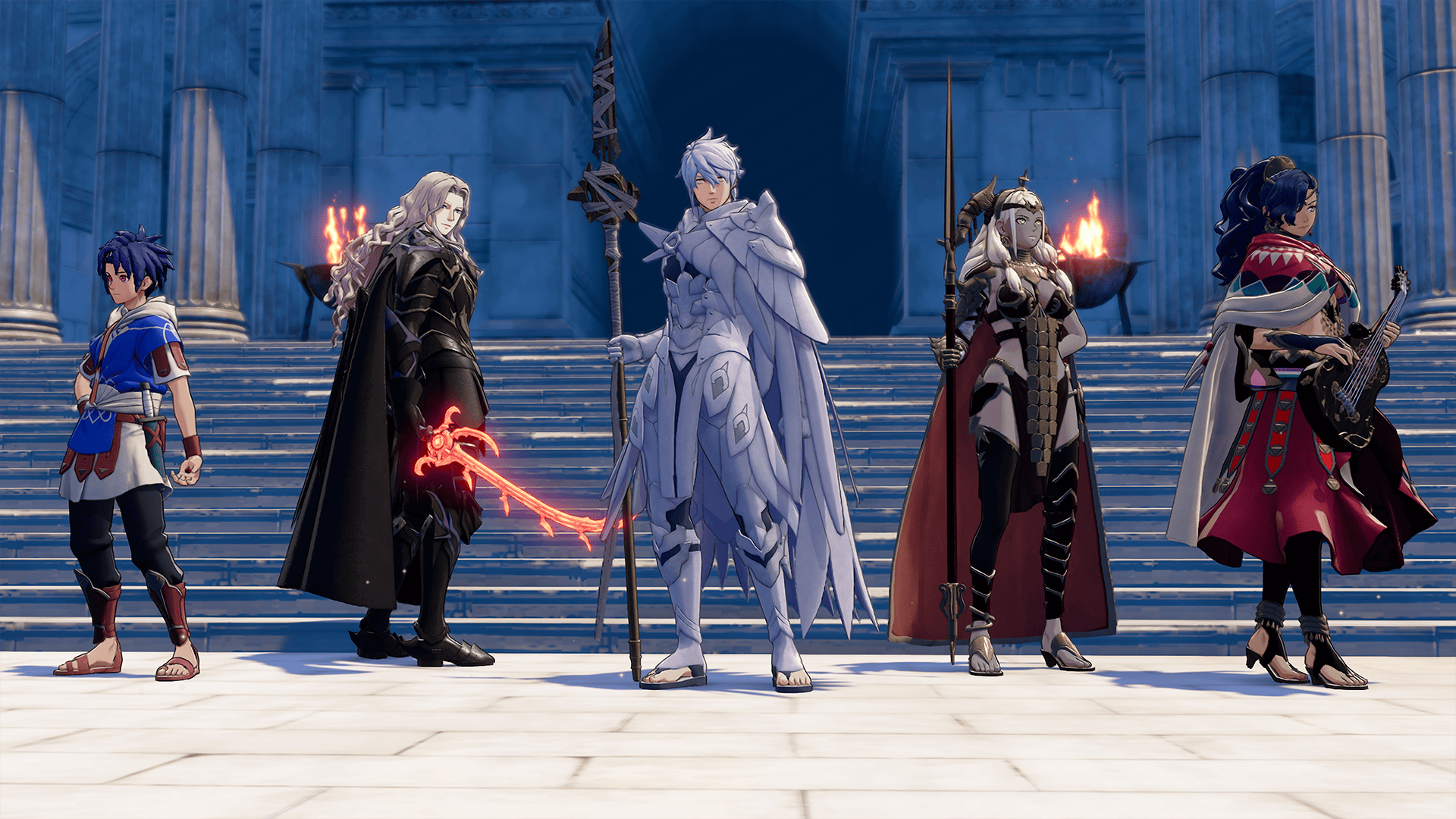
Visions are the big innovation with Resonance, as main characters from previous Final Fantasy games return to help your party in combat. Did knowing or not knowing who the characters were help or hinder your enjoyment of the mechanic?
Barry: The visions meant nothing to me, storywise. I have zero experience with Final Fantasy games in my life. I am aware of, I think, three total characters over the entire series and they’re all from the same game. I know Big Sword Guy (because of his big sword) [Luis note: Cloud], I know Lady With Suspenders And Absurdly Large Chest (because of … well.) [Luis note: Tifa], and I know The Guy From The Twitter Meme (this link is possibly a spoiler) [Luis note: It is a spoiler]. If I had a previous relationship with any of these characters, it probably would have hit harder to see and use them, so I feel like I missed out on a potentially large emotional component.
However, I did watch through each’s intro, and tried to guess/intuit the correct answers to the questions about their respective games’ plots, even if there was no penalty for getting the questions wrong. It almost felt like a minigame.
Luis: The main reason I wanted to play Resonance was for the visions. I love Final Fantasy and have played most of them (I am missing II, III, and V, and I never did finish XVI, oops), so the idea that I would see characters from all of those games in one was highly appealing to me. The execution was ... not quite as exciting as I hoped, but I still broadly liked the implementation. My main issue was that the visions didn't really have much narrative purpose after you acquired them; they were simply a gameplay mechanic. So, I felt no need or desire to use my favorite characters (Zidane, Tidus from X, Cecil from IV, Terra from VI), and a compulsion to just use the strongest characters instead.
Unlike Barry, though, the characters whose games I hadn't played, I just turbo-skipped through their introductions. It's really funny to me that Resonance straight-up spoils every mainline game in the series for anyone who hadn't played them. Kind of fucked up, too, if Resonance is to be a gateway drug into the series. For the ones that I did know, though, the introductions were lovely; I felt a powerful burst of emotion at hearing the opening notes of the Final Fantasy X main theme. I'm sure that people who had played the games I hadn't felt similarly there.
How did the visions feel in combat?
Barry: I enjoyed them as combat mechanics, as their movesets made them feel like entirely additional party members. I got the sense a player could go much deeper, and find some real game-breaking synergies with them, but in practice I mostly stuck with equipping the visions that gave me the widest range of elemental attacks, so that I could have every enemy weakness covered. I also switched up my equipped visions fairly frequently. I think I prefer a system somewhat like Hades, where you luck into various useful synergies rather than try to plan them out. Or even something with less choice, like Octopath's jobs system, which is basically the same thing but only offers eight options, one per character. Choice paralysis is a real problem in games and I'd usually rather just not have to deal with it.
One thing I loved was the animations for their special moves, specifically the wide, wide range of graphical fidelity. One guy would be a little 8-bit wizard casting an 8-bit fireball, and then some modern photorealistic CGI-looking guy would be dropping a planet on an enemy's head. That’s video game magic, baby.
Luis: Other than the quibbles I mentioned above, the visions were fantastic to play around with. Their abilities allowed for my broken combos, the special attack animations were hilariously over-the-top (thankfully, you could skip through them after seeing them a couple of times, if you wanted to), and it was nice to see some of my faves in beautiful HD, even if that clashed with the game's primary art style.
Did you grind like a maniac in true JRPG fashion, collecting experience points and rare gear?
Barry: No grinding was required, so full credit to the game there for respecting my time. Between the party members and all the visions, it felt like something was leveling up after just about every battle. My dopamine receptors love to see Number Go Up.
I did all the side quests I came across, because I'm completionist enough to need to cross off the unfinished quests on my ledger, but not completionist enough to worry about the ones I never found. And combat was never challenging enough that I felt the need to do the Colosseum or collect tablet shards—the reward of "slightly stronger weapons" was neither necessary nor game-changing enough to engage my curiosity.
Luis: As stated above, I did a lot of grinding in chapter five, especially once my party was complete. I knocked out most of the vision's full ability lists for every character, I bought everyone the best gear I could at various points, and I only stopped doing the Colosseum once I needed to grind more levels after that initial grindfest. I also collected all of the Adamantite weapons and ancient gear, and I got Ribbon accessories for everyone. Yeah, I went a little overboard, but I found the rhythm of the grind pretty soothing and easy to do while watching TV.
Did you dip into the post-game content at all?
Barry: I didn't seek out any post-game content, no.
Luis: I did not do any real post-game content, mostly because I have a lot of other games to play, both for future blogs and for my own enjoyment. I might go back to it at some point, or I might not, but I certainly got my money's worth from my time with Resonance.
Any final thoughts on Final Fantasy Resonance?
Barry: I feel like I've come across as overly negative so far! That's not fair to a game I enjoyed a lot and that kept me engaged all the way through its non-excessive length. It's a gorgeous, gorgeous-looking game, and the overworld/dungeon loop is mixed up often enough to keep it fresh throughout, and the combat is satisfying both in the shallow end in which I played and seemingly in deeper waters for more committed players. Everything about the presentation is incredibly polished in a genre I've usually associated with a bit of jank. I also get the impression that a lot of what I think of as JRPG tropes were in fact just Final Fantasy tropes—this feels like the granddaddy of the genre taking a deserved victory lap through its own past. And for whatever it's worth to Square Enix's bottom line, it got me to buy the FF7 remake.
Still, what I really, truly want is Octopath Traveler 3.
Luis: I'd like to think I helped by convincing you that the FF7 remake was worth the $8 or whatever when it was on sale. Anyway, I loved this game! Resonance truly is the victory lap Barry mentions, and if it falters as a game on its own, its only because I wanted it to be a true mainline Final Fantasy epic. It's not that, exactly; it's more of a spin-off, an experiment with both art style and visions. The latter was a mixed bag, but I truly hope Square Enix keeps making side games in this HD-2D, turn-based style. The mainline games have moved further and further away from that; XVI was basically an action game, rather than an RPG. If that's the direction the company wants to take the numbered entries, that's fine; just give me more games like Resonance for when I want to satisfy the pre-teen who first stumbled into Final Fantasy so many years ago and fell in love with its worlds.