


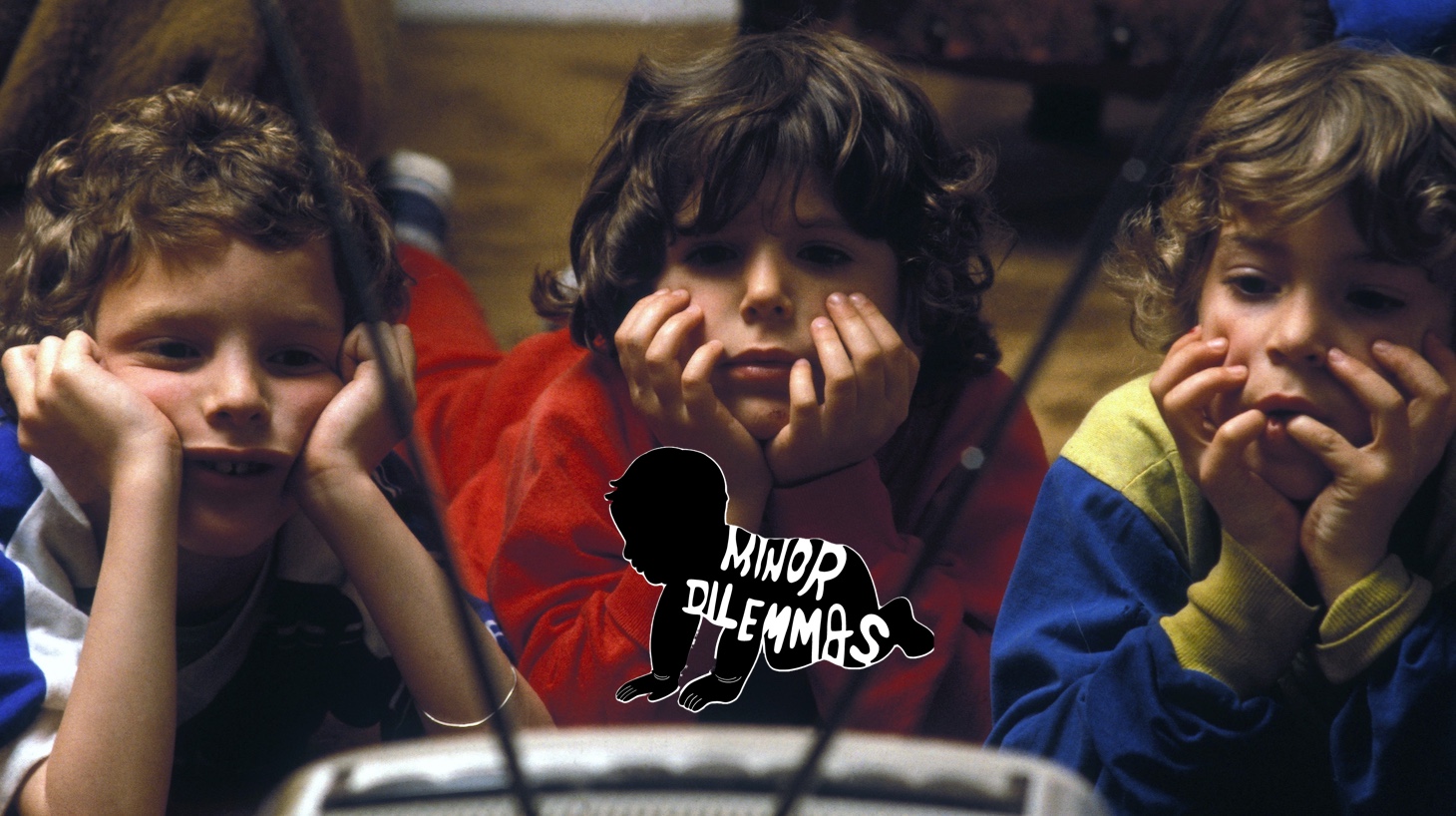
Welcome back to Minor Dilemmas, where a member of Defector's Parents Council will answer your questions on surviving family life. Have a question? Email us at minordilemmas@defector.com.
This week, Billy dives into the tricky question of screen time.
Spencer:
When I see parents let their toddlers or young kids sit on an iPad at a restaurant, I am often tempted to ask the parents wtf they’re thinking. Hell, even on flights, car rides, etc, I can’t understand for the life of me why parents can’t trust their kids to entertain themselves without screen time.
I really try not to second guess other people’s parenting much, but I can’t help it with this screen time because I see how relatively easy it is to just not give kids’ screens. My 7, 5, and 2-year-olds have all made it through long car rides and flights - and certainly dinners - without touching tech. Why do so many parents - many of whom are ostensibly smart and capable people - insist on afflicting themselves and their children with this self-inflicted wound? Am I overreacting?
On the social side of things, one of the trickiest aspects of parenting life is navigating parental judgment. This is especially difficult because so much of what's up for judgement is left unsaid. The decisions parents make in regards to their child—what kind of food do we give them? How do we deal with sleep? What are our beliefs about structure and discipline? What kind of media do we expose them to or protect them from?—are so weighty and personal that oftentimes the mere presence of a different approach can't help but feel like a rebuke.
In that way, the shared experience of parenting is both bonding and alienating. Close friends who don't parent quite the same way can find themselves estranged from one another when talking about subjects you'd imagine would bring them closer together. In the other direction, even more so than personality fit, I've found that the best determiner of how well I'll get along with parent friends is whether our parenting outlooks are similar enough that we can be ourselves at, say, the playground or a playdate without either of us feeling judged by the other's choices. The fact that we aren't, and probably wouldn't be, friends outside of the parenting context somehow makes it easier to open up about this single but enormous aspect of our lives.
There's no getting around it: You will judge other parents, and they will judge you. Likely both parties will feel that judgment, even if it never comes up explicitly. Likely there will be times when the feeling of being judged arises even when there is no actual judgment on the other side, but instead originates solely in the mind of the one who feels it. Likely judgment will strain relationships, hurt feelings, and reveal fundamental differences in values where you wouldn't have imagined them. While it can be illuminating and sometimes fun getting judgmental with like-minded parents, on the whole the judgmentalness thing just sucks for everyone.
With TVs, smartphones, tablets, and streaming, shows and games are everywhere. With the prevalence of families with two working parents, the sometimes prohibitive costs of childcare, and the increasingly limited communal parenting support, the appeal of using screens to help meet the burdens of day-to-day parenting life is obvious. In a society growing more alert to the potential negative effects of technology, and a culture obsessed with optimization and the perfectibility of every aspect of life, ideas about the risks of screen time and the best or safest ways to raise your child are as varied as they are categorical. Because of all that, screen time is one of the biggest sources of parental judgment.
Personally, I fall somewhere in the middle on the great screen-time debate. My wife and I let our son watch TV, sometimes for his own entertainment and other times out of our own exhaustion. We limit how much we let him watch, and over the years have become more intentional about the kinds of shows we put on, mostly focused on avoiding over-stimulation. We don't have a tablet, and we haven't let him play any of the kiddie games and apps some of his peers play, but for instance, if we're at a restaurant and he is getting antsy, we'll pull out a phone and put on Blue's Clues. When we fly from our East Coast home to visit my family on the West Coast, we let him watch as much TV as he wants. Our approaches to this stuff aren't informed by much in-depth research or anything, and instead come from our shared beliefs that good TV shows aren't necessarily bad in moderation, but that tablet obsession and the kinds of re-skinned slot machines that make up most of the games there are best avoided outright.
Because of my own approach to screen time, I have felt both judged and judgmental. I've been icked out seeing children glued to tablets for hours on end, barely verbal toddlers navigating the touchpad with an adroitness that genuinely makes me queasy. I've noticed a telling pause or glance when I've sought to appease my cranky son at a dinner with friends by putting a show on my phone and propping it in front of him on a ketchup bottle. But what I've tried to remember when looking down on other parents' screen-time allowances, and what I've wanted to communicate to others when I've sensed someone looking down on ours, is that everyone really is doing the best they can.
If you spend enough time around kids, and especially if you have multiple kids yourself, one thing that will be made immediately clear to you is that kids are just different, and parents are too. Despite what the books and blogs and studies about parenting best practices might insist, there is in fact no one right way to go about any of this. What works for one child or family does not necessarily work for the next, and identical approaches will often lead to highly varied outcomes. In the parenting realm, the pervasive optimization mindset seeks to alleviate parental anxieties by promising a certain outcome to all who follow some strict, "scientifically" "proven" program, but often it only exacerbates the anxiety it purports to cure. Also, it's usually just plain wrong. A good childhood is defined much more by the love present in the home, the involvement of the parents, and the strength of the community than by some actuarial accounting of how much time a child spent in front of a screen.
Of course, the lines you draw as parents on screen time and everywhere else are important to your family, but it's good to give others grace and the benefit of the doubt. More often than not, their own lines reflect what's best for them and their specific need at any given moment, even if those lines cross yours. So Spencer, while I admire the fact that you've raised three kids without having to turn on the TVs on the back of the airplane seats' headrests, I'd appreciate if you kept your judgments to yourself when you pass my family's aisle, and in exchange, I'll do the same.