
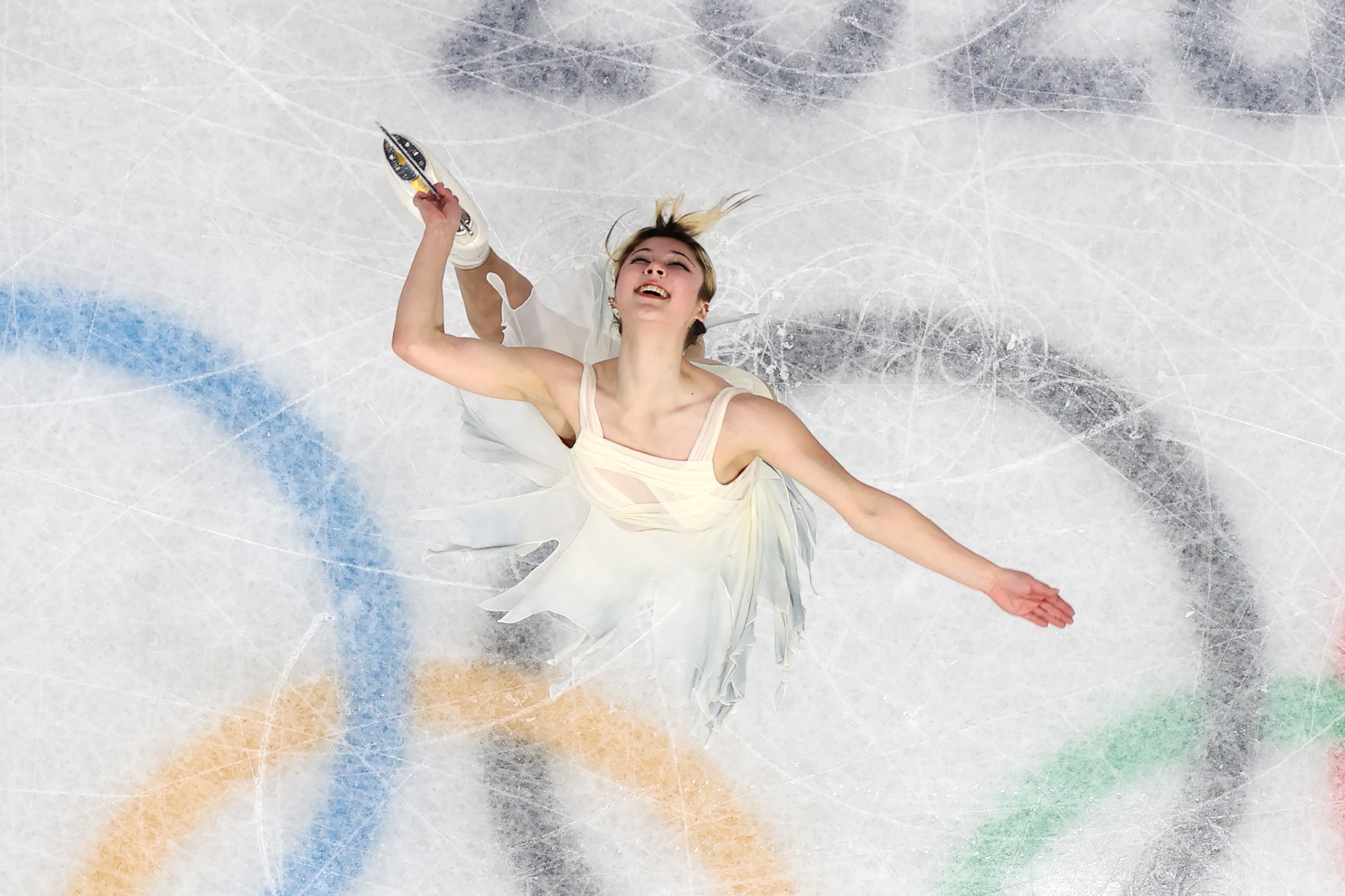
Since returning to figure skating, Alysa Liu has displayed an indifference toward earthly happenings that a bodhisattva would envy. That is not to say that she doesn't express joy upon completing a stellar performance. But she is never particularly moved by wins or losses, which has earned her internet descriptors of "totally unbothered," "nonchalant queen," and so on. Improbably, through the pressure cooker of the Winter Olympics, she has maintained this attitude. "I'm really confident in myself, and even if I mess up and fall, that's totally OK, too," Liu said after placing third in the short program on Tuesday. "I don't know! I'm fine with any outcome, as long as I'm out there, and I am. There's nothing to lose."
It is not difficult, watching Liu in the past couple of years, to believe those words to be more than generic athletespeak—that the point for her is the performance, and external validations like medals and scores are unnecessary. Control is the long-running theme of Liu's no-longer-so-new comeback. She picks her own music, dictates what she eats, and gets more involved with her choreography. When she skates, even on the ice of the biggest competition in figure skating, this is the sense the viewer gets: that she is in total control of what is happening.
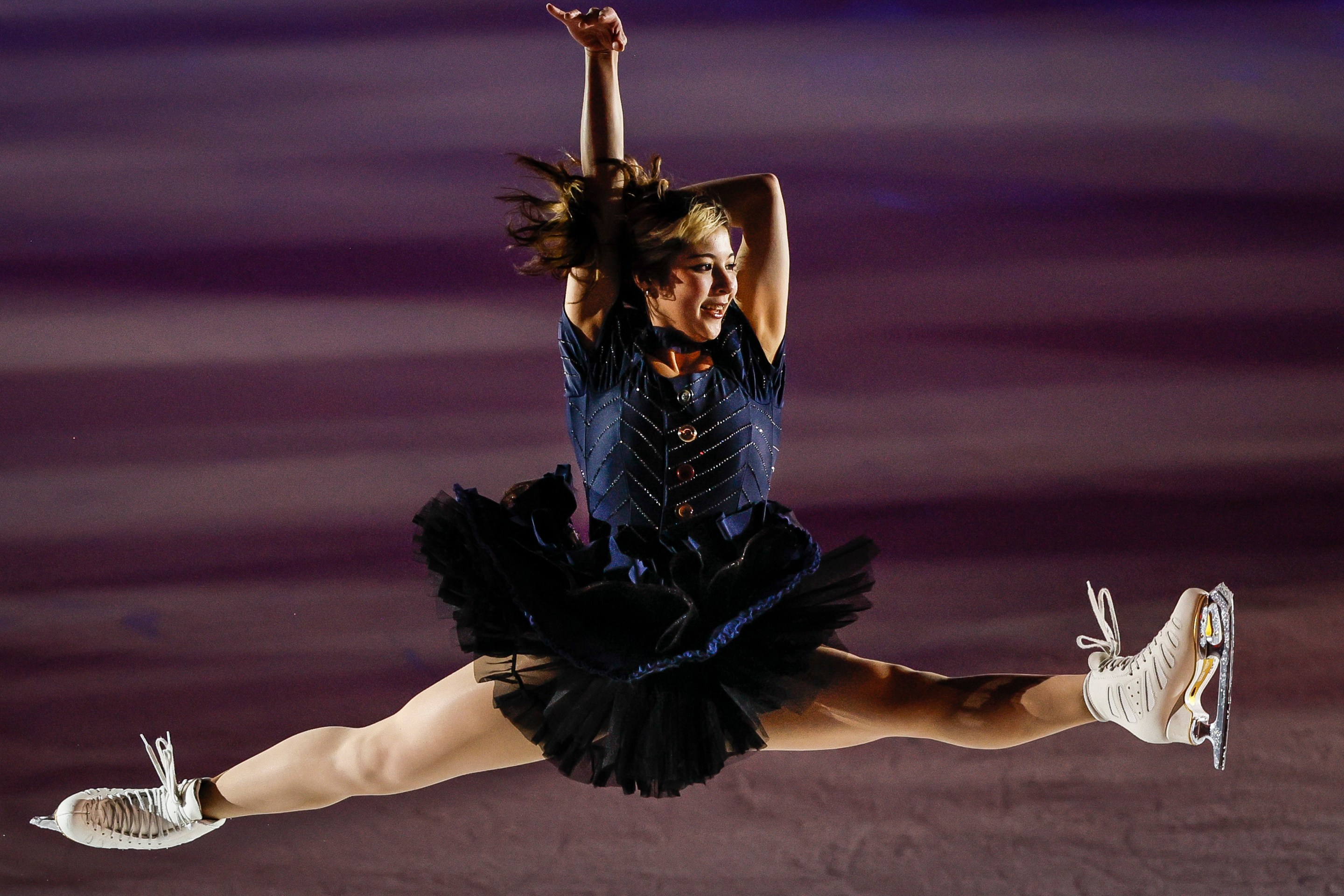
Liu's short program, set to "Promise" by Laufey, is the same program she skated to upon her return from retirement in 2024. While it is often easy to be wowed by a big, bright short program, Liu is incredible at pulling off a wistful presentation, filling the space despite such pared-back music. The unique triple Lutz–triple loop combination she jumps in the back half of her program does the technical heavy lifting for her score, and is perhaps the most eye-catching sequence—she whips from the first jump to the second with so little time in between it feels like one continuous motion—but her spins are what I return to. The final spin in particular is stunning and worth watching thrice: once to take in the full picture, once more to see how little she moves on the ice, and one last time to watch her arms.
Liu does not have the sledgehammer that is a triple Axel, like Ami Nakai or fellow American Amber Glenn. She has a tendency to underrotate her jumps, which means she can't reliably muster the full quality of Kaori Sakamoto, who has dominated the past four years. She does not have the quad toe loop or so-far generous scoring of Russian wild card Adeliia Petrosian.
But Liu appears to want for nothing, and it is the resultant armor against pressure or mental blocks—along with her aforementioned triple Lutz–triple loop combination—that she has over all her peers. Ilia Malinin was as consistent as male skaters get, but in the end, he wanted too much out of the Olympics. Even Sakamoto popped a jump at the Grand Prix Final. And then, of course, there is Glenn, Liu's fellow American podium contender.
It is almost too neat to have a skater like Liu and a skater like Glenn on the same national team, at the same event. Watching Glenn skate is like watching someone free solo a skyscraper. The routine is a fight between Glenn and herself, with potentially disastrous results. While Nakai will occasionally stumble and fall on her triple Axel, Glenn's inconsistency comes from aborting the jump. Her primary issue comes from pressure.
Glenn opened her Olympic short program with a gorgeous triple Axel. She fought her way through a triple flip–triple toe loop, and then through a spin, until finally she popped her triple loop to an invalid double, for which she could score no points. (By figure skating scoring standards, it would have been better to fall on a triple jump.) From there, Glenn skated out the remainder of the program knowing what the mistake lost her: probably an Olympic podium, certainly the chance at a gold medal. She started crying before she made it off the ice.
Liu’s emotional remove is an asset as a competitor, but Glenn exemplifies why it can make Liu a little bit polarizing. Spectators of sports often find it easier to relate to emotional athletes who allow them to flex their own powers of empathy. Jubilation and devastation work in tandem to form investment: Show me how much, how desperately you want it, and I'll want it for you, too.
Well, what does that matter to Liu? She was the savior of American figure skating at 13, formally retired at 16, and when she started her comeback at 18, she was told that it would be impossible. Now she is 20, with a smiley piercing that she did herself ("getting pierced at a shop is really expensive for no reason") and a distinct halo hairstyle that she adds a ring to with each passing year. It is a victory, after all, to continue to exist as we are, every day. As the poet Czesław Miłosz wrote, "Not that I want to be a god or a hero. Just to change into a tree, grow for ages, not hurt anyone."
What Liu offers the spectator is rarer than relation. It's confidence—not that she will skate a perfectly clean program, or that she will break America's longstanding medal drought. But that if she doesn't, or if she falls, she will be all right in the end anyway.