For Cherien Dabis, it all comes back to 1948. Her latest film All That's Left of You takes place primarily across three different decades, with a brief visit to a fourth at the end, but for her, this story couldn't be told without depicting the events of the Nakba, the mass expulsion of Palestinians in which they lost their homes and land, the basis of the ongoing fight for self-determination.
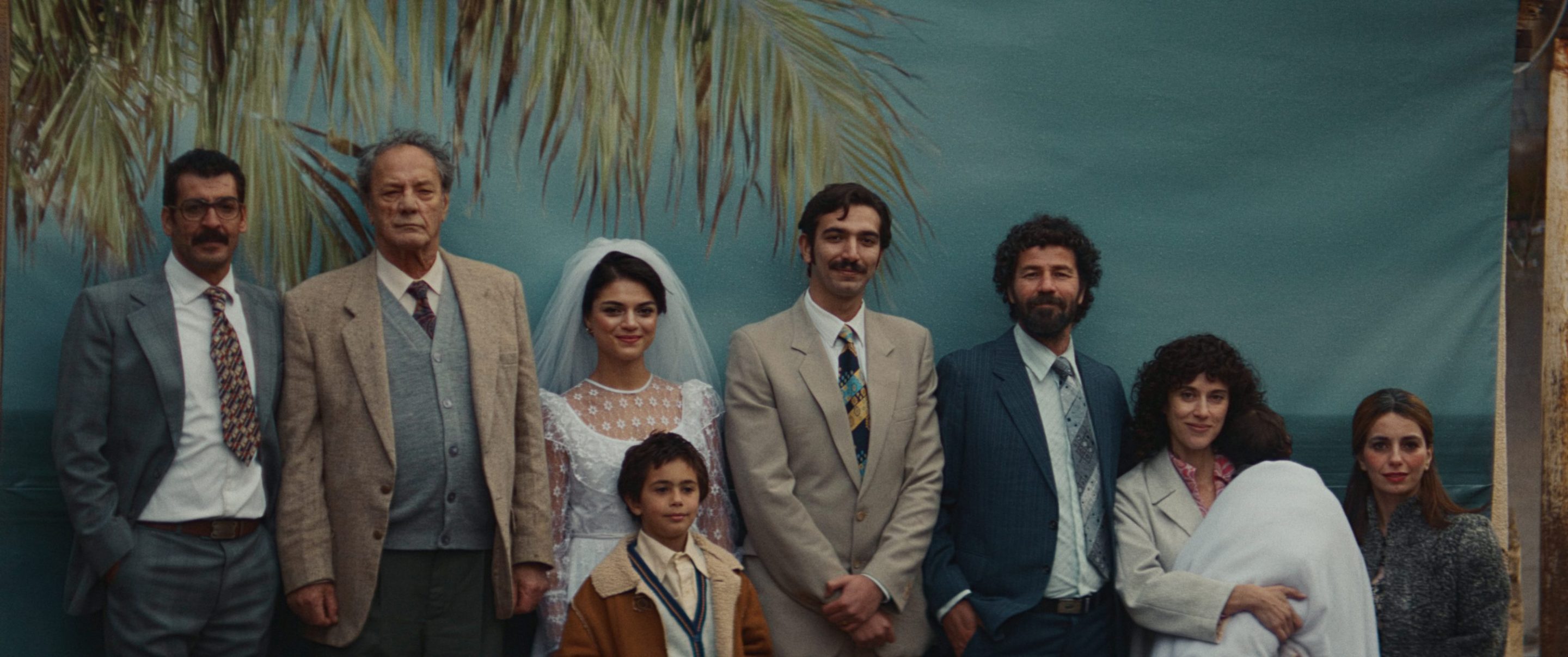
All That's Left of You, which Dabis produced, wrote, directed, and starred in, spends time in 1948, 1978, 1988, and 2022 as it follows three different generations of one Palestinian family as history happens to them. Zionists bomb them and drive them out of Yaffa; Israeli soldiers stop and harass a father and son; a teen joins a protest in the streets. None of these acts of violence are shown in particularly lurid ways. Instead, Dabis focuses on how it shapes the lives and outlooks of her characters, played by herself, the late Mohammad Bakri, and two of his sons, actors Saleh and Adam Bakri.
Earlier this month, I spoke with Dabis about the difficulties of filming and selling All That's Left of You, the balance of education versus entertainment in producing a film based on history, and the level of detail within the production design. Our conversation has been condensed and edited for clarity.
I know indie films are always difficult to produce, but I was wondering what extra barriers you faced in making All That's Left of You, especially at this time.
One of the biggest challenges or complications was that we prepped the entire film in Palestine, and we were only two weeks away from shooting when the events of October 2023 forced us to evacuate and basically start all over elsewhere. So it was like five months of work that we had done in Palestine, and that in and of itself—prepping an occupied territory, going in and out of checkpoints and an airport where we were interrogated and harassed—that was challenging enough, and then to have to leave all that work behind, and leave our Palestinian crew behind, which was devastating, and start all over outside of Palestine, where we had to look for Palestine everywhere but Palestine. We were forced to recreate it outside.
Then on top of that, we found ourselves making a movie about what was happening as it was happening. We're shooting scenes of the 1948 Nakba [while] watching scenes of the 2023, 2024 Nakba. And it was really just devastating, emotionally intense, surreal, art imitating life. In so many ways, I think it felt like everyone was just channeling their grief into the film. But obviously this was a huge emotional challenge. We found ourselves making this particular film during a genocide, and it's an incredibly intense film to be making.
And for the distribution process, what were those studio meetings like? Once you had a cut of the film, how was that?
The film distribution was also somewhat challenging. We found great distributors all over the world, but [in] certain places, the gatekeepers were afraid of the subject matter. Essentially, the major distributors in the U.S., major distributors and streamers, all passed on the film, and many said that they were afraid of the subject. So that was incredibly disappointing and demoralizing.
In some ways it was no surprise, because no Palestinian film has ever been picked up by a major distributor or streamer in the U.S. But I think that a lot of us had hope that the times were changing, given what we were watching unfold, and a lot of us really hoped that the gatekeepers would recognize that Palestine was on the forefront of people's minds, that more people were more interested than ever before in trying to understand the Palestinian experience, the Palestinian narrative, which has been long denied and omitted from history books and erased, especially with the success of a movie like No Other Land which had not only critical and awards success, but box office success in the United States. So it was tremendously disappointing.
Ultimately, I think that I ended up recognizing the opportunities because distribution, in general, is not working for many filmmakers. I think that there are some opportunities to really rethink things, and that's the part that I decided to move towards: the opportunity in this massive obstacle that was before me. So I ended up partnering with Watermelon [Pictures], and they're doing things that other distributors refuse to do or are too afraid to do, and I'm looking to try to build a very artist-forward distribution model.
What really struck me about the film was—I know it's about three generations, but I also felt like the grandfather-father-son dynamic also displayed the different Palestinian attitudes of those eras. Sharif was more proud, the original victim of the Nakba. His son Salim was more stoic about it, reserved, and that's a critical part of the movie in which he and his son are stopped by the Israeli soldiers. Then Noor, I felt, was more engaged and rebellious. Obviously this would be accessible to a lot of Palestinians, in that they would find some connections to these characters. But how did you balance the task of education versus entertainment in that respect? What level of knowledge were you expecting of the audience when you were putting that together?
Yeah, I think it's a good question. At the beginning I was like, All right, I want to assume that people have a basic knowledge. I wasn't too focused on having to educate anyone on the events, because I thought this is a movie that's much more about family, a family surviving political turmoil. Even if you don't know exactly what the political turmoil is, hopefully you get enough of it that you walk away from the movie wanting to learn more. I've had people watching the movie and be like, "I googled [the massacre of] Deir Yassin right afterwards." I don't want the movie to be expository.
Some of that is inevitable, you know? The first act of any film is the setup, and some exposition is necessary. I tried to minimize it as much as I could, and to go against this feeling that I needed to overly explain things. I thought: Let people just see how a family reacts to what's happening in their environment, what's happening around them, what's happening to them, what's being imposed on them. And if they're curious, then they can learn more and pick up a book.
For me, it was just really more about needing to focus on the story of this family and immerse people in the events of how they go about attempting to survive what's happening to them. At first I was maybe more concerned with exposition. Once I got a draft of the script out, then it became about taking away, and being like, No, too much, too much, and just kind of taking away the parts that I felt like were overly explaining.
It's funny, as a Palestinian, I think that we sometimes feel the need to overexplain. You know what I mean? I saw myself wanting and needing to explain, and having to go, No, that's not what you're doing here. That's going to get you into trouble in a film. You're going to lose people.
There are some scenes of violence in the film. Obviously there's the Israeli soldier stop, as I mentioned. But also early in the movie, there's bombing shown off screen, represented through the house shaking and the family screaming, crying, getting together. I was curious how you maintained a sense of that violence while keeping a lot of it in limited moments.
I definitely approached this movie as a movie that was more about the consequences of violence than about the violence itself. So I really wanted to center the family and their experience of events. The moment of violence, even though we feel the siege of the city they're living in, Yaffa, and we feel the bombings, like you said, through them waking up in the middle of the night to the sound, the shaking, the house, everything kind of trembling in their home as they hear the sound of bombs nearby, and they all kind of get together with family and huddle together and protect each other. The real moment of violence in that time period is not until Sharif is thrown off of his land, where he's forcibly removed from his land and taken prisoner, and taken to a prison camp.
All of the previous moments of violence kind of build up to that moment, right? For me, the key was really staying with the family, really only seeing and experiencing what the family sees and experiences, and everything else is either heard or experienced, perhaps, like in the 1970s where Sharif sees the women all gathering and they're talking about something, and he learns that one of the boys was taken in the middle of night and arrested by Israeli soldiers. So a lot of it is kind of just experienced through the lens of the family. Then that way, the movie stays focused on the members of this family and how they are impacted by what's happening around them, how their identities are shaped by their environment, and what's happening politically.
In the three generations, you showed the stoicism of Salim. Would there be any way that we would go back to that kind of stoicism? I can't see it. There was a time when we were looking toward institutions to be the decider in some way, not just in film but more generally. We were hoping the New York Times would tell the truth about this, or something like that. But now we don't rely on them. We create our own sources.
Exactly, that's the freedom in this moment, isn't it? Look at all of these alternative news sources: Zeteo, Drop Site. That is the future of this, and that is what comes out of, as you said, the systemic racism that has become so clear, so manifest and in our faces, that we are now like, Oh, you've been showing me this side of the system. Somehow I didn't fully believe it, I still had hope that it would change and that I could change it. And now I'm like, OK, no, now I'm gonna go this other route.
Shifting gears a little bit: Are there any memorable individual reactions you've received in response to someone seeing All That's Left of You?
I've gotten so many really memorable, deeply emotional reactions from Palestinian survivors of the Nakba, basically telling me that the film brought back memories of their childhood and made them remember things they had forgotten, that it was captured so authentically that they felt like they were reliving their youth, to people who didn't really know a lot about the situation coming to me after the film, very emotionally, and saying to me, "I didn't know," just like deer in headlights.
The reactions have been really profound. What I'll never forget is some of the really visceral reactions of literally people coming up to me and hugging me after the film, some of them crying in my arms. Somehow it's like the movie is holding up a mirror to people and showing them their own trauma, whether they're Palestinian, Arab, or non-Arab. It feels like it's traveling, and it's showing people their own intergenerational trauma. I've had people say "This could have been my family during World War II," or "My mother's Cambodian, and something similar happened to her." So it's been really profound for me to see people responding to the universal family aspect of the story.
One other thing I wanted to talk about was in terms of the production design. It felt painstakingly done. I was wondering how you went about that and recreating that time, so that the people who did come up to you who had seen the film were brought back to that decade.
Yeah, I think that my crew and I felt a great deal of responsibility in showing especially the 1940s part of the film. I mean, really all of it, we felt a tremendous amount of responsibility, but especially knowing that we're showing moments of Palestinian history that have not really been seen before in cinema. Certainly, urban Palestine in the 1940s is not really something we've seen in cinema.
To recreate it, we really looked to the archives. We looked to photo archives and news archives, and tried to find archival footage. There aren't that many resources that show urban Palestine, that show the inside of people's homes in Yaffa. We were looking for that in specific. Thankfully, when we were able to prep in Palestine, we did enter a lot of homes, old Arab homes in Yaffa that I learned were the homes with the three arches. This was the typical Yafawi home during that time. For me, it was important to show that architecture, to show that typical Mediterranean style home that was popular in Yafa and Akka. You also see it in parts of Lebanon, but you don't really see it outside of that.
Once we had to evacuate Palestine, we took everything we learned in Palestine and we just built upon that. We said, OK, we're not going to be able to shoot in that home in Yaffa. Now we have to create it. Now we have to find a home with a similar architecture, where there's a living room surrounded by bedrooms all around, the kitchen—everything is an offshoot of this living space. That was how these homes were constructed. Then they were separated with these beautiful arches inside, and the arches outside.
We ended up shooting most of the film in Jordan once we had to evacuate Palestine, and we found a home in Amman with a similar layout, but this was a crumbling home. We had to restore the tile work. It was a historic home. It had a lot of the bones, but it didn't have the arches—we had to construct that. We had to restore the tile work. We had to create the texture on the walls and find the colors and the paint, and bring in all of that, the furniture and all of the details and the props.
I worked with a really talented Palestinian production designer named Bashar Hassuneh, and what's so great about Bashar is he gets lost in the details. In fact, sometimes you have to be like, Bashar—I need to bring him out of the details to see the bigger picture. But he's so good with the details, which is really what you want, especially for recreating these historic time periods. He would go on these rabbit holes of every single prop and detail and piece of set dressing, and the construction and the architecture, but it was really beautiful, because I think that's what we needed to really authentically get it right, especially once we had to evacuate and shoot elsewhere. A lot of it was just about finding locations that gave us kind of the layout that we wanted, then constructing within that. We were still on location, but we were really constructing a lot of the interior details of the location.
Obviously this is a different decade from that, but there was something about the scenes that took place when Sharif and Noor would be watching TV in that little area, or hanging out in that little area at the front of the house. That was really well done.
Yeah, the construction of the refugee camps was another really interesting detail. Again, I learned so much about the architecture of these camps, because they went from tents to essentially cinder-block rooms—really one-room homes made of cinder block and tin roofs. These were always meant to be temporary, right? No one really put a lot into expanding them, but when their families expanded, they would add another room, and if their families expanded more, they would add another room. All of these rooms would be added to this existing structure. But that's why all of the interior doors are actually exterior doors, and there's exterior windows from room to room, because these used to be single-room homes that just kept getting larger as the family expanded.
The architecture of the windows being high up on the wall was something that I witnessed in the Palestinian refugee camps, and I wanted to recreate it. A lot of the details of the production design were things that we saw when we were researching and location scouting in Palestine, and just things that I thought, Oh, that's amazing. The windows being high up like that, they bring light in, but they bring light in from a height, right? The light is hitting you differently inside the home. But also they make you feel a little bit like you're in a prison with the windows being high up, almost like you're in a bunker.
The whole architecture of the place makes it feel temporary. It was really so much about diving into the details of the architecture and how refugee camps evolved.
Going off that with the architecture, how much of the movie in general was inspired by your own family's experiences versus pulling from historical texts you might have read, versus other Palestinian cinema?
It was kind of a combination. The movie was inspired by a lot of the Nakba stories that I heard growing up, things that happened to friends of the family, people that we knew and people that we didn't know. The Nakba part of the film is almost like a compilation of stories that I heard and things that I know happened. But at least a couple of the characters, and certainly the character of Sharif, were inspired by my own family. The movie in general is inspired by the different generations of my own family, and how I witnessed all of us and our identities develop in relationship to what was happening in Palestine. Seeing the family, and even the family dynamics, being shaped by what was happening back home, I found to be fascinating.
As a Palestinian American, I feel like I have a little bit of distance, so: the point of view of myself as an observer, as someone who was observing my family and what was happening over time, and how we were just being shaped by Palestine, our identities, and seeing my dad, similar to the character of Sharif, become more and more disillusioned as he got older and angrier at the worsening situation back home, seeing his health suffer as a result of it. He was living in forced exile, watching the situation from afar. So that inspired me to really think about, My god, if we're being shaped by this, and we're only visiting there, we're not living there ...
I was visiting there from the time I was a kid, and getting these windows into occupation, seeing my dad harassed and humiliated at checkpoints, seeing how, in certain situations, he had no power to protect us. We were just at the whim of the Israeli army. We don't have any power in the situation. And then really questioning, Well, if I'm feeling this way, how do people who live there feel? When we're in the U.S., my dad can protect me. If I'm living in that situation all the time, I don't really have parents who can protect me at all. There's just soldiers everywhere. I think the movie came out of some of my own experiences, some of my own observations of the different generations of my own family, and then the collective stories that I grew up hearing, and the collective trauma that was passed down intergenerationally. The movie was my desire to explore that.
We've talked about a lot of different aspects of the film, but either from a technical standpoint or from a story standpoint: Is there any small detail or moment that you really cared about including in this movie that you feel like hasn't gotten as much attention from the audience, like, "Huh, I'm surprised people haven't noticed this particular aspect of the movie"?
That's such an interesting question. People have really talked about so many aspects of the film, from that humiliation scene that is the midpoint of the film, and really shifts the relationship between a father and son. I've very much appreciated people talking about how the movie shows the way in which the political situation infiltrates the domestic spaces and changes relationships between husbands and wives, and fathers and their kids. I've really appreciated that. They've talked a little bit about the bureaucratic violence shown in the movie, and the moral dilemma at the end.
I guess the one thing that I feel like hasn't been talked about as much is maybe the events of 1948. That's the dispossession that leads to what happens in the film, but I'm not sure that everyone understands why 1948 is there. This entire movie really hinges on the moment of violence that this teenager experiences at the protest at the opening of the film. But in order to really tell the story of how this teenager came to be in this place at this time, we have to go back to 1948, to tell the story of the dispossession of his grandfather, and how his grandfather became who he was, because that's how this teenager becomes this fiery, rebellious teenager. That is talked about, but maybe the 1948 part of the film is overlooked a little bit more than I thought it would be.
This is admittedly a daunting question, but how do you think this ongoing stage of political violence might change us?
You mean what's happening in Gaza?
Yeah, the genocide.
I think it already has changed us. I mean, I certainly know I am changed, and so many people I know are changed by the sheer brutality, the level of violence, and the fact that the world is watching it and continues to allow it. We're in the midst of it, and so it's hard to know what happens from here, where we go from here, how we're changed. But I do think that it has woken us up on a certain level.
I feel like a lot of us in the last couple of years realized the extent of worthlessness of Palestinian lives, in a way, the depths of that. I feel like we all kind of knew that, but we didn't really know the extent of it, and I feel like it was somewhat shocking to learn that. I know how it's changed me, and I think that probably what I feel applies to other people, but it's really pushed me into really looking for new ways to do things—different ways, ways outside of the system, looking for cracks in the system.
For example, I work in film, and distribution isn't working anymore. In a way, it's a blessing, because the cracks in that system are allowing for us to build a new system outside of that. I see people do that, Watermelon Pictures arose out of the cracks in the current Hollywood distribution model that has not been working, that has been just kind of echoing the dominant narrative while completely shutting us out, shutting out the narrative of an entire group of people that is being horrifically oppressed and genocided at the moment. So I feel like it's in a way made me almost more radical in my quest to get things done and to get our side of the narrative out there, more committed, more determined.
Probably for other people, it's done a similar thing. It's like all bets are off. This is just a moment where people it's like, you just rise to the occasion and become who you're meant to be. And maybe there's more of a spirit of rebellion and kind of independence.