
Late in the morning of June 13, as most New York City sports fans were mapping out their plans for watching Game 5 of the NBA Finals, I was on the A train headed away from the Brooklyn neighborhood I've called home for 17 years. I was on my way to Aqueduct Racetrack, post time 1:10 p.m.
At the end of the month, after 132 years of equine action, Aqueduct will no longer run horses. The first race took place on Sept. 27, 1894, on a track operated by the Queens County Jockey Club, in a facility named for its locale, where water was delivered to New York City from the Hempstead Long Island Plain. At one point, Aqueduct was a place where people came to soak in the glitz and glamor of the Sport of Kings. When it finally closes its doors after the 5:44 p.m. post time on June 28, nobody but a dwindling crowd of regulars is likely to even notice.
The story of Aqueduct's slow demise is not much different from any fading racetrack's. Off-track betting gave way to TV simulcasts, which gave way to legalized mobile sports gambling. There's just not much reason to come to a place like this, even for chronic gamblers or horse-racing obsessives.
Aqueduct's struggle for survival was made tougher by the fact that it sits about nine miles away from Belmont Park, home to the final leg of the Triple Crown. In 2023, a $455 million "modernization" of Belmont Park got underway, establishing it once and for all as the area's favored track. Ironically, Belmont's shutdown for renovations is the only reason that races are being held at Aqueduct this summer. Come the fall, its last bit of usefulness will be spent.
I'm a dilettante who gets out to a track as a mini-vacation every now and again, not even annually. But I'm also someone who pays a modicum of attention to the sport writ large, and a lot of attention to New York City's sports history. I only found out in late May about Aqueduct's day of reckoning, and it was news to everyone I asked, even those who say they tacitly follow horse racing. I had to pay my respects, but I didn't want to just show up at the track's official farewell weekend, which requires a $6.07 ticket —ordinarily, admission and parking are free. I figure that event will be thick with one-last-timers who haven't been since the Ed Koch administration, and are mainly in it for the commemorative jar of dirt.
My plan was simple and symmetric: Wager $132 over 10 races, a dollar to honor every year of Aqueduct's existence.
(For the uninitiated, an Exacta is two horses in order, an Exacta Box is either order, but a 2X bet, but still listed as a $2ExBx, so $4. Trifecta is three horses in order, Trifecta Box is a 3X bet listed as $2TriBx, so $12. Win/Place/Show requires paying for each, so a $2 W/Pl/Sh is $6. The amount after the bets is the total sum I wagered on each race. Giddyup.)
Race 1: $10Tri 5-3-2, $3Ex
(Won $0) – $13
I got my bearings, placed my bet, and settled in for the first race as I pulled out a notebook. I was near a couple who sat and watched the ponies throughout, even holding hands here and there. Aqueduct is among the least romantic spots in the city, so I planned on asking them about it later, but they seemed in such quiet bliss that I let them be. I will note the reason they caught my eye in the first place: The fella in the relationship, both tall and wide, had basketball shorts pulled above his navel, with a tucked-in illustrated horse T-shirt which read "I'd Rather Be at the Racetrack."
More representative of the outdoor Aqueduct assemblage were three loud men, who I left alone for (in order) being sketchy, volatile, and probably an asshole. One chain-smoked while monitoring races on his phone, multiple TV screens, and on the track in front of him, all the while keeping up a profane stream of consciousness I picked up while washing my hands near him in the men's room. He stormed in ranting about how "this fucking Camacho wins every goddamn race," which kept going while in the stall doing his business, and continued with "this fucking Camacho" back out on the concrete. (Why not bet on "this fucking Camacho," if he indeed "wins every goddamn race"? Whatever, not my money.)
Grown men yelling obscenities at horses from afar, as though the animals comprehend them, is amusing, but the second man in this group was a bit too frothing for my conversational taste. However, I did enjoy his full-throated, Jamaican-accented, "RUN YOU FAT BLOOD-CLOT MOTHERFUCKER FAT-ASS NO-RUNNING MOTHERFUCKER FAT HORSE" interjection.
The third was a more seasoned practitioner of irony. After 27-year-old jockey Dalila Rivera brought in Magnum's Macrobrst and paid $12.10 to win, the loudest old boy, sporting a neon-yellow shirt with the sleeves cut off, yelled out, "Girl power! I am happy and proud to be a woman supporter!" His inflection said otherwise.
Race 2: $4Show 4, $5Place 5, $2ExBx 3-7
(Won $0) – $13
The haunted third floor did have a sports desk tucked away behind a curtain where Andy Serling and partner Acacia Clement did their live show Talking Horses, along with his updates for Fox Sports' America’s Day at the Races. Serling, a one-time Wall Street broker, traded in his old life decades ago and ended up as NYRA’s ace handicapper. He's a big button-pushing personality in the horse racing racket, but one who doesn't take himself too seriously, telling me that in 1985, he skipped the only Breeder's Cup held at Aqueduct for a Grateful Dead gig in Virginia. ("No regrets! Great show, never miss a tour.") On this day, Serling was reading Contrapposto, the latest Dave Eggers novel, between television hits.
As a Saratoga youth, Serling's had horse racing in his blood since childhood, first seeing Aqueduct at 12 at his grandmother's side. A decade later, Serling arrived in Manhattan, where he still lives, taking the A train with the rest of us New York Post-and-a-ballpoint-pen stiffs. Serling's seen as much in-person Aqueduct action as anyone.
"The history of Aqueduct is tremendous, including arguably the greatest race of the 20th century: the 1967 Woodward Stakes with three Hall-of-Fame horses in Damascus, Buckpasser, and Dr. Fager," he said.
"I could go on all day about individual races, but its closing really takes me back to my first visit, the Saturday after Thanksgiving in 1974. There were 38,000 people; a great Italian restaurant, Filomena's, in the grandstands; French and West Indian food stands; and a level of excitement everywhere you turned that I couldn't believe. When I moved here, I took the subway out every weekend. Handicapping is a great intellectual pursuit, and I got a wonderful education from so many smart serious players covering all walks of life. I managed to glean something from pretty much every one of them, which enabled me to build this career."
And as far as favorite Aqueduct memories go, Serling's got one that's hard to beat: "I'd say my fondest memory is from February 2005, when some friends and I hit $156,000 Pick Six. Winning with your group of guys? The best."
Race 3: $5Show 5, $5Win 4, $3Ex 5-8
(Won $0) – $13
I found Sean W., a finance dude making his maiden voyage with a group of 20-somethings who wanted a fun pregame activity before the Knicks tipped off. A true sign of the times was Sean and his boys betting races on their phones, even though live human tellers were within eyesight.
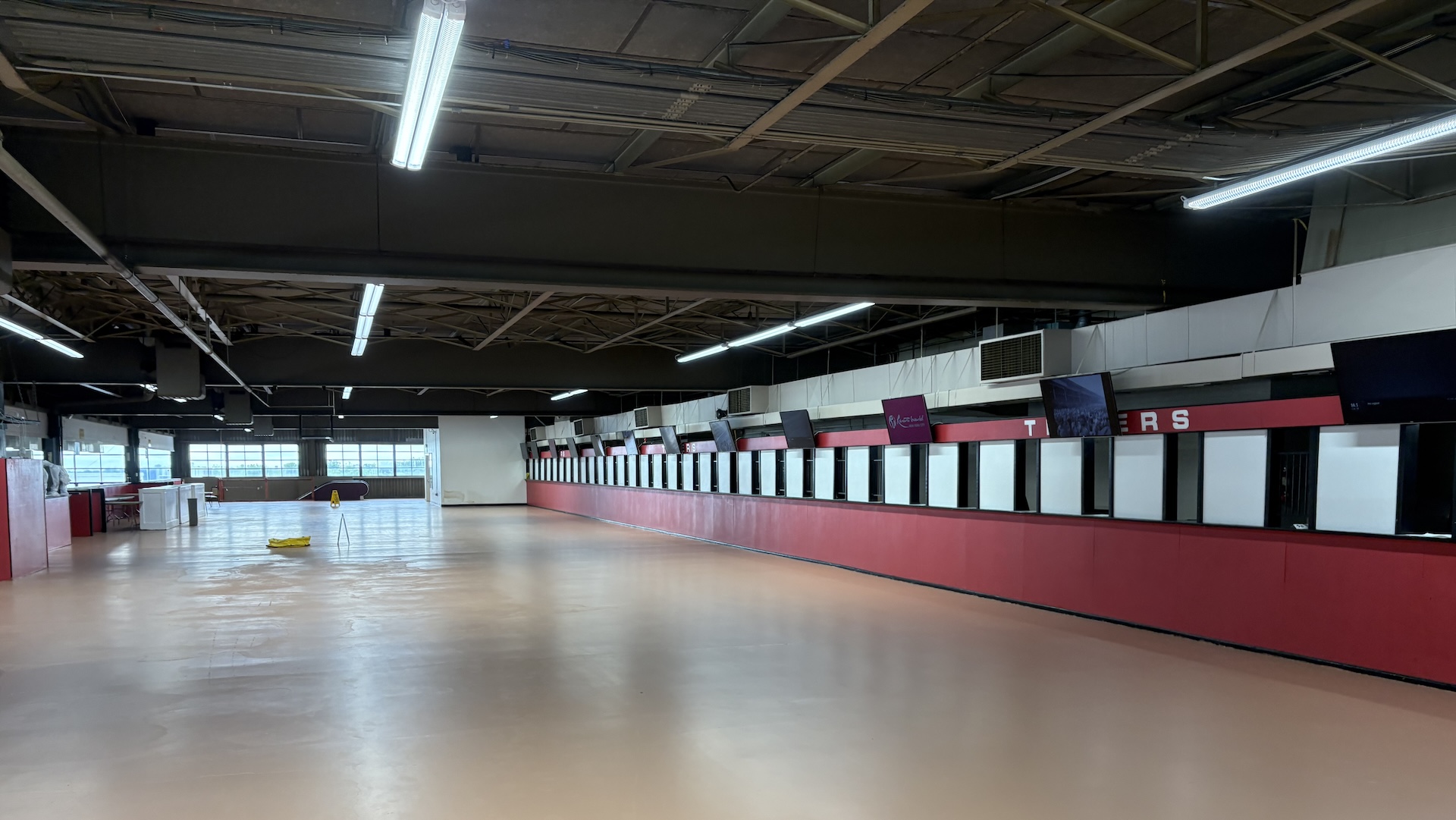
"Growing up, my family wasn't into horse racing or any kind of gambling, so I think maybe I've been to one other track," Sean said. "We came out to Aqueduct because it feels like a big New York City cultural event. Today is a perfect day for that. To be honest, though, I thought it would be way more built up. It’s pretty spartan out here."
Sean and his friends lasted three or four races, tops.
Later in the day, Harri C., 70, saw me taking notes and bombed over to let everyone within earshot know what's up. A retired garment industry worker and cab driver originally from Guyana, he said he's been at the Big A every race day for 40 years—unless some other damn thing like a wedding gets in the way. He pointed toward a picnic area to mark his time at Aqueduct.
"You see that big tree standing there all by itself?" he said. "I remember when they planted it. It was eight feet tall, and now look at it. Beautiful. I hope they build around it, but I don't trust them."
Harri was dismayed not just at Aqueduct's impending death, but at how little anyone seemed to care about it. "I'm going to say something controversial, but one reason they're closing this track is because Caucasians stopped coming," he said. "When I first started coming, it was packed with white people, but when they left? When Aqueduct became mostly black and brown, they stopped caring. They disregarded us, even though Jamaicans are their best customers."
Harri told me that in times of need, Aqueduct became much more than just a track for underserved South Brooklyn and Queens communities. In the immediacy of Hurricane Sandy, it was an evacuation center where Harri brought his wife, daughter, and two grandsons after his Canarsie home was flooded out. In the aftermath of the storm, it became a Red Cross mobile feeding kitchen and relief staging area. In April of 2020, the Aqueduct parking lot transformed into a drive-through Covid testing center and, the following January, a major vaccination site providing more than 180,000 doses.
"They could build a convention center in the parking lot and keep running in the winter for us," Harri said. "I don't care what the hell is all about Belmont—this is our place. A lot of my guys out here are crying, literally crying, bro. It's beautiful like that tree. Aqueduct closing sucks."
Race 4: $2Win 2, $4ExBx 3-7, $3Tri 5-3-4
(Won $0) – $13
One thing Aqueduct was always known for is the quality of its tracks. The powers that be let the facilities slowly deteriorate, but the tracks were never neglected.
"In 1962, at 19 years old, I ran [my] first race in the United States at Aqueduct and I won," said legendary jockey Ángel Cordero Jr., owner of 7,057 victories, six Triple Crown races, and around $165 million in purse earnings. In 1988, he earned the honor of being the first Puerto Rican inducted into the Racing Hall of Fame.
"Aqueduct was where I spent most of my time. It was a special place with the greatest surface I ever rode," Cordero told me. "The grass was good, but the dirt? It was so consistent, no matter what changes they made. It’s the best track I ever rode on. From the time I started through the '80s, the place was packed, so we had $100,000 purses. It used to take forever to get out of the parking lot just to get home, and so much traffic."
The love Cordero has for Aqueduct must definitely run deep, because it's also home to two of the worst days of his life. On March 8, 1981, in the fourth race, Cordero's mount Highfalutin stumbled and fell ("without apparent reason," according to the Newsday report), throwing the jockey, who was then stepped on by Nolle Pros. He ended up in a Long Island ICU with a bruised liver and fractured tibia, which kept him out of racing for six months.
That was minor compared to the injuries he sustained on Jan. 12, 1992, in a four-horse pileup. Cordero suffered life-threatening injuries after falling off Grey Tailwind into a strut supporting the inner rail. After doctors removed his spleen, he was in the hospital for 31 days and retired. Although Cordero later made an ill-considered return to racing in Puerto Rico, he never ran again at Aqueduct. Nobody would fault him for wanting to light the match that burns the joint down, but that's not how Cordero sees it at all.
"We're losing the best surface in America. It was my home track, the place that helped me raise my kids," he said. "I already miss it. To me, Aqueduct is nothing but happiness."
Race 5: $10Win/Place/Show 5
(Won $0) – $30
I placed my largest bet of the day on … well, not a sure thing, but the only horse owned by an industry stalwart I've interviewed in the past. "King of the Pick Six" Steven Crist retired in 2016, after a 35-year career as a transformative handicapper and writer, and now owns a dozen horses with two partners. I had a great feeling about Deacon Blues prancing about the paddock. No, I am not a Steely Dan guy.
For this one, I watched up close from the rail. Deacon Blues didn't do the dirty work. I took a bath, but it was still the most thrilling race of the day as the 7-4-8 horses (21-to-1, 5-to-1, 10-1) came in, paying $44.16 to win and $1,533.80 on the $1 trifecta. Three days later, I caught up with Crist to ask about no longer having hooves on the Aqueduct ground.
"As a reporter, I was at Aqueduct a lot, but I also went to cover the Derby horses in Florida and Kentucky during winter, real hardship assignments," he said. "The three years Belmont has been closed for renovation, we've been running horses at Aqueduct 10 months out of the year. It's more Aqueduct than anyone's ever had. All of us who endured it should get commemorative pins or something."
Like Cordero, Crist isn't looking forward to a future without Aqueduct's well-groomed track. "Belmont is going to have a synthetic track, which I think is an abomination. It's not just losing Aqueduct, either. The $450 million new Belmont is going to look like a space-age airport, no ivy or red brick in sight. If you're a horse racing history guy, it's been a lifetime of shuttling between three tracks. It's going to be awfully strange cutting it down to two. Our world is changing, but I also don't do the full Saratoga stretch anymore, either. I'll day-trip a few times, but I'd rather place bets at home in my bathing suit."
Race 6 and 7: No wagers placed
After the severe whipping in the fifth, I decided to take a break from the ponies to make it through the last race on my $132 budget. A cold beer, a hot dog, and a battery recharging beckoned. I eschewed Longshots, the classy windowless, air-conditioned, $10-cover charge upstairs bar (it's staying open for the simulcast handicappers), and went to the only other option: Silks, a ground-level oasis rife with track lifers. It's a place where, between races, a regular will tell the burly Irish barkeep that "my scotch-and-water got into a fender-bender out there." The drink was instantly refreshed, on the house, exceptional gratuity allowed.
At Silks, I chatted up two retired union electricians, both of whom told me their Aqueduct origin stories. While horse racing doesn't really allow for the participatory aspects of playing sports as kids, or even rooting for the local team in the same way, love of the game still boils down to family and friends—just with money on the line.
It was the day before Skip W.'s 74th birthday, and he was in a fun-loving, garrulous mood. He's the Silks' resident raconteur, one of many guys—and it was all guys—who all know each other, bet the machines on the wall, and keep the drinks flowing at a respectable but not troubling pace. Skip juggled multiple horse racing conversations, including one about his earliest days at Aqueduct, in 1972 if his memory serves.
"So I'm hanging out with my buddy Paul, and it's the last race of the afternoon," Skip said. "I got $1.80 left and I tell Paul, 'Lend me 20 cents, so I can lose what's left in my pocket and call it a day. I'll split it with ya.' I hit two triple-straights, long odds, paid $500. I had to give Paul $250 for two dimes—the best investment that bastard ever made."
Tony's love affair with Aqueduct, a place he gets a kick out of because of its "two-dollar bettors, salt-of-the-turf crowd," also began in 1972. At 12, his father brought him along for the first time. Tony said his dad loved horse racing but was smart about it. He always set aside a few hundred bucks in January, and if it ran out, he didn't go back to the track until the following year.
"I brought like $5 and bet $4 of it on the first race, and lost," Tony said. "I learned a life lesson, what Dad said: 'You'll never beat this game.' But then I proceeded to pick the winners in the next eight races. My father can't believe it. He asks who I like in the ninth and gives me an extra dollar to bet. Horse wins at 18-to-1. Dad is going crazy: My son's a genius! I won $36, but he put $50 on it, cleared enough cash to hit the track for the rest of the year. That's how I got hooked."
Not everyone is as sentimental about Aqueduct. The bartender, who admonished a customer trying to order from the opposite side of where he was sitting—"Come down to this end of the bar, I'm union, I don't walk"—said Silks closing was no big deal. "I work at Belmont and Saratoga, and these guys always follow me wherever I go."
A 25-year ticket window employee in blinding pink lipstick gave me a thumbs-down as to the Aqueduct clientele, but turned it into a thumbs-up for the Belmont bettor. She's working Longshots during the upcoming Saratoga stretch, and going to the new Belmont track when it opens in September. "We got people here who just hang around all day doin' nothing," she said.
I wanted to probe for personal anecdotes, but as we began to speak, a man started verbally abusing her over a messed-up ticket. It required her to "reset the machine," which she repeated multiple times to the aggressive counter jerk before storming off in a huff. I never got her name, but fair to say she won't shed tears come demolition time.
Race 8: $1Super 5-2-9-7, $2TriBx 1-2-3, $10Win 5
(Won $0) – $23
There's a constant drumbeat about the demise of horse racing as a sport, a book-length subject too rich for our purposes today. However, I'm curious if Aqueduct shuttering means anything specifically substantial in the bigger picture, beyond the end of a long, mostly glorious Gotham era. I reached out to David Hill, one of the best writers on games of chance going, and author of The Vapors, a fantastic history/family memoir about the mobbed-up scene of his hometown of Hot Springs, Ark. Hill is working on a new book and hosts a podcast on the theme that found him yakking out in Queens not long ago.
"On the podcast, I discuss gambling-themed books with interesting people," he said. "For the episode covering union organizer-turned-horserace handicapper Len Ragozin's memoir The Odds Must Be Crazy, I had Ryan Goldberg meet me at the track. I thought it would be cool to do the interview with Aqueduct ambiance. It did not disappoint.
"The energy was so fun, the background noise of people hooting and hollering in multiple languages, both in anger and ecstasy. I got everything I hoped for out of recording there. It's a totally different energy than at a boutique destination track like Saratoga, a time capsule to the turn of the 20th century. Aqueduct is my favorite place to take out-of-towners for a true New York City track experience. It also offers a chance to step back in time, but more like to the mid-70s."
As for the death of horse racing, Hill isn't totally buying it. "I've been hearing the sport is on its last legs for a quarter-century, and I've always been skeptical of that idea. Overall right now, horse racing is in a great place," he said. "Casinos have helped, there's always some cable channel simulcasting races 24/7, and the Triple Crown is an enormous event. The Kentucky Derby just had their largest TV audience ever and a handle of $340 million. The question is whether there's a place for a workaday track like Aqueduct with a few horses in any given race and a $15,000 purse.
"The sport suffers in America because we have too many tracks, too many races, and frankly too many horses. It's hard because a lot of people make their living at the smaller lunchpail levels of the game, so this is my long-winded way of saying contraction will make the sport of horse racing better. As a hardcore sicko who enjoys any and every opportunity to spend the day at Aqueduct, it pains me to say so."
Or, as Crist succinctly put it, "I have real sadness about Aqueduct closing, but I can't stand up and argue with a straight face [that] we need two racetracks within a few miles of one another anymore."
Race 9: $3Tri 2-3-4, $5 ExBx 5-8, $5Win 2
(Won $18.35) – $18
Hill is right: There’s an undercurrent of scuzziness and malevolence in the air, mixed with the deep Queens accents. Even if you never set foot in the joint, I bet your mind can easily storyboard the 2020 $284,000 Aqueduct heist with two gunmen in surgical masks, a security guard on the inside, bags of cash, and a bunch of employees forced into a closet without their phones.
Longtime character actor Joe Pantoliano filmed a couple of scenes at Aqueduct when he worked on The Sopranos. The track served as the setting for Pantoliano's doomed character, Ralph Cifaretto, to cheer on his horse Pie-O-My, through the windows of the third-floor restaurant alongside Tony Soprano. Pantoliano was familiar with Aqueduct well before those scenes were shot, though.
"First thing to know is I come from a long, long line of degenerate gamblers," he told me. "I grew up poor in Hoboken, but my mom used to work for three bookies, so she would take us to Long Branch in the summer because they needed her to keep running the numbers. The Italian lottery as we called it, down at the Jersey Shore.
"As for Aqueduct, my father Monk was a foreman at Standard Brands. When I was 9 or 10, I was told my mom got a call saying Dad had a heart attack on the factory floor. Turns out that's not what happened. His white-collar boss Larry—I've always remembered his name was Larry—would have Monk make the 30-minute drive to the Big A, catch a few races, and get back in time to punch out. Dad was getting paid to go to the track. One day, they had a horse come in, Dad is screaming like you do, has a heart attack, and falls to the ground. Larry drags him to my father's car, back to the factory, up to the sixth floor, and drops him on the floor, shouting 'Holy shit, Monk had a heart attack!' It was serious, Dad was close to death, but Larry didn't want anyone to find out they played hooky. Of course they found out. Monk and Larry got fired."
Pantoliano witnessed his second insane Aqueduct story firsthand, but it needs a bit of setup. His mother left Monk—although they never actually divorced—for Florio, a third cousin who became Joe's stepfather after a 15-year stint in Atlanta on federal drug trafficking charges.
"Flory was terrible," Pantoliano said. "He lost a lot of money at the track, money we didn't have. At 12, out at Aqueduct, I watched Flory hit his head on beams, steel beams, when his horses didn't come in. Banging away, cursing Jesus Christ, blaming God or the Son of God, for losing. It was fascinating that someone could be that stupid. After that, I don't know if I ever went back to the Big A until we shot the [Sopranos] scenes there. I'm sure I told the guys that story with a laugh, but it was a very traumatic moment for me."
Before hanging up, Pantoliano added, "You should talk to Michael Imperioli; he's an amazing handicapper who really knows his shit."
(I did not get a chance to talk to Christopher Moltisanti, horse-knower.)
Race 10: $3Super 5-8-7-1, $3ExBx 8-11, $2Win 4
(Won $0) – $11
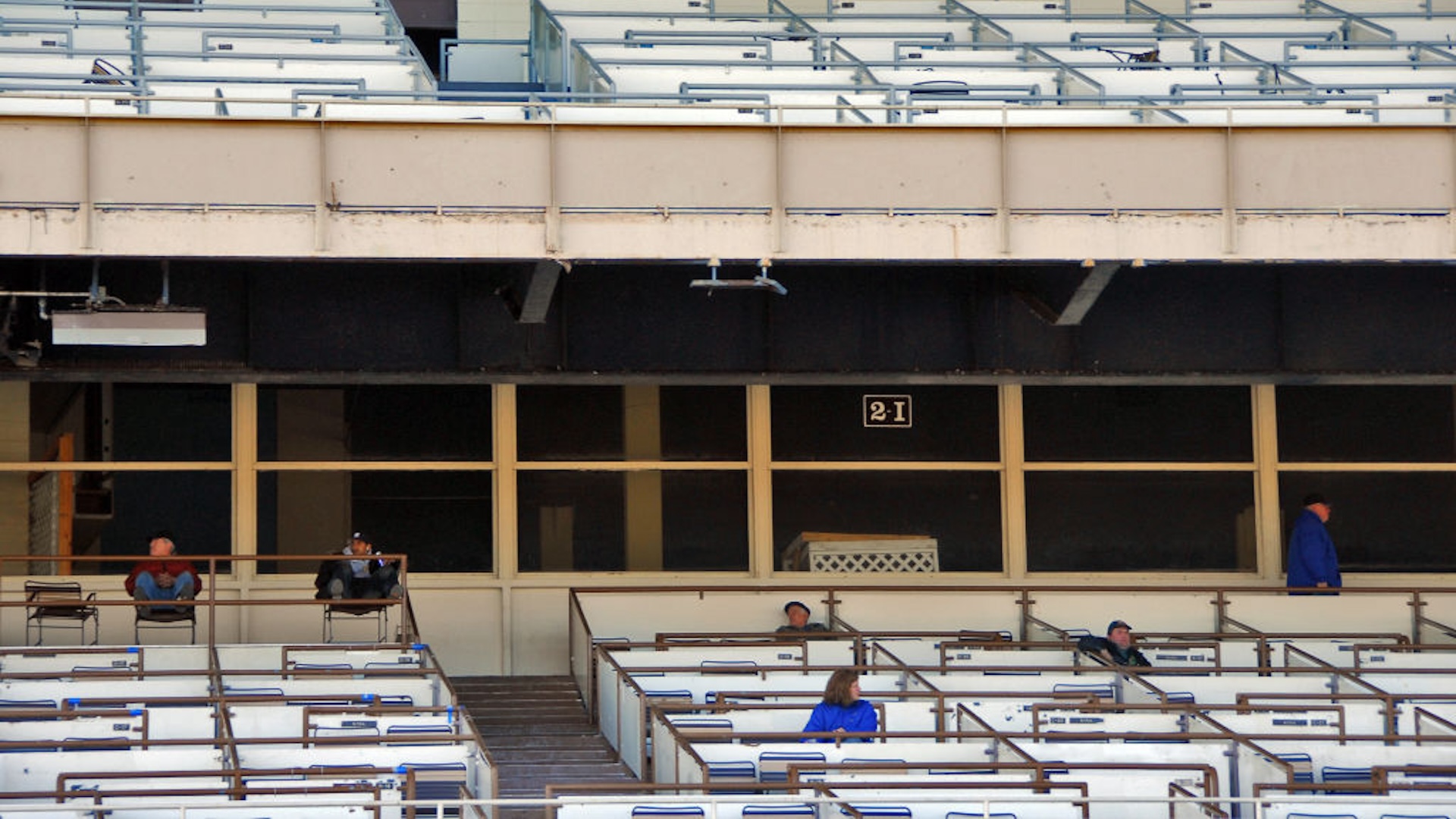
As the day wore on, the crowd, such as it was, dwindled down to the real diehards. I sat down next to an older guy in his work shirt, sitting alone at a table close to the rail, with a wooden clipboard and a stack of papers. I wanted to hear from someone fully devoted to the game, and Erskine, 81, certainly was. As he's done countless times before, the Barbados native who calls Brownsville home came straight from his job cleaning offices at JFK. All to suffer through his favorite pastime.
"I know some of the guys inside, but they're all drunk now, making too much noise," he said. "I like to take it easy. If I start drinkin', I can't concentrate.
"I don't even bring my wife to the track; then we'd have two people losing money. I've lost a lot, man, thousands over the years. But Aqueduct is my thing. I get the bus after work; 20 minutes later, I catch the late races. For Belmont, I'm afraid I have no choice but to buy a car. Then there's gas and insurance, parking—oh boy, there goes more money."
Race 11: $2Win 2, $7ExBx 3-7
(Won $0) – $16
It was getting late, Game 5 was coming, and I could've walked away down "only" $113.65, but I'd come this far with Aqueduct. What the hell—let it ride. Just a few of us stragglers remained. As the 6:19 p.m. post time arrived, shadows crept in, a light breeze picked up, and the brilliant sky filled with big puffy clouds. A few hungry pigeons even showed up. I boxed the orange and blue horses at $7, hoping for some Bing Bong luck. But of course, Aqueduct isn't Madison Square Garden. Tizlwary and Karsten did nothing for me.
I walked in with $132, and walked out with 65 cents. Just this once, I joined in traditional protocol, tore up my pari-mutuel tickets, and let 'em fly, a farewell contribution to the sucker-tape parade. For the record, Sir Oscar paid $4.90 to win after running for the local roses in my final race.
Leaving the facility, I passed an energetic group of dudes passing a bottle of rum and a spliff, firing up a "Let's go Knicks!" cry as they prepared for the madness of the night to come. Walking to the train back to Brooklyn, I stopped, turned around, and said goodbye to the charmingly retrograde jockey-and-horse mural. The brief pause put me in mind of an Ol' Blue Eyes ode. Soon enough, all that will be left of Aqueduct is the memories, and maybe the occasional passerby who will say, "There used to be a horse track here."