

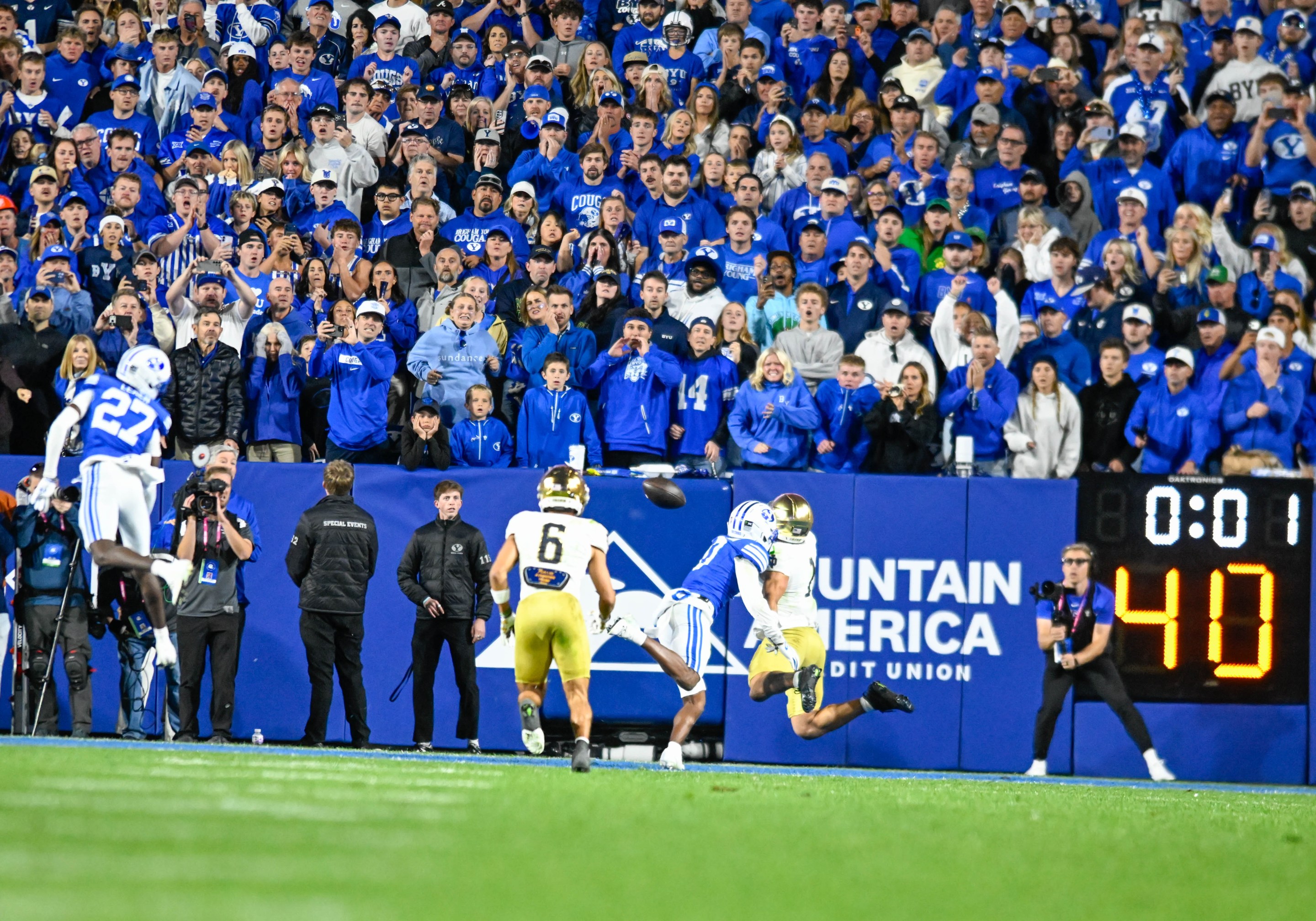
Nobody got laid at BYU last night, but it looked like a fun party all the same. The eighth-ranked Cougars hosted the No. 2 Notre Dame Fighting Irish in the big primetime slot on Saturday, and they stayed undefeated by squeaking out a 28-24 win. There was some fourth-quarter distress when BYU threw an interception just after surrendering their lead. But quarterback Bear Bachmeier—who wears No. 47 because he says he embodies a "fullback mentality"—took advantage of an Irish three-and-out to pilot a go-ahead drive that concluded with less than two minutes to play. The defense still needed a stop, but they allowed the Irish to creep all the way down to the eight-yard line before mustering an incompletion as time expired. The Mormons flooded the field, and a program that barely missed last year's playoff celebrated a signature win.
But wait. The top story from this game on Sunday morning was not BYU's epic triumph, but the fact that the officials apparently ended the action too early. In a passive-voice statement released by the Big 12, the conference said that, in actuality, "it was determined that time remained on the clock when the ball hit the ground and the play was incorrectly cleared by the replay officiating crew" on Notre Dame's final snap. "The Conference will conduct a complete review of its end-of-game officiating process in advance of next week's games," the statement said. The crew's supposed error means the Irish should have enjoyed one more shot to gain eight yards and avoid defeat, instead of dodging the most sober field-rushers in college football history on their way back to the locker room. The fact that we know this, I think, is supposed to be progress.
The Big 12 admitting to this mistake caps a whole Saturday of college football officiating arguments—like whether or not Florida State deserved a touchdown at the end of their overtime loss to Miami. But most strikingly, BYU-ND's wrinkle in time is the mirror image of the unforgettable clock controversy that allowed Michigan an extra second to find a miracle against Western Michigan in Week 1. Saturday's ending will likely garner less consternation for a couple of reasons: This one doesn't force fans to disbelieve their initial conclusion, and it was perpetrated on a significantly less sympathetic victim. But both WMU's rug-pull and Notre Dame's belated "oops, our bad" require some absurd thinking. Had the fourth quarter really been timed flawlessly up until the end? Is that extra second given in retrospect truly an objective unit of time that belonged in the game? The end of the Michigan-WMU fiasco proved that the average fan cannot know these answers for sure. But probably not. In reality, people only gain awareness of these particular end-of-game hiccups, and not others, because they happen at moments that demand the most scrutiny.
I lose respect for any adult who gets legitimately angry at a referee—i.e. every single local radio color commentator in this sport—so my advice for dealing with this kind of screwiness is to accept it and move on. But the leagues that have decided they can live with (or actively encourage) sports gambling have put themselves in a bind. For betting to function smoothly, there needs to be a widespread belief that the games aren't fixed. In order to avoid undermining that faith, sports have moved in the direction of extreme transparency, where more and more types of officiating decisions can be second-guessed—balls and strikes, out-of-bounds, red cards, charging, time on the clock, and so much more. Some of these additions have worked better than others, but together they've permeated the games to the point that "rules analyst" is now a de rigueur position in most major broadcast crews.
It's funny that the all-seeing surveillance that surrounds every step a player takes hasn't done more to decrease the amount of time fans spend arguing over calls. The controversies are no doubt more granular than they used to be, more informed than the man in the 500 level shouting "You bum!" because he knows that was pass interference. However, they don't seem to be going away anytime soon, which means that all this review protocol is at least a partial failure.
But what would success even look like? Some fans, I know, want to feel totally satisfied with the officiating accuracy. Others, however, might accept some slips if it meant watching sports felt a little less like serving on a jury. Everyone will have different lines, and different levels of emotional reaction to blown calls. But personally, I'd love if we could all just loosen up a bit. Screw the gamblers; this is supposed to be fun.