

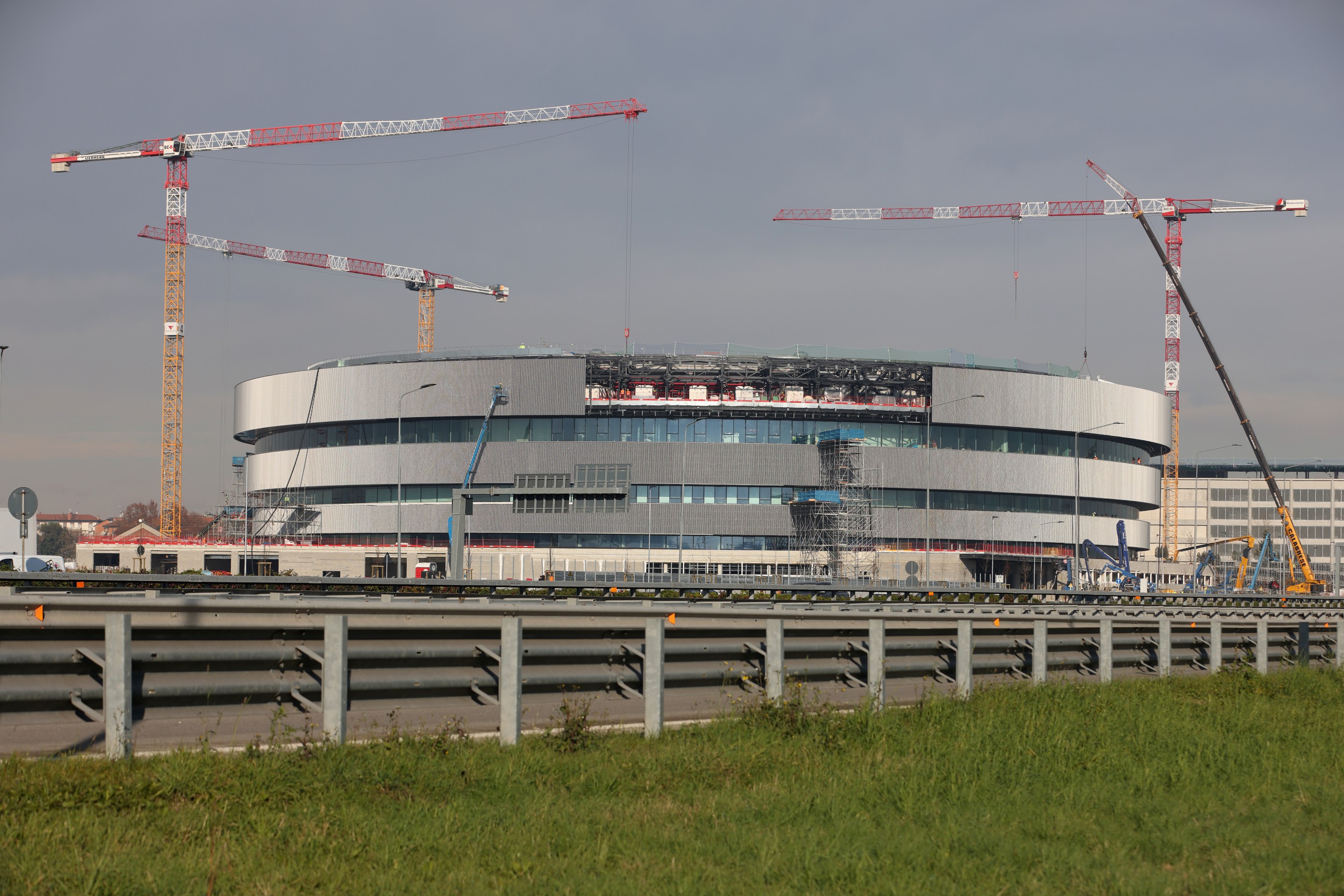
It is 64 days until the first hockey game of the 2026 Winter Olympics in Milan and Cortina d'Ampezzo, Italy, and the main hockey arena is still under construction. A test event, to determine whether the ice is good enough to play on, has already been pushed back. While providing plentiful entertainment for the region's Umarell, the construction delay is proving stressful for everyone else, given that, as a top organizer said last week, "there is no Plan B." Now comes the news that even if construction is completed, the ice surface—usually significantly larger for international play than in the NHL—will be smaller than NHL rinks.
The league's relationship with the Olympics has been fraught for a while, but 2026 will see NHLers compete in the Games for the first time since Sochi. So it sounded perhaps like a squeaky wheel seeking some grease when Gary Bettman complained way back in 2023 that construction hadn't yet begun on the 16,000-seat Santagiulia Arena, in Milan's outskirts, which will host half the men's and women's tournaments and most of the marquee games. But Bettman was right to be concerned. When league officials toured the site this past August, they saw a complex still under heavy construction. Ground hadn't been broken on a planned practice facility. They hadn't yet even laid down roads leading to the arena. That's Italian excellence in action; historically, most Olympic venues are opened and tested a full year in advance of the Games.
More recent photos, like the one atop this post, show a building that from the outside looks mostly but not quite done; it's unclear how far along the barn's guts are. But the ice itself has become the story. Team Canada assistant coach Pete DeBoer revealed this week that the rink "looks like it's going to be smaller than NHL rink standards, by probably three or four feet." DeBoer continued: "I don't understand how that happened."
NHL rinks are a uniform 200 feet by 85 feet. IIHF rinks are allowed some leeway in width, but past Olympics have used significantly wider ice surfaces of 60 meters by 30 meters (196.9 feet by 98.4 feet). The Athletic reports that at Santagiulia Arena, the ice will be 60 meters by 26 meters—essentially the same width as an NHL rink, and three-plus feet shorter.
The international game is traditionally different from the NHL game—there's less hitting, and more speed and skill. Rosters are usually constructed with this in mind, with smaller, speedier skaters getting the nod over more physical players. The smaller Milan ice will absolutely influence both roster construction, and how the games are played and officiated. Team USA GM Bill Guerin is already talking about bringing the big boys.
"I just don’t think you can put into words how tight those games were [at the 4 Nations Face-Off, which used NHL rinks]," Guerin said. “How little room there was to operate. And how well these elite players can check. In NHL games, they’re not always counted on to do that, but when they are, they can. And not everybody can play in those situations. No matter what their offensive gifts are, if you can’t check, it’s probably not the tournament for you."
Of course, this is all assuming the building is actually completed in time. A test event initially scheduled for December has been pushed back a month. The women's ice hockey tournament will be played before the men's (and will start on Feb. 5, even before the Opening Ceremony), so they promise to suffer the brunt of any early hiccups. There is still no target date for completion. When asked for more frequent updates, the chief games operations officer offered this less-than-reassuring statement: "There are daily updates in the sense that our team is there working every day." Italy is so funny; I wish it were a real place.