Well, what is it? According to the official 2026 MLB rules, a strike—in isolation, absent swings and foul tips—is called when "any part of the ball passes through any part of the strike zone." The strike zone is duly defined, in a long-winded and broadly unpunctuated phrase, as "that area over home plate the upper limit of which is a horizontal line at the midpoint between the top of the shoulders and the top of the uniform pants, and the lower level is a line at the hollow beneath the kneecap," which "shall be determined from the batter's stance as the batter is prepared to swing at a pitched ball."
The definition, handed first to human umpires, is filled with human imprecision. Reasonable people may disagree on the exact location of the "hollow beneath the kneecap." How precisely middle is the "midpoint," often defined by fans as the letters on the jersey? Would a given batter's midpoint vary over the course of a season should they start adhering to high-waisted fashion trends?
With the implementation of the Automated Ball-Strike (ABS) system, these ambiguities have been quashed. After a rigorous independent height-measuring process that shrunk batters across the league, ABS now shirks the minutia of calf-to-thigh proportions in favor of defining the top of the strike zone at precisely 53.5 percent of a hitter's height, and the bottom at 27 percent of the player's height. So, that's that. While a human umpire may use knees and torsos as reference points, a true strike is called when any part of the ball passes through any part of the strike zone, which is defined as the area over home plate within a range between 27 and 53.5 percent of the batter's height.
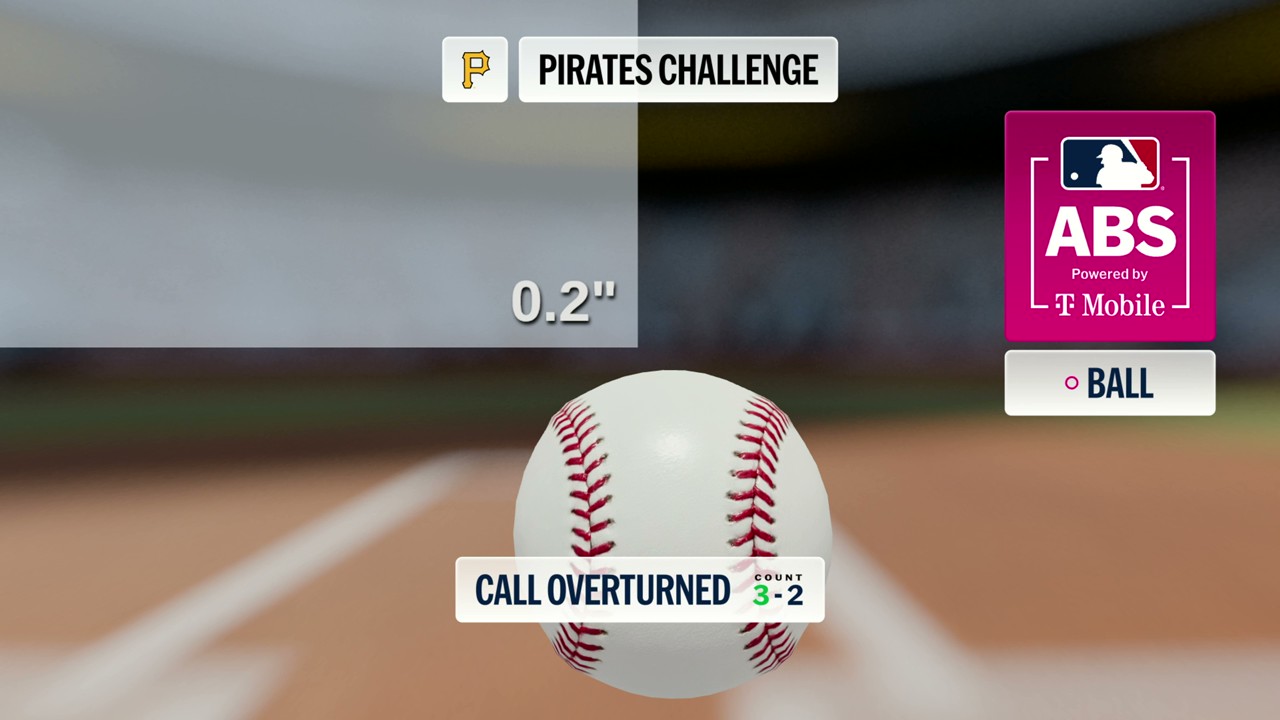
But even extremely accurate machines are not exact. According to MLB, the ABS system's margin of error is approximately one-sixth, or 17 percent, of an inch, helpfully visualized on a baseball here. When called to task, ABS will still overturn or confirm pitches within that margin—and though ABS's most moral and substantive use case is in overturning obvious, potentially game-altering mistakes, the "use it or lose it" nature of the ABS challenge system means that an outsized number of 50-50 calls will still get challenged, so long as the game state is tight enough to warrant it.
As far as processes go, deferring to ABS in all instances is not necessarily materially flawed. It is not true that a human would somehow be more accurate within a sixth of an inch; while ABS renders parts of the strike zone fuzzy, baseball players and umpires have been operating with an even fuzzier strike zone for decades, and games have been decided on slivers of inches. But always deferring to the machine—either pretending as though it is absolutely correct in every circumstance or knowing that it is possibly wrong, and accepting it anyway—feels philosophically wrong.
ABS has reminded us of two things, then. First, that the strike zone is not, never has been, and likely never will be truly defined. And second, that if there are errors to be made, many humans would generally prefer that a human make them.
In 2014, Vanity Fair published a William Langewiesche article on the crash of Air France Flight 447, which killed 228 people in 2009, entitled "The Human Factor." The crash, as Langewiesche argues, was a wholly avoidable accident spooling primarily from the increased automation of flight. In part, so long as the plane primarily flies itself, pilots do not need to be as skilled as before, which can render them unprepared when faced with minor problems. But far more compelling is Langewiesche's elaboration of the ways in which the automation and teamwork to fly modern, "fourth-generation" planes—systems constructed to ensure safety—contributed to the crash.
Langewiesche acknowledges the statistics: The implementation of fourth-generation airplanes has drastically decreased the accident rate of planes. It is an unequivocal success. There is no statistical justification for going back. "No one can rationally advocate a return to the glamour of the past," Langewiesche writes, referring to an earlier era in which planes themselves did much less of the work of keeping themselves safely aloft. At the same time, Langewiesche, a pilot himself, seems to struggle to accept that as complete truth, so long as pilots like the ones on Air France Flight 447 can make elementary and fatal errors rooted in overreliance on automated systems they don't understand. No matter the numerical success of modern airplane safety, he mourns a time when human beings still flew planes.
It is a striking tension. In statistical terms, automation may be the correct option, but it will also create new questions or incidents that would not have occurred during a previous regime. Or, to quote one of many of engineer Earl Wiener's laws that Langewiesche cites in the piece, "Whenever you solve a problem, you usually create one. You can only hope the one you created is less critical than the one you eliminated."
Sometimes the new problems are hard to accept. While few lives are at stake during a baseball game, there are parallels with increasing automation across sports. In soccer, the presence of the Video Assistant Referee (VAR) can discourage linesmen from making offsides calls in real time. In tennis, if the electronic line judging system malfunctions, it can generate new and confusing rules situations.
MLB mitigates the worst of these issues with its current challenge system. Because they are still making the initial calls, umpires are not necessarily deskilled by the addition of ABS; in fact, the challenge process may be humiliating enough that it behooves the umpire to try her very hardest when flying the plane. If the greatest issue with the modern ABS strike zone is that of margin of error, or needing the reminder of what company ABS is sponsored by, then baseball enjoyers are lucky. There is no part of the new game that is functionally faulty; all fans and players and umpires have to do is to come to terms with a game that now runs a little differently.
One of those differences is very simple: It is a different strike zone, even from the ones used by community umpire evaluators like the (now infamous?) UmpScorecards, which solicits strike zone dimensions from Baseball Savant. To use a specific example, Bryce Harper's current strike zone is set with an upper boundary of 3.26476378 feet, and a lower boundary of 1.647637795. But go to an arbitrary pitch thrown by Edwin Diáz, then with the New York Mets, on April 29, 2022, and Harper's strike zone instead spans 3.24 and 1.63 feet. On top of being a fun exercise in necessary significant figures, the differences show that the top of Harper's strike zone was raised by roughly three-tenths of an inch, and the bottom was raised by roughly two-tenths.
The measurements of yesteryear are not wrong, but are now definitively outdated; the metrics used to define a strike have changed. The old measurements also aren't off by very much, at least by a human standard, though they are just outside of the machine's margin of error. And even with MLB's minimally invasive ABS procedures, it is necessary to adapt to caring about what the machine cares about.
One of the more philosophical changes is that the machine cares all the time. It has been taken as a given—justifiably so—that umpires are more likely to call balls on 0-2 counts, and call strikes on 3-0 counts. It is, or was, a part of the game. In the regular season, it was, depending on one's comportment, easy enough to shrug off such a pitch. ABS cares not. Neither, for that matter, do batters, who naturally care about their statistics (important for arbitration hearings, contract negotiations, awards, and egos) and also, well, winning games.
Philadelphia's Kyle Schwarber recently gave a helpful example of the 3-0 strike phenomenon. With two on and no one out in the bottom of the seventh against the San Francisco Giants on April 6, Schwarber challenged a generous called strike above the zone. He walked, rather than going to 3-1 in the count. Later in the inning, he would score the game-winning run. But the best part of the Schwarber challenge is that he, like some batters before him, immediately began to shed his protective gear before the ABS challenge began to play.
That is the ultimate coup of the ABS system. It tries to fix the problem of human error but necessarily does so imperfectly, by making the fix limited and challenge-based. Perhaps an amendment to Weiner's law is that any imperfect fix can open up the potential for something more, reshaping long-standing institutions and opening up the opportunity for something new, even something human, to come out of that: New styles of shit talk, relatable umpires, batters really pimping walks, unheard of frontiers of rage and humiliation. Some batter, some day, will challenge a strike on a three-ball count, take off all their gear in anticipation of a walk, and then find they have to strap back in and shuffle back into the box. And isn't that a beautiful thought?