

One of the strangest tales in Icelandic folklore concerns a creature called the Loðsilungur, or the furry trout. The trout, as you might imagine, looks like a fish covered with a white shag of fur, which it allegedly evolved to stay warm in Nordic waters. The people of Iceland, especially the men, knew not to eat the furry trout. If a man did eat a furry trout, he would suffer the unfortunate fate of becoming pregnant and delivering the child through his split scrotum. In the early 1900s, the legend of the furry trout somehow migrated to the United States, where various humorists assembled and mounted furry trouts to gift to unaware museums, a prank that, I think, stands the test of time.
There is of course no such thing as a furry trout, in Iceland or America. But now a country famous for its development of some of the most ridiculous, bizarre, and frankly alarming animals has stepped in with a furry trout of its own. The fish in question is a new species of ghost pipefish called Solenostomus snuffleupagus, named for Sesame Street's Mr. Snuffleupagus, which it resembles quite closely. (One can only imagine how a Philadelphia-based marine biologist might have risen to this naming occasion.)
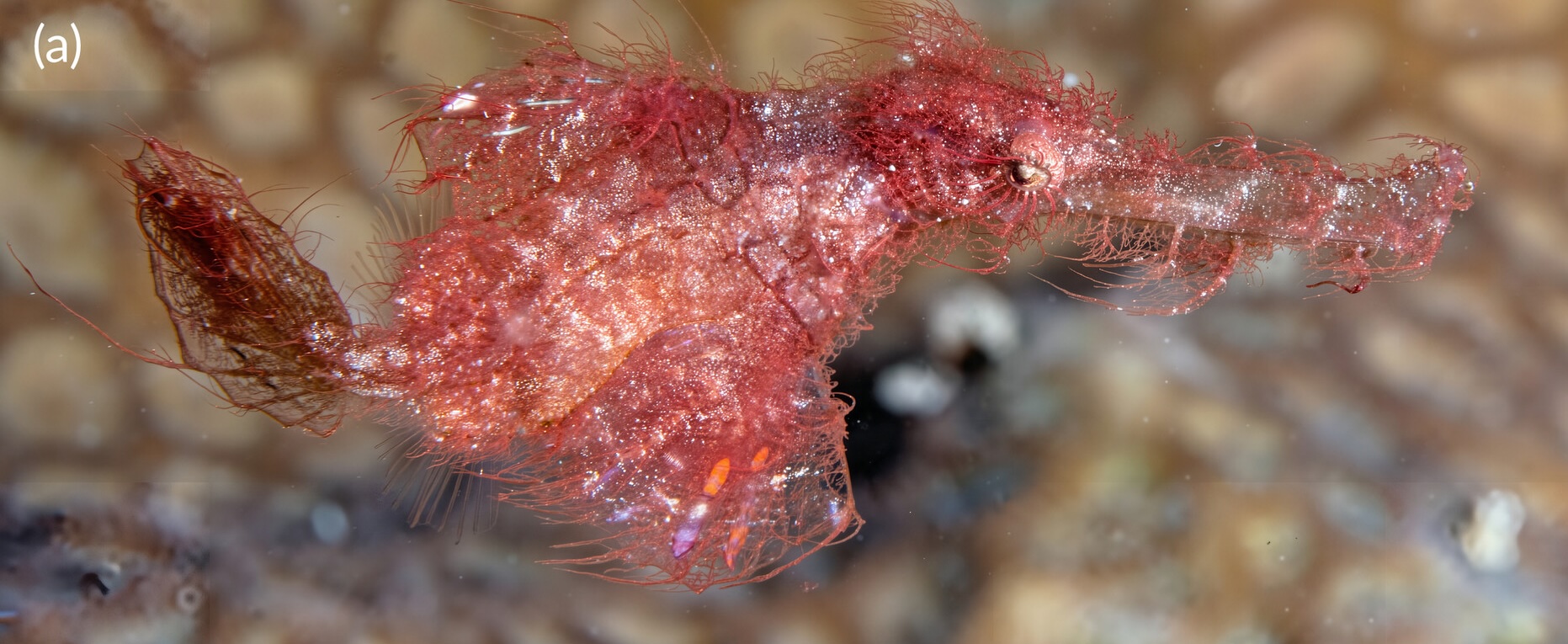
The scientists who described S. snuffleupagus gave it the common name of the hairy ghost pipefish, according to a paper in The Journal of Fish Biology. This fish lives in waters off Australia, which might be the world's most consistently excellent producer of strange animals, such as the platypus and the cassowary. But even by Australian standards, this fish looks crazy.
It is about as long as a matchstick and does the absolute most with the body it was given. If some Icelandic confabulator tried to gift a natural history museum a mounted S. snuffleupagus, they would simply be turned away at the door!
If you are anything like me, you must be filled with hard-hitting questions, such as "Why does it look like that?" and "No, seriously, what's up with that fish?" The answer to these questions is that the hairy ghost pipefish, which is closely related to the seahorse, is simply attempting to blend in. It is mimicking algae, seagrasses, and soft corals. This strategy is called "extreme crypsis," which applied to any animal that truly commits to the bit of camouflage, such as leaf insects and those moths that look like bird shit.
Another question that may have bubbled to the glossy surface of your brain might be, "How did no one notice this damn fish until now?" Well, apparently local divers have been noticing the fish, which is distinguished by its sunset coloration and "conspicuously hairy appearance," for decades. Scientists even collected two specimens of the hairy ghost pipefish off of northern Queensland in the 1990s. But, the researchers explain, the hairy ghost pipefish's resemblance to Solenostomus paegnius, or the roughsnout ghost pipefish, meant S. snuffleupagus went undescribed for years. This makes sense on paper, perhaps. But once I looked up a photo of a roughsnout ghost pipefish, I was no longer convinced. This fish, while certainly strange, is not half as weird as S. snuffleupagus. The researchers highlight some morphological differences between the two species, noting the hairy ghost pipefish's more compact body and larger head crest on the males. But the best way to distinguish among the species is, I think, all the hair.
Unlike the furry trout, the hairy ghost pipefish does not have true hair. The long strands streaming from the fish's body are called dermal filaments. These filaments are what help weedy sea dragons resemble weeds and leafy sea dragons resemble, well, you can guess. But unlike those more statuesque fronds, S. snuffleupagus's filaments cover the pipefish's entire body, giving it a shaggy look. Even the somewhat hairy roughsnout ghost pipefish only has three or four hairy clusters, making them look downright balding when compared to the hirsute S. snuffleupagus.
Also, the fish comes in different colors! Nice.
When the researchers observed the hairy ghost pipefish in the water, the fish drifted just as a gob of filamentous algae might. They swam alone or in male-female pairs, which suggests the species might stick together during periods of mating. And one pipefish was observed patrolling the same area over at least six days, suggesting the hairy ghost pipefish might be a bit of a homebody. Anyway, here are some more of these little freaks.
Surely many more questions will arise about S. snuffleupagus now that the species is finally recognized and more individuals might be photographed. Cloaked in the the aquatic equivalent of a ghillie suit, the hairy ghost pipefish is not easy to track them down. But if you manage to glimpse one, to stare it in the eye amid its tangle of strange hair that is not hair, you would surely be blessed by its strange and unrepentant stare, a fish that knows you could never match its freak.