

As an online basketball fan, you are encouraged by the discourse to consider the Jaylen Brown trade as a matter of asset valuation. One day the Celtics seemed to consider Brown, the asset, as approximately valuable enough to swap for Giannis Antetokounmpo, plus or minus some draft capital. When they didn't complete the trade, it was possible to believe, just for a few minutes, that Celtics president Brad Stevens maybe even considered Brown too valuable for Milwaukee's proposed terms. Then a couple days later the Celtics traded Brown anyway, to the Sixers, for a player a hell of a lot less impressive than Antetokounmpo, and now it seemed like the Celtics viewed Brown, the asset, as worse than expendable: distressed, somehow, and possibly toxic. Naturally there would come an insider tell-all, full of juicy recriminations, to describe how over the course of just a few days Boston went from loving Brown to determined to simply be rid of him, OBO-style.
The whiplash of the trade has hopefully healed enough now to refocus on what the Celtics are doing, not on the market but as a basketball operation. When they won their title in 2024 and seemed poised for a long reign atop the East, it was with Brown and Jayson Tatum as the high-usage core, with a grimly optimized offense, and with a deep bench of complementary role players. They fell short in successive postseasons and were passed in the conference hierarchy by a Knicks team vastly better than expected, to say nothing of a couple of irritatingly young and physically superior Western Conference potential dynasties. Staying the course would've seemed reasonable, but so did a push for Antetokounmpo, a game-breaking specimen still in his athletic prime, whose interior domination could diversify Joe Mazzulla's system, which otherwise is more vulnerable than most to swings in shooting performance.
Now the Celtics have Tatum and Paul George, a 36-year-old swingman whose best days are well behind him, who never scores inside the paint, who has been healthy and available for 60 games just once in his last seven seasons, and who at this stage of his career is suited to not much more than a role player's usage within a balanced offense. It's difficult to work out how the Celtics view this as a meaningful improvement of their title odds, which raises the question: Do the Celtics still view themselves as a title contender?
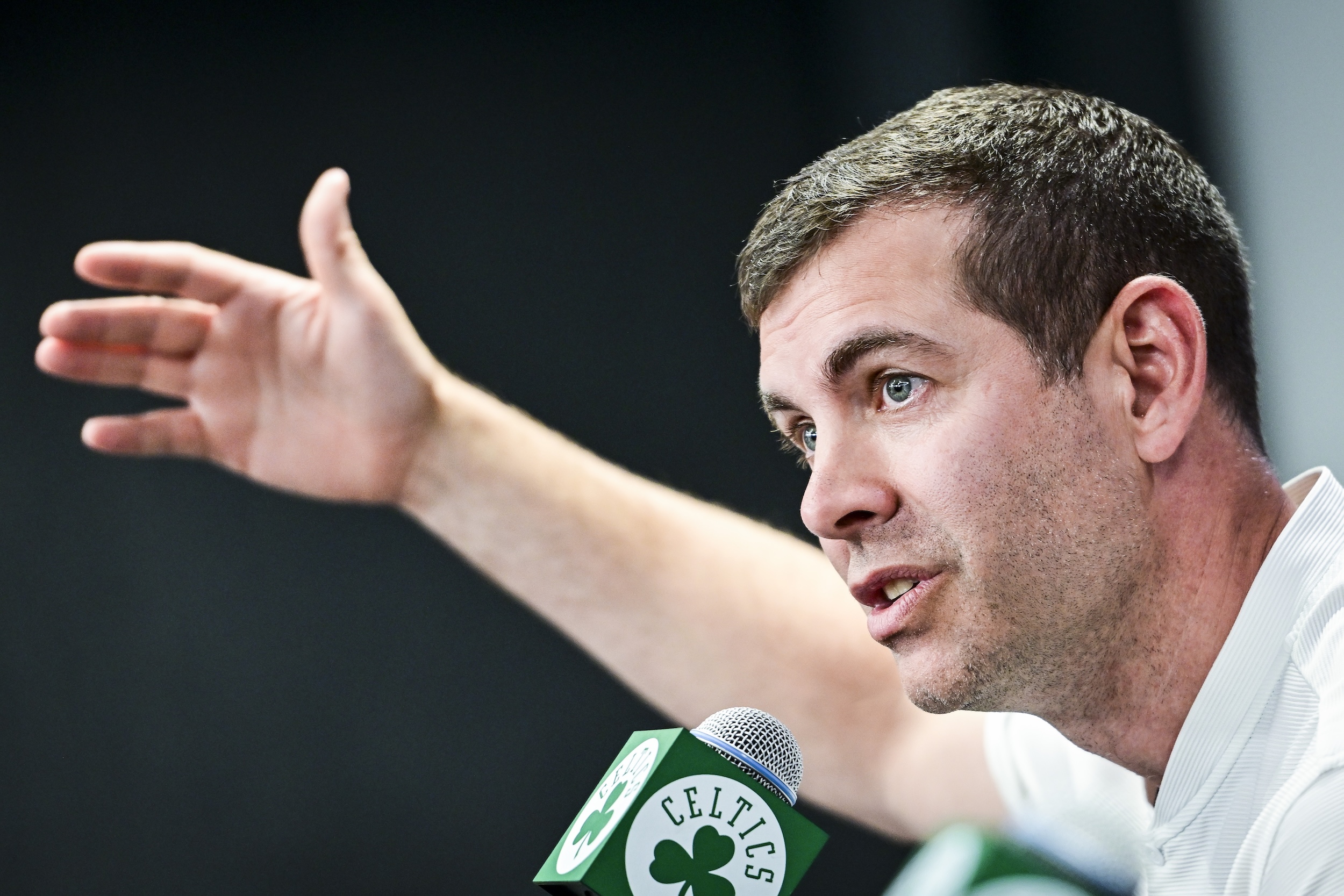
"When I looked at our team and where the league was heading, looked at the way that we've finished the last couple years and at the unbelievable way we've played in the regular season in the last couple years," explained Stevens at a Monday presser, "the path looked a little bit more challenging to me." The trade, says Stevens, is maybe less about straightforwardly fortifying the team for an immediate title push than it is about what ESPN's Ohm Youngmisuk described as "optionality," an awful enough word in any context but particularly gruesome as cold corporate jargon. Part of what makes George attractive, admitted Stevens, is simple contract math. George is only about $3 million cheaper than Brown next season and $4.5 million cheaper the one after, or roughly the cost of a baloney sandwich in NBA contract terms, but the Celtics might be shopping for bargain lunch meat when it comes to filling out their bench, and the fact that George's contract ends a year earlier than Brown's gives them flexibility a couple years from now, when Tatum should still be enjoying his prime years.
But since Stevens brought up Boston's playoff flameouts and the "more challenging" contours of a title push, it's fair to ask whether he believes Paul George plus savings roughly equivalent to a minimum veteran contract will make the Celtics better next season. Is this better for Boston than, you know, having Jaylen Brown, who won a Finals MVP? "We'll find out," answered Stevens, to this very question, not encouragingly. "I think Jayson and Jaylen have had a remarkable partnership where they complemented each other great and have played with other great teammates. And it'll just be on Jayson to continue to grow individually and accentuate the people that are around him now. But what they did together was awfully impressive."
I don't think Stevens is in a position professionally where he can say, Yes, we are taking a significant step back this season and next, but cap constraints, new ownership, and an increasingly grouchy superstar have forced my hand. Because he cannot, instead he is left to pull together an exasperating and occasionally contradictory sequence of maneuvers into an expression of an overarching organizational aim, without the freedom to fully unpack the complexities. Which is how you wind up with a personnel guy who just tried to pair Tatum (30 percent usage, $58 million salary) with Antetokounmpo (35 percent usage, $58 million salary) saying that he swapped Brown for George because it's tough to devote so much money and offense to just two players. "The path looked a little bit more challenging, with 70 percent of our cap and such a high percent of our usage tied into two players," said Stevens, with a straight face, of maybe not having enough room in Boston's rotation for two heavy-use stars. "If you have Jaylen Brown on your team, you should feature him, you should use all those possessions and you should approach things that way. But I think the importance of depth and then obviously, we have to continue to work on ways to diversify our attack overall."
It scans as mildly disingenuous. I can offer only a tepid defense of Stevens, in part because I loathe the Celtics and wish them nothing but pain and failure: Sound logic that could theoretically support, in pure basketball terms, swapping a Kobestan-ish high-use forward for a more analytically upright, Mazzulla-coded one would be justifiably tossed aside for a chance at Antetokounmpo, who when he is healthy can be a Title Window unto himself. Since the Brown trade, it's been rolling around in my head that the Celtics, without intending any unflattering reflection on Brown's overall qualities as a basketball player, might semi-reasonably believe that he and Tatum simply overlap more than they want and together use too much of the ball, and might have reason to believe that Mazzulla's system, which already sings like hell, might actually sing clearer and louder if they sort out that particular congestion. If that's the case, they are probably wrong! And even if they are right in theory, George's brittle and worn-out body is likely to kerplode and leave them stranded well shy of proving their organizational genius. Which, I readily admit, will be delicious for the rest of us.
The Celtics expected to sag out of true contention last season, with Tatum recovering from a terrible injury and Brown left to shoulder too much of the offense. Instead they won 56 games, finished second in the Eastern Conference, and entered the playoffs with enough juice that it scanned as a massive disappointment when they fell in seven games to the at-best half-serious 76ers. Brown had an incredible season, and proved that the Celtics can thrive spamming Mazzulla Ball around a single dominant creator. Maybe that's the model they're pursuing. Maybe it's wrong to think of George as a replacement for Brown, or a meager consolation for missing out on Antetokounmpo. Maybe it's better to think of Brown's replacement as Tatum, and to think of George as a turbo-charged Sam Hauser. In any case, the pressure is now on Stevens, George, Tatum, and Mazzulla to prove that this was not Boston neutering itself in the confused aftermath of a failed courtship, and prematurely ending what not so long ago looked like a blossoming juggernaut.
"Listen, I lost sleep over the fan part of this," Stevens said, acknowledging the anger and heartbreak of Bostonians. "Somebody asked me earlier today, 'Do you miss coaching?' I did this week. This is not for the faint of heart." Stevens could not avoid citing flexibility and draft picks in his Monday presser, bringing to mind the blogger-endorsed but formally under-rewarded Danny Ainge era. The Celtics sustained a hilarious decade-plus of asset collection to arrive at the summit of the sport, with a homegrown core, a convincing identity, and every reason in the world to expect a wide-open period of contention. If Paul George is poor consolation for failing to win Giannis Antetokounmpo, freakin' draft picks will be an apocalyptically poor consolation for sabotaging their own title window. We will indeed find out.