

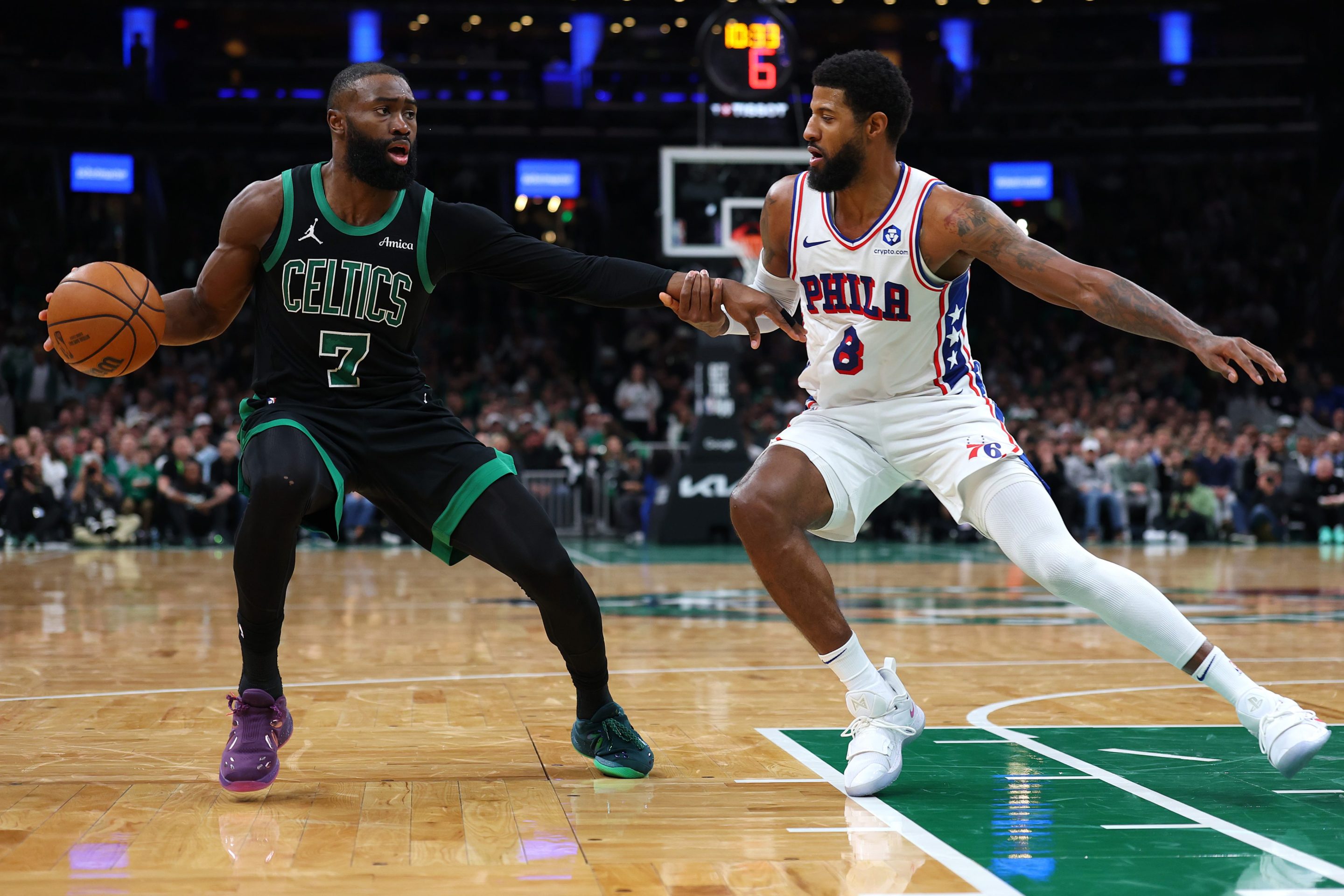
The Boston Celtics finally found another team serious about trading for Jaylen Brown. Following a couple of weeks where everyone offered their own opinion about the star's true value, the Philadelphia 76ers came in with a real offer—"real" in that it existed and was accepted, not that it was good for the Celtics.
Those dreams of acquiring Giannis Antetokounmpo or even Jamal Murray in exchange for Brown did not come to pass. Boston's reality is this, as reported Wednesday night by ESPN's Shams Charania: Paul George, two first-round picks, and two second-rounders. That's it. That's what the Celtics accepted for the five-time All-Star and 2024 Finals MVP, whom they gave to a conference rival. The LaMelo Ball trade involved more first-rounders. The goddamn Walker Kessler trade involved more first-rounders!
The Celtics weren't discreet about their willingness to move Brown, after a season that began with low expectations due to Jayson Tatum's recovery from an Achilles injury suffered in the 2025 playoffs, then became surprisingly competitive, then concluded in embarrassing fashion when the team blew a 3-1 series lead to the Sixers in the first round. Brown reacted to that postseason collapse by going on Twitch to litigate the officiating and complain about how much Joel Embiid flops. Now those two are teammates. The Celtics humiliated themselves as well as the guy they traded away.
Even if Brown doesn't once again reach the statistical heights of this past season, even if he somehow ends up performing like a team's seventh-best player, this deal is pretty low-risk for the Sixers when judged by what they gave up. George, who will be paid $54 million next season and has a $56 million player option for the season after that, was widely understood to have one of the most untradable contracts in the league. When you consider that the Sixers likely would have had to attach a first-round pick in order to convince any other team to take him, the Celtics essentially let Brown go for one first-round pick. Brown's contract is bigger than George's and runs for an extra year, but he's also seven years younger and a much better player than George.
It's difficult to understand why the Celtics accepted this meager deal for a guy who had just finished sixth in MVP voting, or anyway it's difficult to understand if the goal is to field a competitive basketball team that could win a championship in the next couple of years. Later this month, Brown would have been eligible for a two-year, $142 million extension on top of his existing supermax contract, so presumably the Celtics didn't want to pay that. But they also didn't necessarily have to deal with it this year. Instead they chose future cap flexibility (read: cheapass mindset) and dumped one of their core members for George, who has played more than 60 games in a season only once since his 2018-19 campaign; Brown has played at least 63 games in each of his past five seasons.
Two years ago, George's debut season in Philadelphia was so dreadful that he had to stop podcasting so as to pretend like the Sixers weren't toast. (They finished with a 24-58 record.) He received a 25-game suspension this past January for violating the NBA's anti-drug policy, but returned toward the end of the season and performed well when he was on the court, especially in the first-round series against the Celtics. George functioned as a useful complement to Embiid and Tyrese Maxey as they beat Boston in seven games. The important caveat here is that the expectations in Philly were lower for him due to that abysmal first season. In Boston, George will be expected to carry a level of responsibility similar to what Brown did, because he's the guy who was traded for Brown. Is it realistic? Of course not. Will it happen anyway? Yes. Any assumption that Paul George will remain healthy for the majority of a season is made entirely at your own risk.
I don't know why Celtics executive Brad Stevens felt that this trade needed to happen right now, with three years left on Brown's contract. Even when Brown rebuked analytics in a public meltdown over an aggregator's out-of-context Bobby Marks quote, he still never officially requested a trade from Boston. There remained an outcome, however realistic it may have been, in which the Celtics could have smoothed things over with the player they drafted in 2016. In this timeline, perhaps the team could point toward the Mitchell Robinson signing and a fully healthy Tatum as proof that another title run was possible with this group if Brown chose to ride it out. Maybe they could remind Brown that he and Tatum won a championship literally two years ago. What the Celtics did instead was mimic the Red Sox and make a decision that belongs in the same realm as the Mookie Betts trade, a deal done out of parsimony and cowardice that remains one of the most embarrassing moments in recent Boston sports history, non-Sedona category. This shit sucks.