A couple weeks ago, I bought an apple cider slushie at the farmer's market. It was a hot summer afternoon, and the ice crystals in the slushie sparkled and burst in my mouth with crisp acidity that immediately cooled me down. The cider had been made by the farmers who ran the stand so it wasn't too sweet, just the platonic ideal of apple flavor somehow frozen into slushie form. Before I took another sip, I pulled out my phone to snap a picture of it. The rich brown of the slushie was framed by cartons of fresh, local blueberries. A light layer of condensation had just started to form on the outside of the cup. It was the perfect encapsulation of a lovely summer day in my town.
Later, I posted the photo to my Instagram story. No caption, just the ordinary proof-of-life type of content I post to my personal social media that serves as a digital record of the life I'm living. It blended in with the endless stream of similar photos and videos in my feed, which I scrolled through to catch up on what my friends, acquaintances, and even enemies have been up to.
There's nothing exceptional about what I did. The act of documenting life on the internet has become so commonplace that it is unremarkable, and yet the act of documentation—who does it, and how—continues to incite debate as people's digital selves impose more and more on their meatspace lives.
Last week, East Coast influencers took up digital arms over what they perceive to be a slight against their work, gender, and very way of life, when a shop in Nantucket, Mass., hung up a sign reading “No Influencers.” Nantucket has become an extremely popular vacation spot for influencers, which has apparently made the summer months in particular pretty annoying for locals, who see their towns overrun with long lines and beautiful women posing in front of their homes and businesses for content.
The defenses came quickly: In an interview with the New York Times, influencer Paige Paul said that "mocking women when they become powerful in a new industry isn't new." She also compared banning influencers to banning women. Other influencers defended themselves by reminding their audiences that what they did was real work, and that their content amounted to free PR for these businesses, so they should stop complaining. It didn't occur to them that Nantucket is already a tourist destination which doesn't exactly need advertisement, or that the attention they have given the island might be doing more harm than good.
To state the obvious: Encountering influencers doing their work in real life can be incredibly annoying and obstructive. The Instagram account Influencers in the Wild provides an anthropological perspective of what it takes to make this stuff by exposing how the process looks from afar. To state the doubly obvious: Influencers are not a protected class, and banning them from a store does not constitute discrimination. That this claim of discrimination is coming most loudly from wealthy, white women who by definition have experienced very little actual discrimination is grossly ironic and makes me want to unplug the internet forever.
The more videos about the debacle flooded my timeline, though, the more I felt like this was a more complicated question rather than simply banning the most vapid and fatuous among us from expensive antique stores.
I am somewhat sympathetic to the defense that influencing—or "content creation," as many in the industry prefer to say—is legitimate work that drives billions of dollars in the global economy and has touched every part of American life, including the White House. And there’s no doubt that misogyny plays a role in the bad rap that the industry gets. But to defend one’s line of work simply by arguing that it’s "real work" is a weak argument. Destroying small businesses in private equity is a real job, and so is selling weapons in defense industry contracting; people work hard at these jobs and undeniably generate value by certain measures. That doesn’t mean they’re defensible ways to make a living.
I also don’t think that scoffing at influencers makes you smart or interesting, or somehow above the forces that create them. I cover influencers because I consider their work an interesting cultural harbinger. Despite what the name implies, influencers generally reflect trends rather than drive them. Once a trend has become popular with the boring New York City girls with too much money, it has hit the mainstream, and it’s only a matter of time before your six-year-old demands a Stanley cup to take to school.
The other question this raises for me is how one defines "influencer." At what point is someone an influencer? Is it a number of followers, or is it a general vibe? What is the difference, to a shop owner who wants to keep "influencers" out, between a 25-year-old filming on her iPhone and a 70-year-old filming the same moment on her iPad?
Influencers reflect trends in consumer behavior, but I think it's more interesting to look at the ways they reflect the wider population's evolution on things like politics (never forget the black squares of 2020), body modification (the proliferation of cosmetic procedures and GLP-1 use), and the acts of narrativizing and recording our own lives. When considering their behaviors, it’s more useful to look at them as mirrors rather than crystal balls.
In her new book The Story of Your Life, Kathryn Jezer-Morton notices the way influencer-inflected behaviors have crept into the online behaviors of laypeople, including her own friends. "All the content on my feeds, sponsored or not, was beginning to look eerily similar," she writes. In interviews with everyday social media users, Jezer-Morton found they were extremely aware of their audiences and adjusted their posting accordingly, whether it was for 300 people or 300,000. They expressed anxiety about repeating outfits on their page; they were concerned about keeping things "exciting"; and when they told stories about their lives and families, they often framed them in redemptive, tidy arcs. "We see this in how families narrate themselves into existence," she writes. "Going-out photos and 'She said yes!' posts give way to documentation of the intimate struggle to conceive, then the quest for a certain kind of birth."
Some of this is built into the architecture of the social internet. When MySpace reigned over social media in the early 2000s, the atomic unit of connection was to "friend" someone, which implied a sort of reciprocity in a relationship. Then Twitter launched in 2006 and friends turned into "followers," a subtle change that suggested a tweak to the nature of the connection, framing the act of posting as an act of broadcast, regardless of audience size. Even Facebook, a platform that primarily exists in "friend" space, created a "follow" feature in 2011, so you can have both friends and followers on your profile. When told they are performing, people will perform.
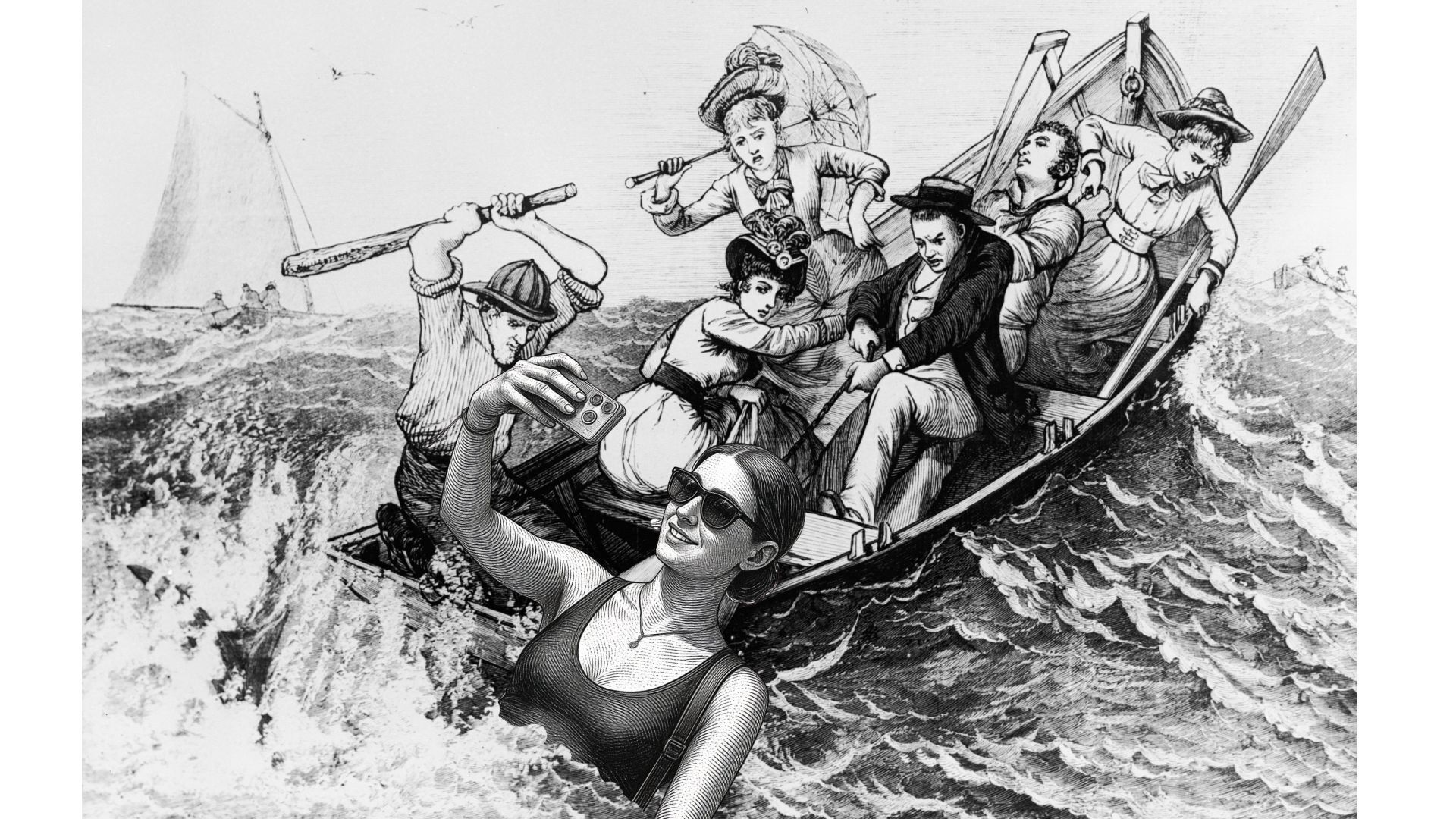
Even as we all perform online to some extent, there is a difference between documenting a moment or a space for personal use and what an influencer does, which is more often to capture moments in real life for monetization online. In the moment, the actions look the same: a person holds a phone up and snaps a photo or video. That action of documentation can certainly be annoying regardless of the motive, but the real difference is what happens afterward. The act of recording and broadcasting, when done by an influencer, compresses a time, place, or moment into one in a series of sellable images. The scale of their audiences means that their act of recording and sharing has the potential to transform public spaces into sites of shallow performance.
The impulse to turn our lives into stories is ancient and deeply human. What's different about this time is the immediacy of the technology we use to do so, the way we can capture a moment and instantly share it. "Over the past two decades, we have become experts at creating and consuming internet-expressed selves, and through doing this, we have acquired sets of habits," Jezer-Morton writes. "Some might argue that our phones are simply tools we use, and nothing more. But the tool defines the task."
The Nantucket "No Influencers" sign, then, is less about the effects of influencers on a small island than it is about the common desire to document and publicize every moment of one’s life, and the expectation on the part of so many social media users that interesting, beautiful life experiences can and should be documented as a way of experiencing them.
Maybe some of the people conducting ad hoc photoshoots have aspirations of brand deals and free stuff, but far more common is the ordinary person who experiences beauty or novelty and their first impulse is to grab their phone to capture it, as if they could take that moment home with them in the form of a photo. You see it at any major landmark around the world, at concerts and at museums, at weddings and births and sites of tragedy and celebration. The act of capturing and sharing every experience has become, in the eyes of so many on the social internet, inseparable from the experience itself, if not the entire reason to seek the experience in the first place.
Touring musicians have long complained about how smart phones get in the way of their connection with audiences, who seem to prefer to film entire sets rather than experience them in real time. In June, Phoebe Bridgers banned phones from her one-night show in Madison Square Garden. This past weekend, Audrey Hobert closed her Lollapalooza set with a second performance of her single “Sue Me.”
“I play this song twice,” she said, “and the second time, I ask for all of you to put your phones away. Can we do that, Lollapalooza?” Miraculously, I haven’t been able to find a phone video of the performance.