Who among us has not attempted to start a whimsical community-oriented project, only for it to devolve into a site of small-scale authoritarianism? It happens all the time! It even happened in my own town!
For a couple of months earlier this year, there was a white box screwed into the outdoor wall of a restaurant on my street. Every time I passed it, people were crowded around it, picking out little toys, stickers, and knickknacks that were stashed inside. One time, I stopped by and traded a sticker for a clear mancala marble that I now keep in my jewelry dish. A lovely trinket trade!
But after about two months, the box disappeared, leaving only four holes screwed into the stucco wall where it had been installed. A visit to my city's subreddit revealed that because the citizens of this city were taking more than they were leaving, and also leaving the box's door unlatched, the box's creator had decided to move it from the street to inside a nearby cafe to "protect the space [...] and spirit of the project."
The trinket box in my city is one of many that have popped up around the country. It's an idea that is growing in popularity on social media, a twist on the already-ubiquitous Little Free Libraries that dot the kinds of neighborhoods where people put "Coexist" stickers on their cars and pay for annual Ring subscriptions. Instead of books, these boxes are for trinkets: little toys, stuffed animals, or blind box spoils. It's a cute idea, a way to spread delight around your neighborhood.
It turns out the idea is not so simple here, or anywhere.
One of the problems that has emerged among trinket traders is an inconsistent definition of what a trinket is. Last month, the person running a trinket trade box in St. John, Ind., posted a video complaining about the types of trinkets left in the box: "Please, when you come to visit the box and you're doing your trading, please do not leave broken items, rocks, or whatever this is," she said, holding up a rave sprout clip. "I try to ensure that there are always good items in the box." Commenters immediately criticized the video, pointing out that the rock she was holding was actually a hagstone, a rock with a naturally occurring hole in it.
"Maybe some people would have thought it was cool to have that rock, but it was a rock," the box-owner said in a response video. "Like, I could have picked that out of the grass and put it in here."
"Sometimes trash is also trinkets," the YouTuber Hazel Soda said in a response video, because what is a trinket if not a delightful piece of junk?
Whittier, Calif.–based blind-box store Pickaparty posted a video clarifying what does and does not count as a trinket for their trinket trade box: "So trinkets are gonna be any toys. I'll give you guys examples of things that I pulled out of the box that are not trinkets." She pulled out a clothespin painted to look like a little man. "We love that you guys are getting creative, but we're just gonna say no arts and crafts, you guys." Also definitively not trinkets, according to Pickaparty, are water bottle straw charms, Croc charms, stickers, pendants without chains, and Pokemon cards.
Pickaparty concluded the video by placing a sign over the door to the box that read "Please ask for assistance" in cute, bubbly handwriting. Traders are only allowed to trade trinkets of equal value—that is, an authentic Sonny Angel for an authentic Sonny Angel—all in the name of keeping things "fair." These trades must now be overseen by a store employee.
At this point, the trinket trade box is less a communitarian project in pooled resources of whimsy and more like an arbitrage crossroads. Which could be fine on its own, but is not the thing they're advertising. And the creeping capitalist tyranny makes the whole endeavor feel like the most selfish person you know justifying their actions with therapy-speak.
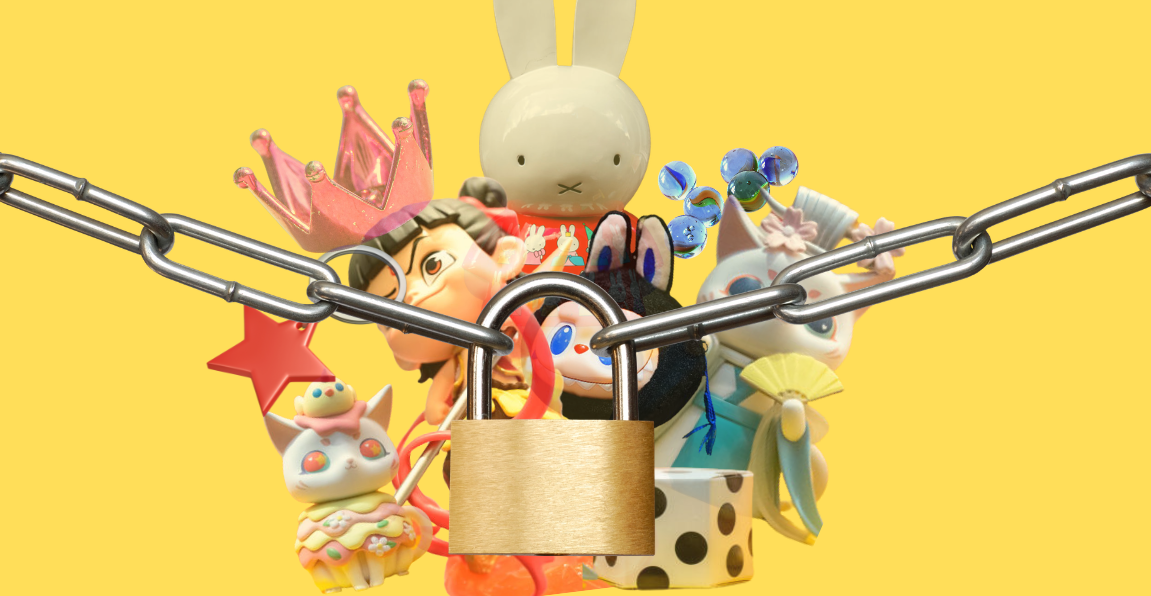
Trinket box purveyors have gone so far as to post lists of rules for their boxes, lock their boxes, and even set up security cameras, so members of their community can have a little police state with their treats.
Gone is the presumption of good faith, as well as the abiding understanding that even if any particular trade isn't perfectly balanced, things will level out over time. It's the difference between lending your neighbor a cup of flour—in the understanding that over time, in a neighborhood, eventually you too will need something—and charging them the monetary value of 16 ounces of flour before handing it over. The former is a community; the latter is a grocery store. When you've locked up your whimsy like shampoo at CVS, that might be a sign to take a deep breath and reconsider what you’re doing here. When you're policing your trinket box like an HOA policing the size of people's garage door windows, you've lost the plot altogether.
In the short term, bringing a community together is harder than portraying yourself as a person who cares about bringing a community together. But the image can't last if that's all it is.
"This is my trinket box," the Indiana trinket-box purveyor said in her video. "So I get to decide if the rock should be something in the trinket box. For me, this was about bringing community together. And also, other people enjoying things that I enjoy."