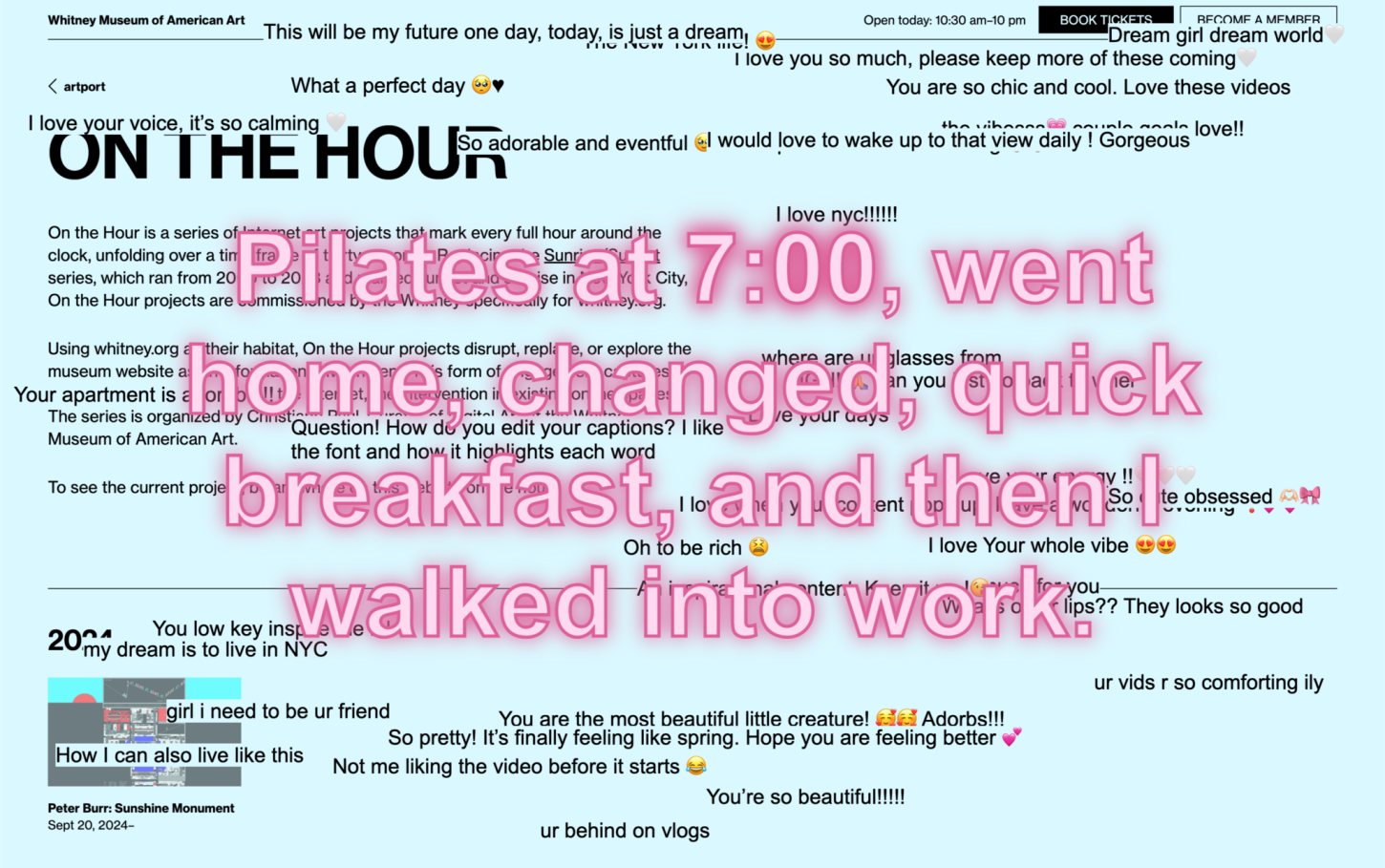


Recently on the subway I observed a phenomenon in person that I had previously only seen on the internet. Two teenage girls sitting across from me were talking to each other. They were both dressed in the teenage-girl uniform—loose-fitting jeans, cropped black jacket, white sneakers—and they were idly tapping their phones as they chatted. That is not the phenomenon I'm talking about. I couldn't look away because one of them was speaking in what I have labeled Lip Filler Accent.
Lip Filler Accent is a noticeable pursing of the lips that creates more open space between the teeth and lips, constraining the shapes vowels take and compressing the sound. I call it Lip Filler Accent because I associate it primarily with online content creators who have had filler, but I think Botox injected around the mouth to smooth out smile lines can contribute to it as well, because Botox essentially freezes the muscles around the mouth, restricting expansion.
To be clear, I am making a few assumptions about this teenage girl: I am assuming that she adopted this style of speech, because of the way she was pushing her lips out while she spoke; I'm assuming that she had not received filler, because children under 18 generally are not allowed to receive cosmetic procedures like this. Which, if I'm right, would mean something even more fascinating is happening: Not only is Lip Filler Accent a thing, but people without lip filler are now mimicking it, either intentionally or not, online and in their real lives.
I wanted to know if I was completely inventing this phenomenon or if I was onto something, so I gathered a few sample videos online and sent them to Ann-Mari Pierotti, the associate director of Clinical Services in Speech-Language Pathology at the American Speech-Language-Hearing Association (ASHA). "You're definitely seeing what I think is a confluence of speech and voice and intonation and pitch impacting the overall delivery of the message," she said.
One of the videos I sent her was of a woman giving daily reports following a lip filler injection. Pierotti said that a procedure like filler could make the speaker more careful about how their lips come together during speech, which would have the effect of softening consonant sounds. As the lips heal, though, the precision should improve. So … why doesn't it?
Pierotti said procedures like filler or Botox alone shouldn't affect speech longterm, so the accent I noticed was more likely the product of a variety of factors combining to create a speaking style that was catching through memetic transfer.
Another of the videos I sent her was of a middle-school girl getting ready for school. "She sounds to me like she's in her bathroom getting ready before school and trying not to be too loud," Pierotti said. "Because she wants to quickly do this little video and not be heard."
So there are the physical explanations for the accent (lip tenderness and frozen facial muscles) and the environmental ones (recording in an environment where the speaker doesn’t want to disturb others). But the accent has become ubiquitous enough that it's issuing from the mouths of people who have none of those physical or environmental constraints, like the girl I saw on the subway, who was speaking in a normal conversational tone and volume.
Lip Filler Accent is a subtype of the influencer accent, a broad category of linguistic trends shaped by the specific demands of speaking on algorithmically governed social-media platforms. Adam Aleksic, who runs the account Etymology Nerd, pointed out variations on the influencer accent a couple years ago, telling NPR that "it's sort of a prestige dialect on the internet that also helps with platform retention." It's a transmogrification of the famous Valley Girl accent, with its trademark upspeak and vocal fry, but also includes long sentences that never seem to end; the thinking goes that viewers will hold off on scrolling away until the sentence ends.
In one video, Aleksic distinguishes between three subtypes of influencer accents: the educational influencer, the MrBeast–style influencer, and the lifestyle influencer. Educational influencers, which Aleksic considers himself to be, speak quickly and emphasize important words in their sentences, similar to how a broadcast reporter might talk. The MrBeast–style influencer is loud and aggressive; they're trying to shock you into staying put. If you've ever heard my colleague Patrick Redford do his "Wwwwwwwwhat's up YouTubers" bit, that's the MrBeast-style accent.
The lifestyle influencer speaks slower than the MrBeast influencer and employs a technique called macroprosody, where lilting tones place emphasis on certain parts of words to maintain attention.
I consider Lip Filler Accent a subcategory of the lifestyle influencer accent: a nonchalant, pouty type of pillow talk that makes more sense in the context of the contrived intimacy between a person and their smartphone, but less sense if you imagine addressing a large group of people. I wanted to be sure that there wasn't another explanation for the accent, so I double-checked with Pierotti, who said that aside from one having had a stroke or a head injury, "there's no physiological reason" to speak that way.
There is still very little scholarship on influencer accents of any kind, though, so Pierotti hesitated to fully cosign the phenomenon I'd identified, which: fair. But I'm extremely excited at the prospect of a new subcategory of influencer accent. If any academics are reading this, please take this free idea for your research.
Speech is a profoundly intimate part of a person's self-conception and so is inherently political: The choices people make, consciously or not, about how to communicate reveal what they value as individuals and as communities. That children are—perhaps unconsciously—mimicking the speaking patterns of those who receive cosmetic procedures indicates how deeply these procedures have saturated the culture. The Lip Filler Accent, it turns out, has a lot to say.
First, there's the cosmetic procedure itself, which is undertaken most immediately in pursuit of fuller lips. If a single pair of lips defined the aspirations of young women in the 2010s, it was Kylie Jenner's. Fans speculated for years about whether her full lips were natural, and a social media trend even took off in 2015 in which people would stick their lips into a glass, suck the air out to create a vacuum, and cause bruising on their lips to make them look bigger. Also in 2015, Jenner launched Kylie Cosmetics, the company that would make her a billionaire, with "lip kits" meant to emphasize and enhance the size of lips. That year, Jenner also confessed to having had her lips done; according to Allure, "Google searches for 'lip fillers' [increased] by 11,300 percent in 24 hours."
After Jenner came clean about her procedures, lip filler became less of a dirty secret and more a staple of a certain type of very online woman's self-optimization routine. According to one study, between 2014 and 2024, Google searches for "lip filler" saw "an average 75-percent increase in relative search volume per month." Having had filler injected went from an ugly, private secret that would expose the deficits of your God-given form to a way of publicly expressing things about who you are. It was OK if you weren't born with The Lips; if you bought them, that meant you could buy them. Having filler—or speaking like you've had filler—became a signifier of wealth and a way to connect oneself to a class of glamorous, fashionable, popular women who had also had filler.
As more rich, beautiful, and influential people got filler, more of them started talking like this, too. Their audiences, the young people and those who couldn't afford the cosmetic procedures, still aspired to emulate those figures. If they couldn't get the procedure, they could mimic the accent. This style of speaking becomes less about the appearance of one's lips at all, and more about the image of wealth, fashionability, and social power projected by it.
The old Hollywood Transatlantic accent fell out of common use because of its association with East Coast prep schools and elocution training. As mid-century culture changed around it, it went from signifying refinement and grace to sounding affected, phony, and elitist. As long as mainstream culture prizes a kind of engineered beauty mediated through social media feeds, influencer accents of all types will continue to creep into everyday speech. Meanwhile, because of its relative accessibility and ubiquity, I think lip filler has passed its peak of popularity: Kylie Jenner has apparently even had her filler dissolved.