When I first saw the press release announcing that scientists had harvested yeast from the remains of Ötzi the 5,000-year-old iceman and used it to make a sourdough bread, I admit I was not terribly moved. The announcement smelled like a publicity stunt designed to get Ötzi back in the headlines—as if he does not get enough coverage as is! Ötzi the iceman makes the news more than any other 5,000-year-old person, given each new horrible clinical diagnosis scientists make after analyzing his mummified body with newer and newer technology.
Of course, Ötzi is not the only person we know from around that time. There is Ginger, the man whose body was naturally preserved in the hot, dry sands of Gebelein in Egypt more than 5,000 years ago. There is the 4,000-year-old Cashel Man, who appears to have been violently sacrificed in a bog. But have you heard of Ginger? Have you heard of the Cashel Man? No. You have only heard of Ötzi. I do not mean this as a slight against the iceman. Rather, I mean to suggest that he makes headlines on his own terms, by which I mean the fact that his body is a Pandora's box of medical maladies. Ötzi has never needed to become bread to go viral.
As such, I was prepared to close the tab spreading the good word of Ötzi's yeasts. But then I saw the publicity photo the researchers had chosen to accompany this paper, which was published in Microbiome, a paper that found four cold-adapted yeasts that survived in the sub-zero temperatures of the iceman's tummy. The photo was, to me, even more shocking than the revelation of the yeasts. It was a crisp close-up of the iceman's glossy feet.
The prominence of his piggies perplexed me. The press release included one additional photo, of a researcher's white-gloved hand gently touching Ötzi's clutched fist. I found this photo tender, even symbolic, of the way that science helps to bridge the gap between ancient and modern people, how even across 5,300 years and one mummification two people can do something as human and timeless as hold hands.
But this was not the image the scientists chose to lead the story. The hand photo was a backup, named "iceman mummy 2." The photo at the top of the press release did not merely contain feet; it spotlit them, revealing the lustrous glacial shine I have come to associate with the iceman. It is quite the foot pic, and as such it has led many of the stories about the Ötzi yeast.
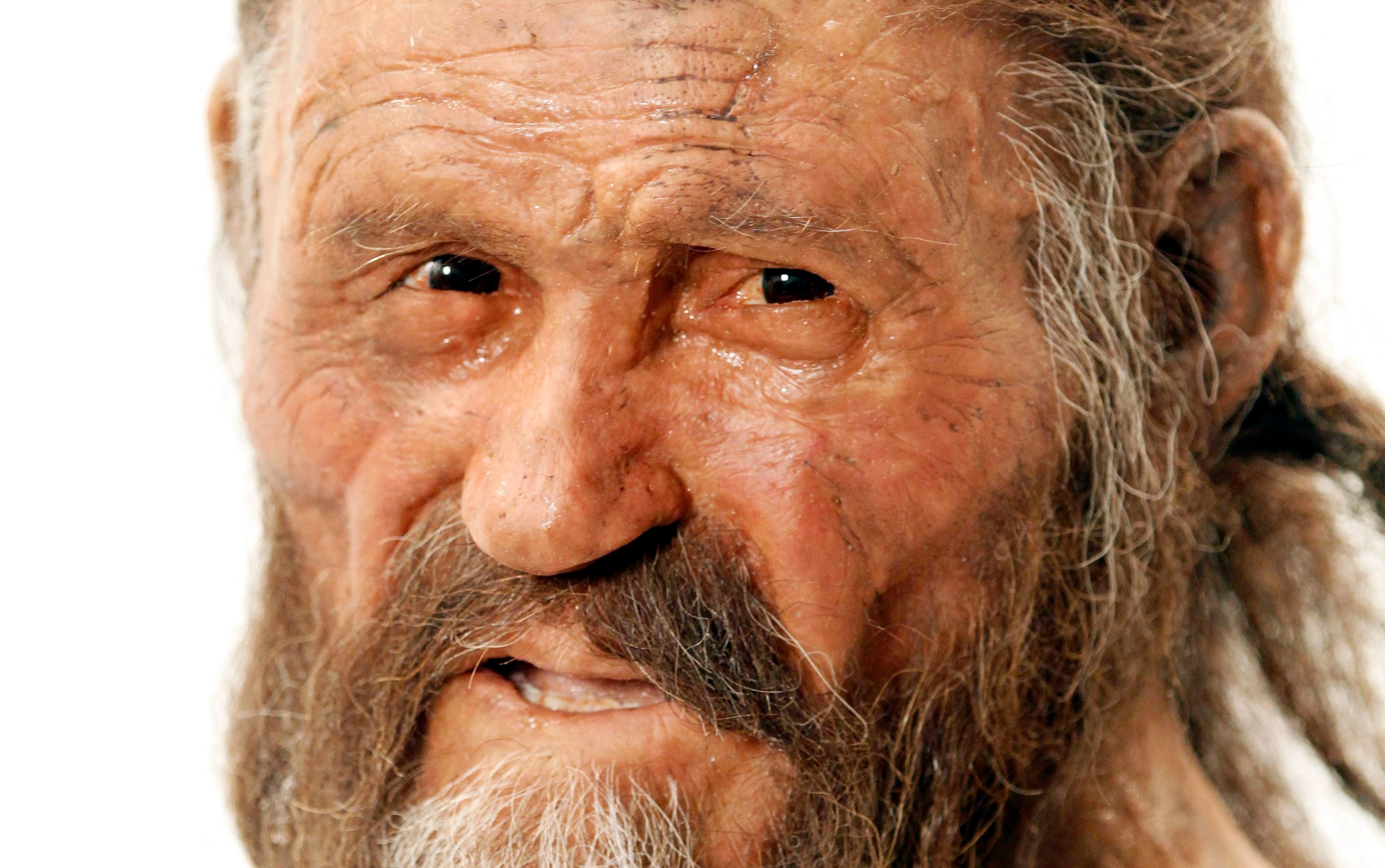
I can understand the intentions of this publicity team. As the world's most famous iceman, Ötzi experiences a kind of overexposure that cannot be fixed by a crisis marketing team. Ötzi did not die dabbing—he fell face-first, and then the glacier on top of him shifted and caused his body to contort—but he will always be dabbing. He cannot be posed in new ways. There are only so many ways to photograph a 5,000-year-old mummy stored in the glaciated conditions of a chamber kept at -6 degrees Celsius and 99 percent humidity, conditions that prevent bacteria from growing on him and decomposing his remains. (This is why Ötzi looks so glossy; he's continually spritzed with sterile water to prevent desiccation.) Of course an enterprising photographer might seek out new angles and perspectives to put a new spin on an old iceman.
And at the same time, I ask you this: Might Ötzi the iceman deserve a little privacy? It's not enough that he was murdered and left to bleed out in the alps. It's not enough that he is condemned to languish in this refrigerated afterlife as scientists discover more things that were all fucked up about his body—because that's all they ever do. (When, I ask, will someone publish a paper about how Ötzi was lowkey ripped or had iceman synesthesia?) And now, on top of all this indignity, now scientists are out there getting clicks with Ötzi's tootsies?
At least the iceman took good care of his feet. Although many parts of Ötzi's body were weathered and broken, his feet remain largely intact. He did not even die with his dogs out. He died in warm shoes made of bearskin, deerskin, and cowhide and stuffed with hay for warmth. They even had shoelaces braided from linden bark. Scientists historically thought Ötzi had frostbite on the tip of his left pinky toe. But a 2025 paper questioned this assessment after a new clinical analysis of the bone, instead suggesting the iceman merely had an arthritic cyst. Perhaps this is part of what led the photographer to fixate on Ötzi's objectively pleasant and rather well-preserved feet, as the iceman's face is what some in the scientific community might describe as "busted."
I took some consolation in the fact that Ötzi has not yet joined the hallowed ranks of the community-curated fetish site wikiFeet. You do not need to be alive to have a profile on wikiFeet—I've checked—but you do need an IMDb page with "valid and verifiable credits," according to the site's rules. Unfortunately Ötzi might be the only mummy with with an IMDb page, which he earned for appearing in the 2007 documentary The Curse of the Ice Mummy, in which he appeared as "Self." It seems only a matter of time before such pristine toes make it on wikiFeet, by which I mean wikiFeet Men, wikiFeet's immensely less popular brother site.
Although it's possible that icemen were into feet—bearskin shoes leave a lot to the imagination—the man responsible for our modern concept of foot fetish photography is Elmer Batters, a photographer born in Milwaukee in 1919 whose work has since been archived in art books with titles like From the Tip of the Toes to the Top of the Hose. But feet pics are an invention of technology, not of human desire. It is entirely possible that Ötzi was really into feet, his and those of other icepeople; if he fucked, and he did, he may also have sucked toes. But one cannot assume a mummy's fetish any more than we can a skeleton's sexuality.
Ötzi did not ask to become a public figure, an "it" iceman, but people will always be talking about him. The least we can do is not objectify him. Let's respect the full range of his accomplishments. When I ran into a friend at a show this week, they asked me if I'd seen the news about the sourdough starter made from "that frozen guy I write about sometimes." Yes, I told them. I had. And now so have you.