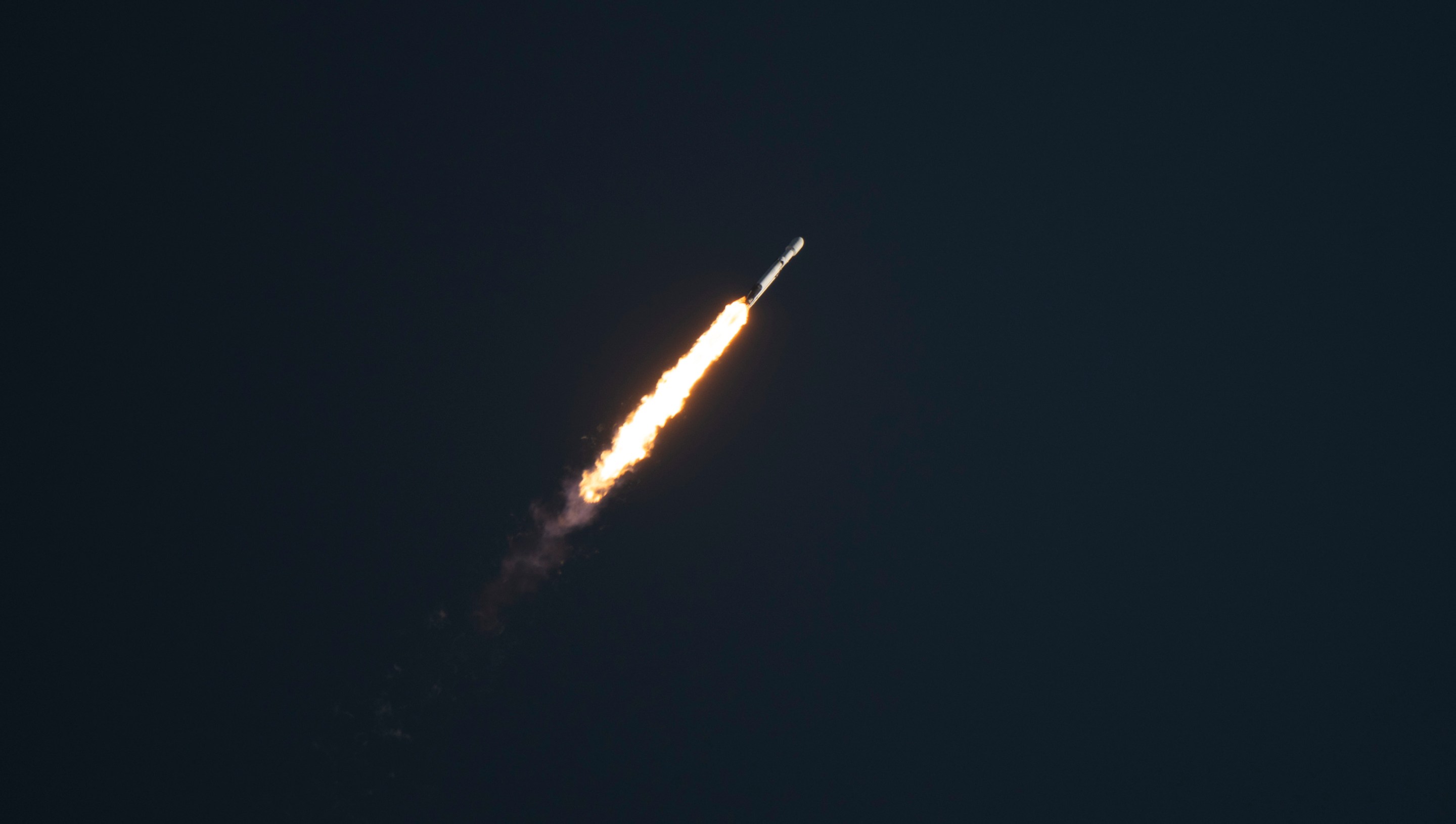
On Aug. 30, the Nancy Grace Roman Space Telescope successfully launched from Florida and will spend the next three months heading to its new home: a Sun-Earth Lagrange point, a million miles from Earth, where the gravity of the two larger bodies are in equilibrium. It's a comfy place to be for a space telescope; Roman can say hi to her old classmate Webb, who got there four years ago and has been sending back brilliant images and doing good science.
Roman's a strange bird by NASA standards. It came in under budget and ahead of schedule. Its primary mirror, donated from the National Reconnaissance Office, is from a canceled spy program. There'll be a shakedown period to make sure everything's working OK, so Roman won't officially enter service until some time next year. I'm sure I'll fawn over its debut images—half of Roman's job description is to look for new planets—but the other half is pretty valuable too. Without any hyperbole: What Roman sees could help us figure out what the universe is made of, and its ultimate fate. Big questions! Hope the plucky telescope is up to the job.
First, the exoplanets. Roman—named after Nancy Grace Roman, NASA's first chief of astronomy and the "mother" of the Hubble Telescope; certainly a nobler eponym than James Webb—is equipped with the world's most advanced Coronagraph Instrument. In its most basic form, a coronagraph is almost ludicrously simple: an attachment that blocks out the light of the star it's pointed at, so scientists can see the things just around the star. Early on, that meant the corona of our Sun. On Roman, it means those planets circling other stars.
Those exoplanets are so comparably dim that they're lost in the glare of the stars they orbit. The star is millions of light years away from us, and its planets mere millions of miles from said star, so the distance between them is basically nothing from our frame of reference. Seeing them isn't a simple measure of putting a bottlecap over a lens to block out the blinding starlight. Instead, Roman's coronagraph utilizes a series of masks, baffles, stops, and detectors to identify and screen it out. Here's a short NASA video explaining it which even my dumb ass could understand, mostly. One especially neat part of the coronagraph involves two flexible mirrors, powered by hundreds of tiny pistons, which shape the mirrors to serve as prisms to fit the exact wavelength of the light it's trying to block, and the light it's attempting to image.
The current list of exoplanets that have been directly imaged is short, and mostly the same type of planets: young, bright in infrared, far from their stars. And the images are rudimentary, often just single pixels. Roman's going to blow them out of the water. It's going to be able to see closer planets, perhaps in their system's "habitable zone." It's going to see planets that are billions of years old, teaching us more about planetary development outside our solar system than we've been able to learn in all of human history up to this point. It's even going to be able to tell, thanks to its coronagraph's spectroscopy mode, whether an exoplanet has clouds, or an atmosphere. This time next year, we might be viewing some other star's Pale Blue Dot.
The exoplanets are the sexy stuff, because you can look at them, and Do Imaginings (I love to Do Imaginings). Planets are easy to wrap our heads around. I live on one. Dark energy, on the other hand, is almost inconceivably weird. We don't know what it is (we have some theories). We only believe it exists because the math doesn't math without it.
In 1929, Edwin Hubble discovered that objects farther away are moving away from us faster than are nearer objects, proving that the universe is expanding. This was explained with the famous and widely accepted Big Bang theory. It makes sense. Large kablammo, everything blows outward, but eventually, scientists figured, the gravity of all the matter in the universe would win out, and the universe would contract into a Big Crunch. But in 1998, scientists discovered that the universe's rate of expansion appears to be speeding up, not slowing down or even remaining constant. How can this be? Enter dark energy, some mysterious force, distributed more or less evenly everywhere, and necessarily possessing the property of negative pressure that drives the outward expansion of the universe.
It explains what we see in reality pretty well, even if it is just an "X" to make the equations balance. But if we take all the normal stuff out there that we can quantify (Y), and then measure how fast the universe is expanding (Z), we can subtract Z-Y to determine just how much X there is. In the most widely accepted theory for dark energy, ordinary matter and energy—stars, galaxies, you, everything we can see—makes up just five percent of the mass-energy in the observable universe. Twenty-seven percent is dark matter (which is also mysterious but continually getting less so). The rest, 68 percent of the entire universe, has to be dark energy.
However! However. In that widely accepted theory, dark energy is a constant thing: the same everywhere, at all times, which means expansion should only ever increase. Over the last few years, observations of unfathomably distant objects—including the Cosmic Microwave Background, the energy left over from the formation of the universe—have been returning some pretty weird results. They indicate that dark energy's effect has potentially been getting weaker over time. Maybe it's not so constant after all. Maybe it's changing.
“It’s looking more and more like we may need to modify our standard model of cosmology to make these different datasets make sense together," said Will Percival, a professor at the University of Waterloo who is working on the Dark Energy Spectroscopic Instrument project, an earthbound collaboration of more than 900 researchers from 70 institutions, and unrelated to the Roman telescope. "And evolving dark energy seems promising.”
This will matter very much to how the universe goes out in the end. Enough expansion, and we're looking down the barrel of a Big Rip, where the universe expands so much that even the most fundamental particles are ultimately torn apart. If expansion is slowing enough to eventually let gravity take over, we'll get a Big Crunch. If dark energy is changing in a cyclical pattern, the universe could be forever undergoing a Big Crunch/Big Bang death and rebirth; we might just be in one of its endless cycles.
The data is so tight here. It's possible the confounding measurements of recent years are all within the margin for error. So how do know if this is a real thing? We make our measurements even more exacting. That's where Roman comes in. It's going to look at everything. Its camera is not meaningfully more powerful than what was on the Hubble, but its field of view is a hundred times wider. That means much less time required to survey the sky, and many more repeated surveys of the same patches of sky to see how things change over time. A fresh supernova flares or dims and Roman will spot it faster than we've ever been able to. A gravitationally lensed image of distant galaxy changes its appearance just a skosh, and Roman will note it. Roman will provide the biggest, clearest, most detailed picture of the cosmos as a changing thing, and we should go some way toward understanding whether what it sees fits our current models of the universe, or whether those models need to be changed.
Roman won't be doing it alone. Scientists will be comparing its measurements with those taken from observatories working in other spectra, and with different instruments—Webb, the ESA's Euclid, the ground-based Rubin, even reliable old Hubble, still plugging away after 36 years. "Roman, Rubin and Euclid, they're siblings. They were all proposed and prioritized at the same time, so the design of each of those observatories has been in the knowledge of knowing what the other ones were doing," Julie McEnery, Roman's senior project scientist, told Space.com. "We're not competitors. We're stronger together, and we both need each other." It's so heartwarming when telescopes work together to find out how the universe is going to die.