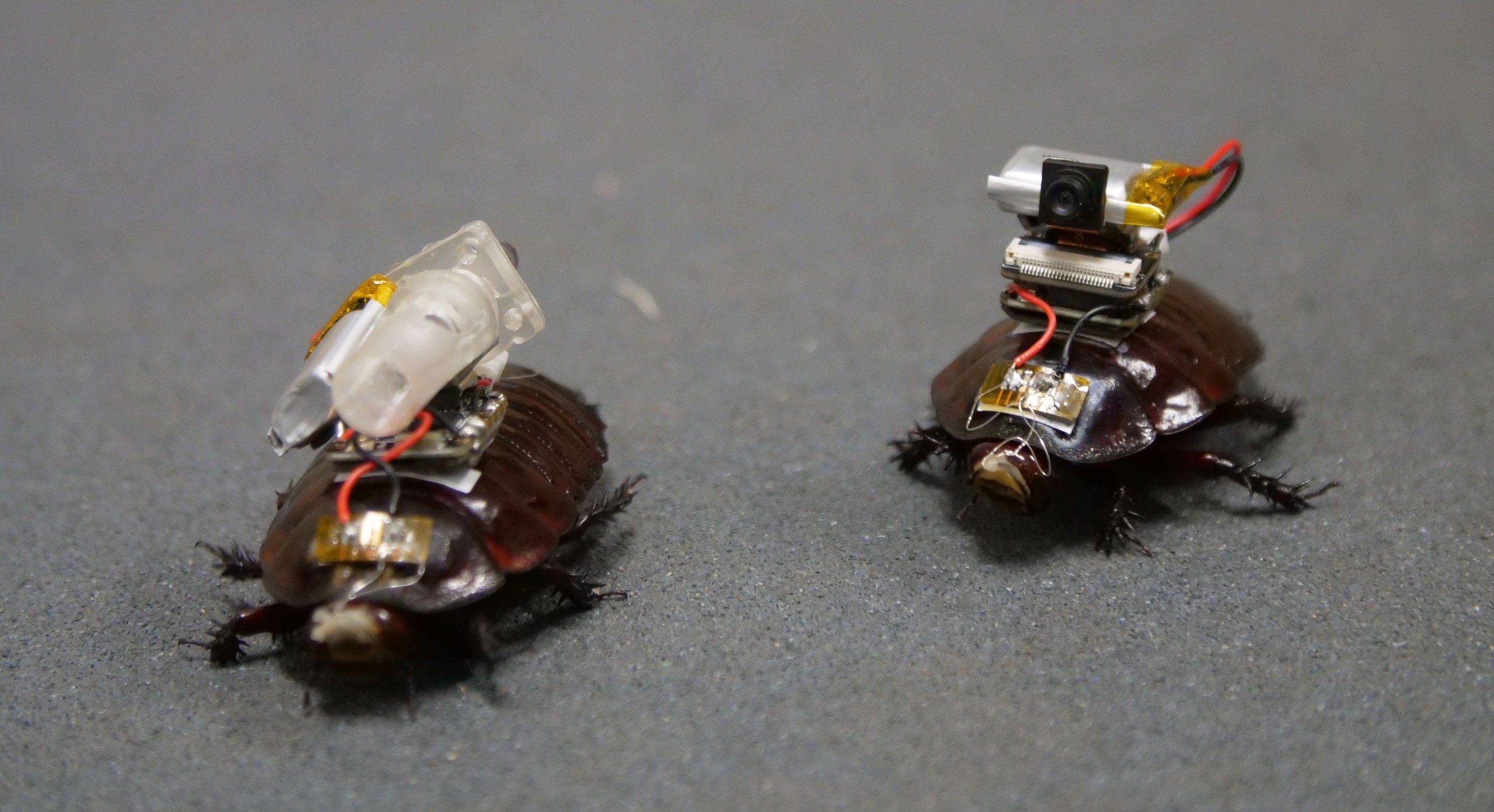
A nightmare has happened. Maybe you were minding your own business in the office when an earthquake hit, or maybe you were spelunking in some wretched cave never meant for humans to enter. Yet regardless of how you got here, you are now trapped and in need of urgent medical attention. There's too much debris to clear before a paramedic would be able to reach you ... a human paramedic, that is. But this guy? This guy eats rubble for breakfast.
This is a giant burrowing cockroach, and it is approximately as long as a lime. It lives and burrows in—you guessed it—Australia. In the wild, the giant burrowing cockroach mostly stick around their burrows. They can live up to 10 years. The roaches only come to the surface at night, gathering leaves, twigs, and bark from the forest floor to feast on later, back underground. In other words, regular giant burrowing cockroaches do not have jobs or any semblance of medical training. Regular giant burrowing cockroaches would be ill-equipped to save you in an emergency situation. But this is not a regular roach. It is a cyborg roach, the fusion of an actual insect and a robot. The researchers behind this creation have dubbed it the paraborg, per a paper recently published in the journal Advanced Science.
A paraborg is not just a cockroach wearing a fancy tech-forward backpack. The researchers implanted electrodes inside its head to steer the roach with electrical signals. For example, stimulating the roach's left antenna makes the roach turn right, and stimulating the roach's back appendages called cerci makes it move faster. The researchers anesthetized five roaches, implanted the electrodes, and left the bugs alone for an hour with gum leaves and apple slices to snack on.
I would be remiss if I did not acknowledge that this genre of science makes me uncomfortable. The idea of manipulating an animal's brain for our purposes, even ostensibly noble ones, makes me squeamish. Insects are the targets of these experiments, having long been dismissed as non-sentient beings incapable of pain—you can imagine the outrage if someone implanted such electrodes into a bird or a bunny. As such, there are very few ethical protections in place for research on invertebrates, although a growing number of researchers are pushing for more precautions. "Because questions regarding insect pain perception, cognition, and agency remain unresolved, we treated the insects as if they could experience discomfort," the researchers wrote in a supplement to the paper.
This paraborg is far from the first insect we have manipulated to serve our goals, and the idea of a swarm of robotic cockroaches coming to your rescue is not a new one. The researchers based their locomotion control on prior experiments designed for Madagascar hissing cockroaches. Cyborg insects offer several advantages over regular robots, as they require less energy and only need a few robotic parts. Thus far, scientists had only been able to design cyborg insects capable of searching, not rescuing. But the paraborg represents the first insect that could feasibly act as a paramedic, delivering drugs in the field. Here is what the researchers propose that would look like:
Although Image A might appear shocking—a swarm of oversized roaches scuttling towards you in your darkest moments—rest assured you are probably unconscious. And even if not, you have bigger things to worry about.
The paraborg strategy requires two roaches, one observer strapped with a camera and another carrying an auto-injector. Human first responders nearby would be able to direct the roaches using the footage taken by the paraborg. And once the roaches reached their target, the responders could trigger the medic roach to release its needle. This is what that looks like:
In laboratory tests in the summer of 2025, these roach duos were able to successfully navigate respectable heaps of rubble to get within launching range of a target, which was a square of silicone and pig skin. Once there, the roach needs to be facing the target and be close enough for the auto-injection to work. In trials, the medic roaches were able to deliver the drugs 72 percent of the time. But if a roach was able to get within just under six inches of a target, the auto-injector worked 95 percent of the time. The trials lasted around five minutes each, which the researchers say does not necessarily reflect the maximum endurance of the roach.
If these roaches ever make it out into the field, the researchers imagine dispatching entire swarms of paraborgs to search for a victim. More roaches would be able to find people more quickly and relay more information to the people controlling them. And if one paraborg were to die in the line of duty, the mission could still go on.
After the experiments, the researchers removed the electrodes and plastic harnesses from the roaches and returned them to a colony of other giant burrowing cockroaches. All but one of the five paraborg roaches remain alive today—one died three months after its return to the colony, but the researchers noted the roach had already seemed on its decline before the experiment. The researchers say this suggests that the process of becoming (and unbecoming) a paraborg does not cause long-term harm to the roach, although they say it's possible the insects experienced stress and more subtle side affects. To that end, the researchers call for a more comprehensive framework to assess the welfare of insects used in cyborg studies to better understand the longterm effects of these transformations.
In the year since the experiment, the four survivors have led full lives by cockroach standards; they have all mated and produced two generations of offspring. It may be for the best that roaches have no language that we know of, otherwise the paraborgs would talk the ears off their grand-roaches about how easy they have it now. Back in their day, roaches had jobs!