Many animals are famous for their extravagant courtship dances. Consider the male Costa's hummingbird, who hovers in front of potential mates with his violet mantle feathers outstretched in the shape of a baby octopus. Or the male greater sage-grouse, who pops his colorful air sacs in a display that seems far less suitable for work than it is. It's not just birds. A flamboyantly colored male peacock spider dances for his life, waving his long legs and shaking his vibrant fan not just to impress a mate, but to dissuade her from eating him.
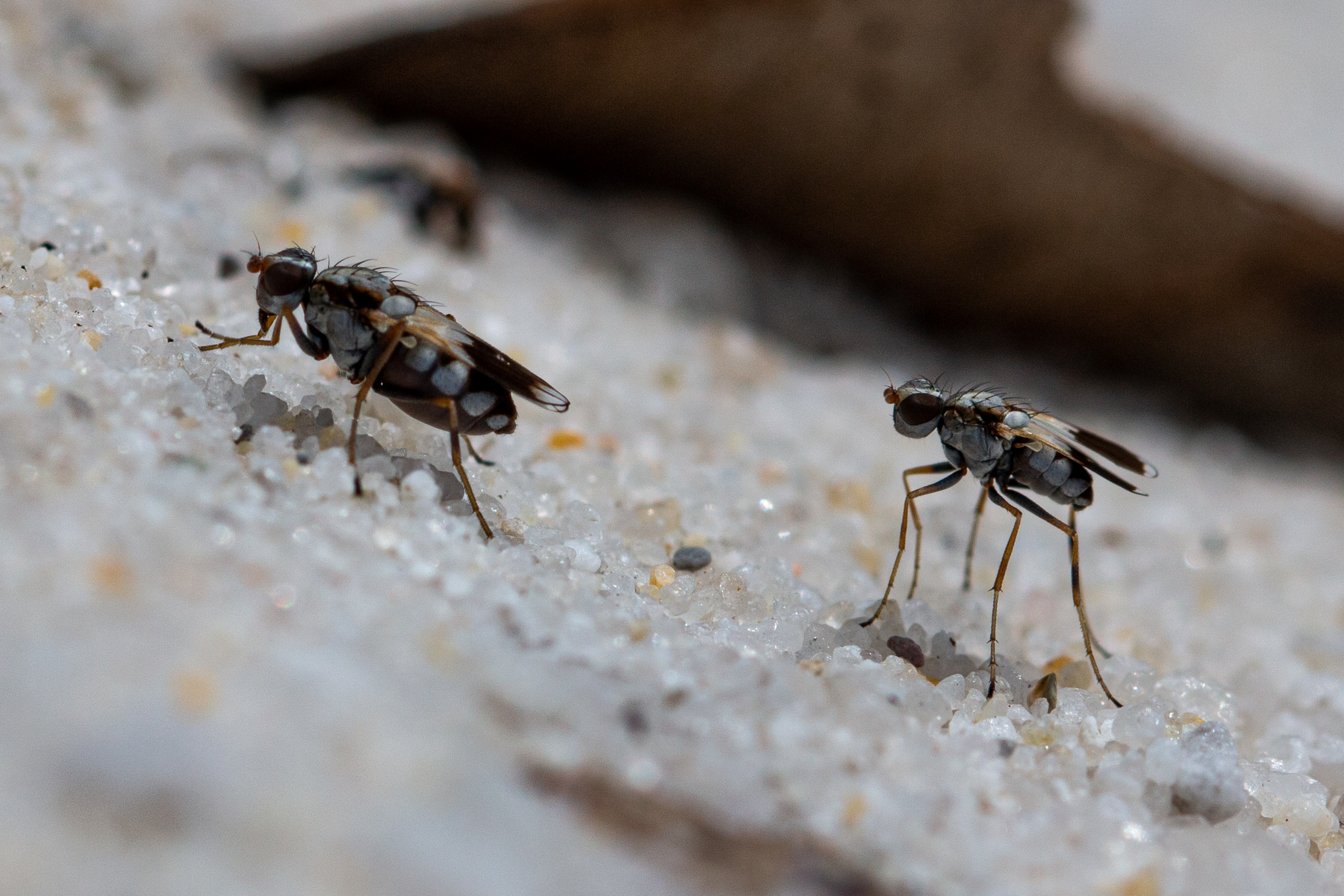
And yet, some of the planet's least seductive creatures have dances of their own. Many flies have courtship dances, moves that have gone unnoticed in popular culture because of their vanishing size or pestiferous reputation. But these dances are marvelously complex and quite beautiful, if you only get a chance to look. In a new paper published in Behavioral Ecology, a group of scientists discuss the surprisingly sophisticated courtship dances of the dancing dune fly Apotropina ornatipennis, whose males gallivant around sandy beaches in Australia dancing desperately in search of sex.
Nathan Butterworth, an evolutionary biologist at Deakin University in Victoria, Australia, has previously studied the dances of many flies: the waltz of the blow fly, the competitive tango of the mud fly, and the ritualized hoedown of another beach fly. He learned about the dune fly when he was living on the New South Wales coast, whose sandy beaches are riddled with the flies. But the insects are so small that most people don't notice them, including Butterworth, who only noticed the flies after his colleague tipped him off. "Until you get right down to the level of the sand, they just look like tiny little ants running around," Butterworth wrote in an email.
His prior research on three different mudflies revealed each species had an utterly unique courtship dance: one that straddles, one that thumps, and one that waves the white tips of its wings like a semaphore. Butterworth had begun to wonder how different species of flies evolved such distinct dances. The dancing dune flies, he realized, seemed perfect to investigate this question. The flies were bountiful on beaches, where they prefer to live in small and dense aggregations. And their populations appeared to be isolated by the beaches' geography, where sandy shores are segmented by mangroves and rocky outcrops that represent substantial journeys for such a small fly.
Butterworth and his colleagues camped out at the beach to film the flies. Temperatures soared above 90 degrees Fahrenheit, and their equipment frequently overheated in the sun. The dancing dune flies were hot, too. The females relaxed in the small shade of a leaf or a stick as they watched the males dance for them in the hot sun. Out of the more than 100 hours of footage they collected, the researchers only observed one successful copulation. "As seems to be the case in most flies, the females are very choosy and reject most males," Butterworth said. A female fly might only mate once and then reject all future suitors until she lays her eggs.
In the new paper, the researchers have compiled a glossary of the dune fly's dance moves, with movements such as straddle, wing flash, wing sweep, and wing touch. These moves can be hard to distinguish, as the flies often combine them or perform the moves simultaneously. Butterworth and an undergraduate student, Jesse Appleton, pored over the footage several times until they were sure they'd described everything correctly. They found 18 separate behaviors that can occur in the courtship dance and 41 different dance moves.
When I asked Butterworth to explain the difference between a behavior and a dance move, he pointed me to John Travolta's "disco finger" dance in Saturday Night Fever. "If you break the move into its discrete components, there is the ‘point’ with his left hand which is accompanied by the 'hip thrust'," he said. The point and the hip thrust are each discrete behaviors that can happen on their own. But if combined, the point and hip thrust become the "disco finger" dance move. "This is mutually exclusive, because John Travolta cannot do the 'disco finger' dance at the same time as any other dance move," Butterworth explains.
So the male dancing dune flies can combine their 18 possible behaviors such as wing-flap, face-off, or tap, to create 41 dance moves, which include orient-wing-sweep, face-off-wing-flap, and straddle-wing-flash. The courtship generally lasts around a minute and a half before the female rejects the male or he simply gives up. The real equivalent of disco finger, however, might be wing sweep, the one behavior the researchers found to be especially effective at catching a female fly's compound eye.
Butterworth recorded the dances of dune flies from various isolated beaches. And genetic testing proved that each population was quite isolated from each other, with northern populations sharing few genes with southern ones. As such, he expected the flies' dances would diverge, with some populations developing new moves or dropping others. But he was very surprised to see that there was no evidence of divergence. The dancing dune flies danced basically the same despite their isolation from each other. There are many possible explanations for this. Perhaps courtship displays shift more slowly on an evolutionary scale, only changing quickly if there is a drastic ecological change, as is the case with the Hawaiian crickets who lost their song. Maybe other aspects of the courtship dance are shifting, such as pheromones, coloration, or wing-buzzing, while the physical moves remain the same.
But Butterworth was most surprised by the sheer complexity of the dances. "They are adorable and fascinating to watch," he said. "The lives of flies are so complex, and they are far more intelligent than we give them credit for." Next, he plans to study a closely related genus of flies with patterned wings and their own suite of unique little dances, research that he hopes will continue filling in the picture of how dance evolves. As a fly guy, Butterworth said he loves to describe a courtship display that is new to science. "I think it gives me the same rush as an astronomer discovering a new planet or a diver discovering a new cave system," he said.
After I saw the footage of the dancing flies that Butterworth uploaded to YouTube, I asked why he set the footage to Antônio Carlos Jobim's bossa nova duet with Elis Regina, "Águas de Março." The song lists various objects being washed away by rain: a stick, a stone, a sliver of glass. Butterworth said that he loves the song, how each line "is just a snapshot of some tiny detail of life, but all builds together into something more meaningful." To him, the back-and-forth between the two singers reminds him of two animals engaged in a courtship dance. It reminds him of how the tiny, often overlooked scenes happening all around us can offer meaningful insights into life. "Like flies dancing on the beach," he added.