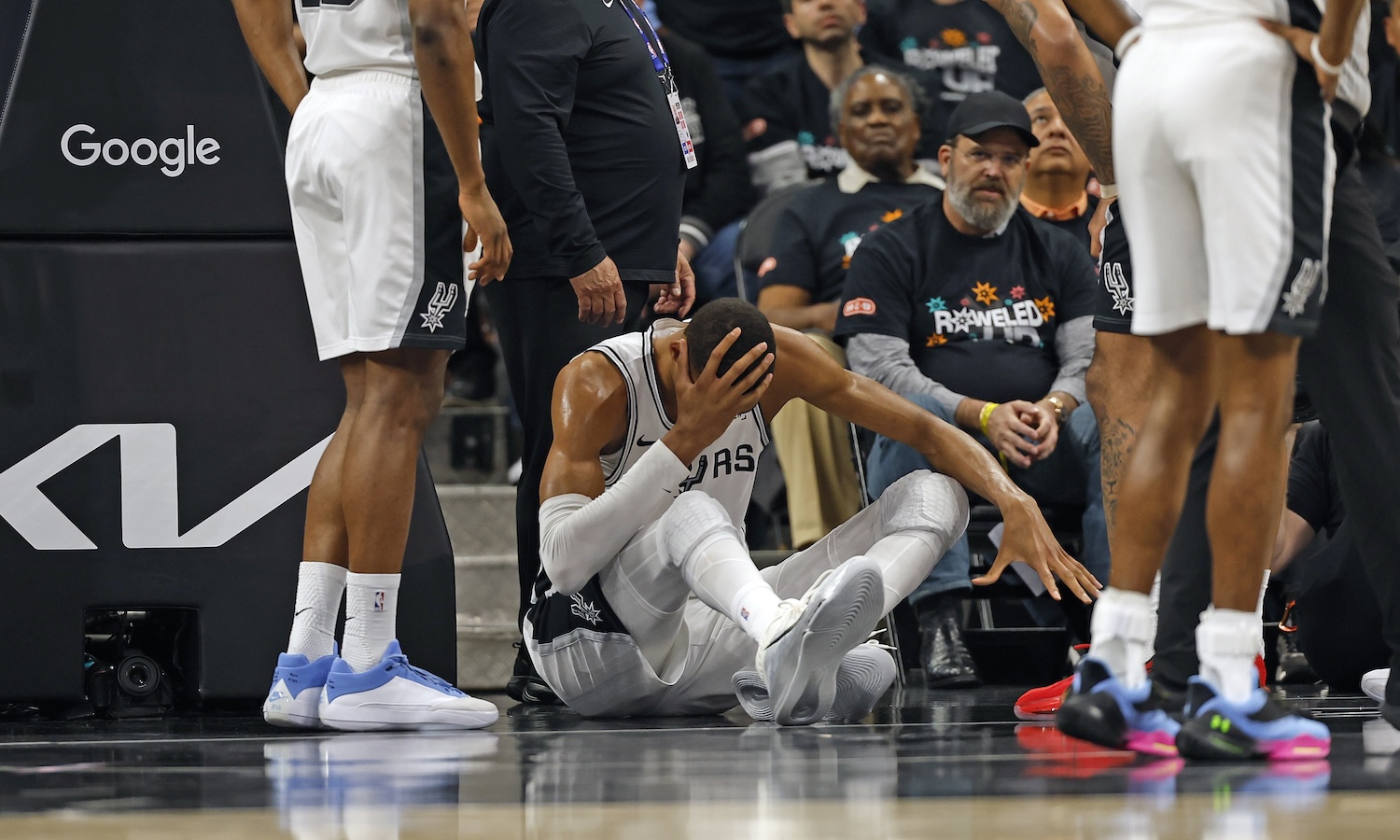
With 8:57 left in the second quarter of what had been a pretty entertaining Game 2 between the San Antonio Spurs and Portland Trail Blazers, Victor Wembanyama lost his footing while driving on Jrue Holiday, slipped, fell, and slammed his face into the hardwood. He left the game, and the team announced that he had a concussion. There's no way to tell when (or whether) Wembanyama will return, and what sort of player he'll be like when he does. That's how concussion recovery works: It is painful and disorienting, and you just have to wait around until something changes, hopefully but not always for the better.
The video is difficult to watch. Wembanyama shot-fakes his way into good position against Jrue Holiday, crosses over between his legs, then spins over his right shoulder. Holiday both pulls the chair on Wembanyama and jerks his head back, getting his body all the way out of Wemby's path. Wembanyama's momentum can't resolve itself; his right foot is pointing the wrong way as he continues to both spin and move forward, barely pitching the ball out to the right corner before he makes impact with the right side of his face. His eyes are closed when his body comes to a halt. Wembyama stays down, covering his face with his hand and blinking in pain. He's able to roll around a little bit before sitting up, though not without being visibly dazed. After a few minutes of "WEMBY" chants from the home crowd, he runs down the tunnel with Spurs head athletic trainer Will Sevening.
Within 20 minutes of the fall, the Spurs announced that Wembanyama was in concussion protocol; shortly after the game, they announced that he had been diagnosed with a concussion. As for the game, the Spurs lost, 106-103. They held a 14-point lead with 8:33 left, only to go cold right as Holiday stepped up and put in a heroic performance down the stretch. The Blazers didn't even need their best player, Deni Avdija, to have another big night, as Scoot Henderson had one of the best games of his career, Toumani Camara caused tons of problems on defense, and Robert Williams III dominated Luke Kornet when it mattered. The Spurs' offensive process looked gummed up, the basketball equivalent of trying to talk through a mouthful of peanut butter.
Were they shocked by the loss of their best player, a man who two days earlier diagnosed Portland coach Tiago Splitter's complex game plan and hit it for 35 otherworldly points, and one day earlier became the first player to win a unanimous vote for Defensive Player of the Year? Maybe, but it doesn't matter. Whether the Spurs can beat Portland without him, which is totally within the realm of possibility, they won't go much further than that.
So when will they get him back? The NBA has a detailed concussion protocol with return-to-play procedures, which we will get into shortly, but the essential fact concerning Wembanyama's return is that it is all conditional. There is no way to know, or confidently predict, how long a concussion will take to heal.
There is little point in parsing the fine movements of Wembanyama's eyes during the fall and in its immediate aftermath, because even though you might be able to derive some rough understanding of the force of the impact, every brain is different, as is every impact. You can't just take a look at someone's brain; there is no direct physical manifestation of a concussion, only the shadows it projects onto the inner shell of your skull (read: headaches). Someone I know who was recovering from a concussion was told by their neurologist that their symptoms, which at that point had persisted for months, would likely dissipate in "1 to 12 months."
The antilinearity of concussion recovery is maddening. You feel mentally itchy, agitated with the state of your addled brain. You are in pain, though it flickers up in different ways and at different intensities, depending on the day, the hour. You will try to grasp for a word to express the sensation, only for the grasping itself to exacerbate your pain. You can feel the physical effort of thinking. It's like lying down with a thick slab of rock on your chest that you cannot squirm out from under. Any movement only heightens the sensation of being pressed, as does any increase in heart rate or aerobic activity. You just have to lie there.
For some number of days, hopefully not months, Victor Wembanyama will not only be kept physically inert; he will have to try his best to keep himself from thinking. He can't stress about his team losing Game 2, or go over game tape to figure out how to attack Portland's Jerami Grant lineups, or let his mind wander to the 2027 French presidential election, because thinking—thinking!—will make his symptoms worse. In addition to warning of the perils of "cognitive exertion," the concussion protocol is at pains to emphasize that concussed players should not play video games or interact with large groups of people. Good thing Wembanyama's a book guy, though he will not be able to be one for a little while.
Hopefully at some point, hopefully very soon, Wembanyama's headaches and other symptoms (e.g.: irritability, dizziness, confusion) will subside. Thus begins his journey through the "Return-to-Participation Exertion Process." The absolute earliest point at which Wembanyama can begin to consider exerting is 48 hours after the injury, which would be Thursday night. If his symptoms flare up, he will have to stop exerting and, again, wait for them to go away. The process itself involves four stages of increasingly demanding exertion: stationary bike, jogging, agility work, non-contact team drills. Various observers and physicians, both team- and NBA-affiliated, will have to keep an eye on him and monitor his symptoms. If the symptoms ebb, and if everyone says he's cool, Wembanyama can come back to play. He can resume thinking, exerting at will, and doing stuff nobody has ever seen on a basketball court.
You may encounter coverage of Wembanyama's concussion that emphasizes the 48-hour timeline; that Games 3, 4, and 5 take place on Friday, Sunday, and Tuesday, respectively; and the number of games players have missed with concussions in the recent past. Maybe he will play, and I hope his recovery is swift and complete. But there is no way to know, and no sense in trying to hew to a timeline.
Don't take my word for it. Take it from Point 5, Section A, Article III of the league's concussion protocol: "It's important to note that there is no timeframe to complete the process. Each injury and player is different and recovery time can vary in each case." I just hope Wemby can surprise us again.