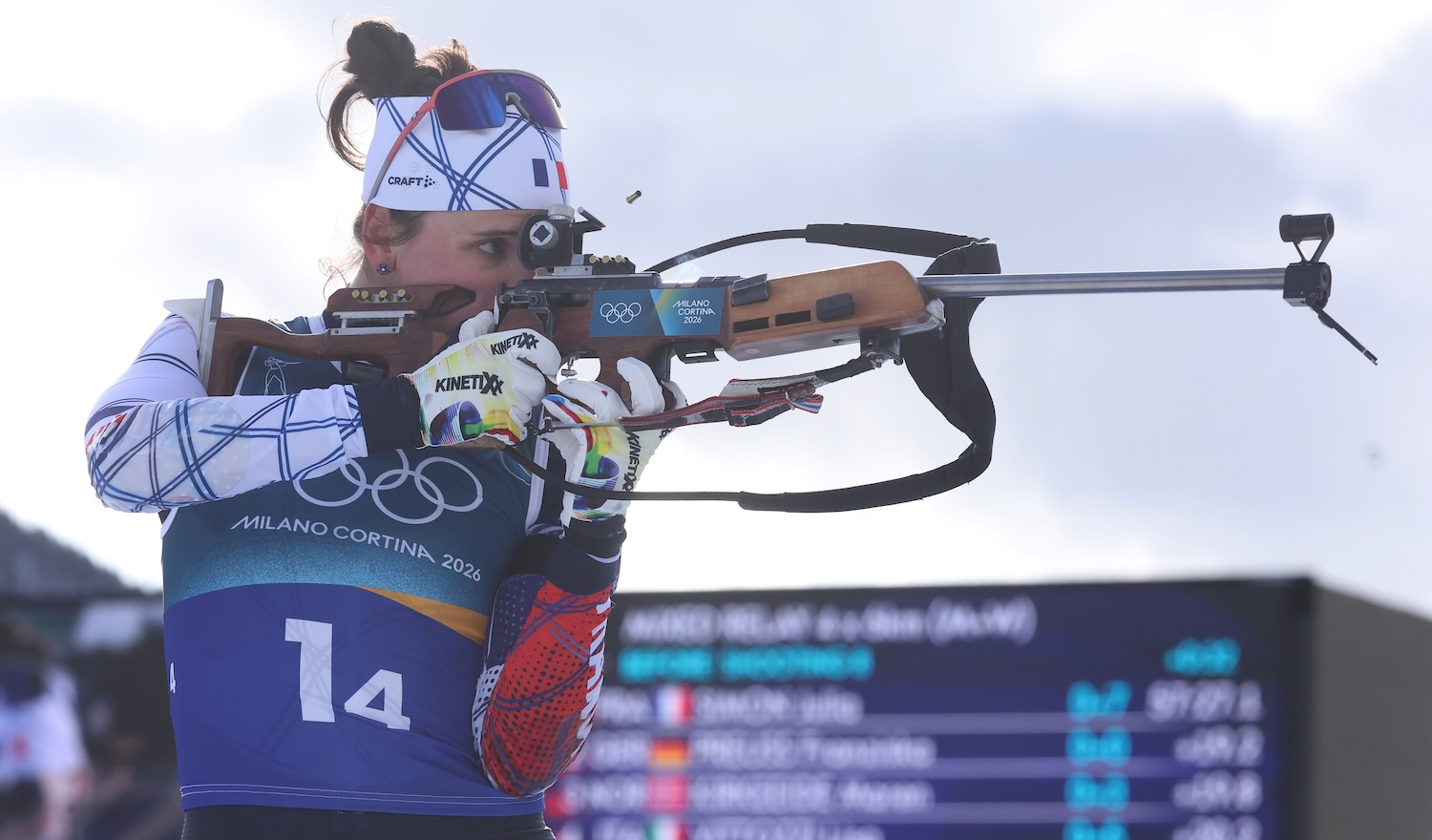
To the layperson, biathlon may be the strangest sport in the Winter Olympics. Most of the sports in the Games involve athletes testing the limits of the human body vis-á-vis gravity (e.g.: big air, ski jumping), sliding (curling, speed skating), or gravity and sliding (figure skating), emphasizing in the process the wintry specificity of it all. Say what you want about curling—and I will: It's fine!—but you cannot dispute that it is a game that takes place on ice. Biathlon, on the other hand, is an ungainly and somewhat seasonally ambiguous combination of cross-country skiing and shooting stuff with a gun. What does one have to do with the other? It took an athlete like Julia Simon for me to see what makes biathlon cool.
A brief note on the history of biathlon: It is the modern evolution of the military patrol event (scratch anything at the Olympics hard enough and you'll see the muscular nationalism beneath), wherein teams of skiers would ski some distance to a range, shoot some targets, then ski away. Switzerland won gold at the 1924 Olympics in Chamonix, and while the event was held thrice more, it was only as a demonstration sport. The IOC reintroduced military patrol as modern biathlon in 1960 at the Lake Tahoe Olympics, and gradually added more individual and team events with each passing decade. The Soviets (and their successors), Germans, and Norwegians dominated it for the next eight decades.
What makes a great biathlete is balance. There are surely better cross-country skiers and probably better shooters, but to excel at both the seemingly contradictory skillsets of the two sports, it takes a special athlete, someone prepared for both the exertive and meditative aspects of competition. In other words, it takes someone like Julia Simon. With 10 World Championship gold medals to her name, a silver at the 2022 Beijing Games in mixed relay, and several World Cup first-places, the 29-year-old Frenchwoman entered these Games as a favorite across the various disciplines—but nobody was talking about that in the months preceding her trip up to Cortina. They were talking about suspended sentences, lacrimal apologies, and credit-card fraud.
Last October, a French court handed Simon a three-month suspended jail sentence for theft and credit-card fraud, after she admitted to stealing the credit cards of teammate Justine Braisaz-Bouchet and an unnamed French team staffer, and making $2,300 in online purchases. "I can't explain it. I don't remember doing it. I can't make sense of it," she told a local French paper. Simon was given the short sentence, and while her participation in these here Games seemed doubtful, the French Skiing Federation loves winning medals, so it fined her and structured her suspension such that she got to participate in both the run-up events to the Games and the Games themselves.
In Simon's professional and personal conduct, we see an analogous challenge to the biathlete in competition. Just as the biathlete must balance effort and placidity, rage and focus, cardiovascular limit-testing and precise, mind-emptying breath work, so too is Simon the person forced to balance various contradictory positions. She is simultaneously a good teammate on the slopes and, in this specific case, someone who has caused her teammates pain. Everything seems to be pulling in opposite directions, and yet the balance holds. That's biathlon, the sporting manifestation of living in some form of turmoil, trying to maintain equilibrium amid a sea of troubles. Rarely do athletes themselves simultaneously cause and solve these problems themselves in such obvious ways, so I salute Simon for her demonstration of biathlon's values and sporting essence in such a clean, direct manner. There is pressure, and there is its resolution. That's the sport.
Simon anchored the French mixed relay team on Sunday. Her teammates set her up to bring the gold medal home on her final leg, and she left no doubt, shooting a perfect 10-for-10 to lock up the first gold medal for Team France. "I felt a bit of pressure, of course," Simon said. "But I felt very confident also because I knew what I had to do, especially on the shooting range. It was a nice race for all the team." In other words, Simon's relationship with pressure is not fear or apprehension, but something far more symbiotic.