
California: Perhaps you’ve heard of it? It is the edge of the continent, it is the apocalypse state, and it is the subject of many songs by the Red Hot Chili Peppers, though fewer than you might think.
California is one of Californian rock bands’ favorite things to sing about. The dreamy surface and its seedy underbelly, the all-consuming city and the bone-dry wastes of the valley, the homeless encampment outside the library-themed cocktail bar that is decorated with fake books: This is good material for rock music. See “Welcome to the Jungle”; see “California Uber Alles.” Even the songs that are supposed to highlight the sunny side end up saying something about the shitty side, if sometimes unintentionally. The sighing minor chords in Scott McKenzie’s “San Francisco” make the flower-power anthem sound a little like a funeral dirge for an already vanishing age, or like the song has a bad conscience about selling a dream it suspects might be false. Phantom Planet’s “California,” the theme song for The O.C., repeats its chorus—“California, here we coooooooooooooooome”—so many times that it starts to sound a little desperate, as though the band is trying to convince itself that the trip will be worthwhile. When you’re away, California evanesces into fantasy; when you’re there, you remember that it’s just a place.
There is a special insularity to a lot of Californian music. California, the mythic land of cults and communes, perfected the art of rock-as-subculture. No region, with the possible exception of Manchester, has produced a higher volume of what I’ve taken to calling "You had to be there" bands. The biggest two are the Bay Area’s Grateful Dead and L.A.’s Black Flag.
These are legendary rock bands, but—especially in the case of the Dead—it can sometimes be hard to tell what all the fuss is about just by listening to their records. When I lived in the Bay and found myself playing gigs in Santa Cruz, I would ask the old-time Deadheads there if they could explain the appeal to me. The answer was usually some variation of: It wasn’t just the music; it was the whole scene. The magic is to be found not in the music, or not only in the music, but in the social world it opens up.
Black Flag was more of a social-phenomenon band than a scene band. As they rolled through endless lineup changes and jammed econo across the country, they became icons of the DIY sensibility, to be emulated for their resourcefulness and defiance at least as much as for their music. It doesn’t surprise me that Black Flag’s Greg Ginn is himself a fan of the Dead. Both bands came to stand for something larger than themselves. To truly love either band is, in some way, to see yourself as a member of a group of misfits: wooks and hardcore kids, hitchhikers and couch crashers.
What do the Red Hot Chili Peppers stand for? Surely they stand for something. They are a T-shirt band; maybe one of the last. They have proven to boomers that the spirits of Sly and Hendrix live on, shown Gen Xers that white dudes in rock bands could rap and that even the most abrasive artists could dominate the charts with middle-of-the-road ballads, and taught millennials—through Stadium Arcadium, and through Guitar Hero—to rock. Gen Z has at the very least absorbed elements of their music secondhand, mostly by way of John Frusciante. (His solo releases crop up on vibe-based background music playlists not infrequently, and a perverted version of his signature two-note, wide-interval chord voicing has become a central part of contemporary Christian music’s vocabulary—and has entered the world of Nashville country through the megachurch back door.) They have sold a lot of albums, and they have been inducted into the Rock and Roll Hall of Fame, whatever that is worth these days.
In 2026, as for the past two decades and change, declaring yourself to be a fan of the Red Hot Chili Peppers doesn’t really signal anything about you as a person, except maybe that you are normal. The Red Hot Chili Peppers are a lot of normal people’s favorite band. Your coworkers probably like them. Maybe they shelled out untold hundreds of dollars to see them live a few years ago, and maybe they didn’t even realize that Josh Klinghoffer was a different guy from Frusciante. Maybe they haven’t heard any tracks off One Hot Minute, not even “Aeroplane.” Maybe they don’t even know who Hillel Slovak was.
You didn’t have to be there to get the Red Hot Chili Peppers: For the past quarter-century at least, wherever you went, there they were. Turn on the radio, and there’s Anthony Kiedis doing the “Doo doo doo doo zinga dong bone” part in “Soul to Squeeze”; hit the gym, and there’s the usually sharp Frusciante sounding truly lost on the “Californication” guitar solo. But keep listening and you’ll also find moments of real sublimity: the perfect “Come Together” bass line in “Give It Away,” those swelling vocal harmonies in “Can’t Stop.”
Still, the Chili Peppers’ sheer ubiquity can dull their charms. It is easier to cringe at them than appreciate them. How many times do we need to hear the California dream renewed or deflated, or renewed through deflation? How many sex raps must we endure, how many rehashed Hendrix riffs, and how much chitty chitty baby and zunga crunga? Do we need further convincing that Flea is very good at playing the bass, or that Chad Smith is an excellent drummer who also happens to look like Will Ferrell? Do we really need to see them shirtless or naked, or to hear about the sexagenarian Kiedis’s endless parade of very young girlfriends (or, via his odious autobiography, a foundational source of rock mythology for myself and many other millennials, much worse)? Must we go back under the bridge?
The Peppers speak the old California language of cosmic love and harmony. They talk about how they feel each other’s musical vibrations, and they make songs about loving your neighbor and standing up to racial hatred. They also make songs about heroin, and about having a girlfriend who is also your maid, and possibly your mom. Love, that overloaded word from the counterculture, is their central term. But the mainspring of their music is violence: crushing drums, ferociously slapped bass, fuzz guitar, yell-rapped vocals.
The love/violence dialectic came to animate much of the rock music of the late ‘60s, reaching its high point in Hendrix’s alien lovescapes and earthly conflagrations. In the ‘80s, the Peppers retooled this dialectic for a Reaganite dystopia—and for an L.A. hemorrhaging the stable manufacturing jobs on which the city’s multiethnic working class had depended. Their early songs sketch a bleak picture of L.A., where police helicopters circle like buzzards and junkies skitter through the streets. Even the psychedelic elements of their early music are lonely and apocalyptic rather than warm and communal: Volcanos erupt in Hollywood; a single warrior rides a sabertooth tiger out into the Hollywood Hills, where he’ll live off the land by himself. These are images of regression and desublimation.
And nothing is more desublimated in their music than love itself. Every Peppers song that rhapsodizes about utopian love, mind-expanding love in the fullest countercultural sense, also makes it very clear that beneath all this hippie patter, there heaves a carnal lust bordering on the predatory.
In the American imagination, California is the site of the future, but it is also the land of regression. We like to imagine its great cliffs sliding into the ocean and its forests charred to oblivion. Frank Norris’s 1899 novel McTeague, a classic of literary naturalism, charts the degeneration of a San Francisco dentist into a base creature without reason, just brute strength and instinct. His final devolution, in which he is reduced to just “stupidly looking around him” and waiting around to die, happens out in the wastes of Death Valley. This is what California can do to you.
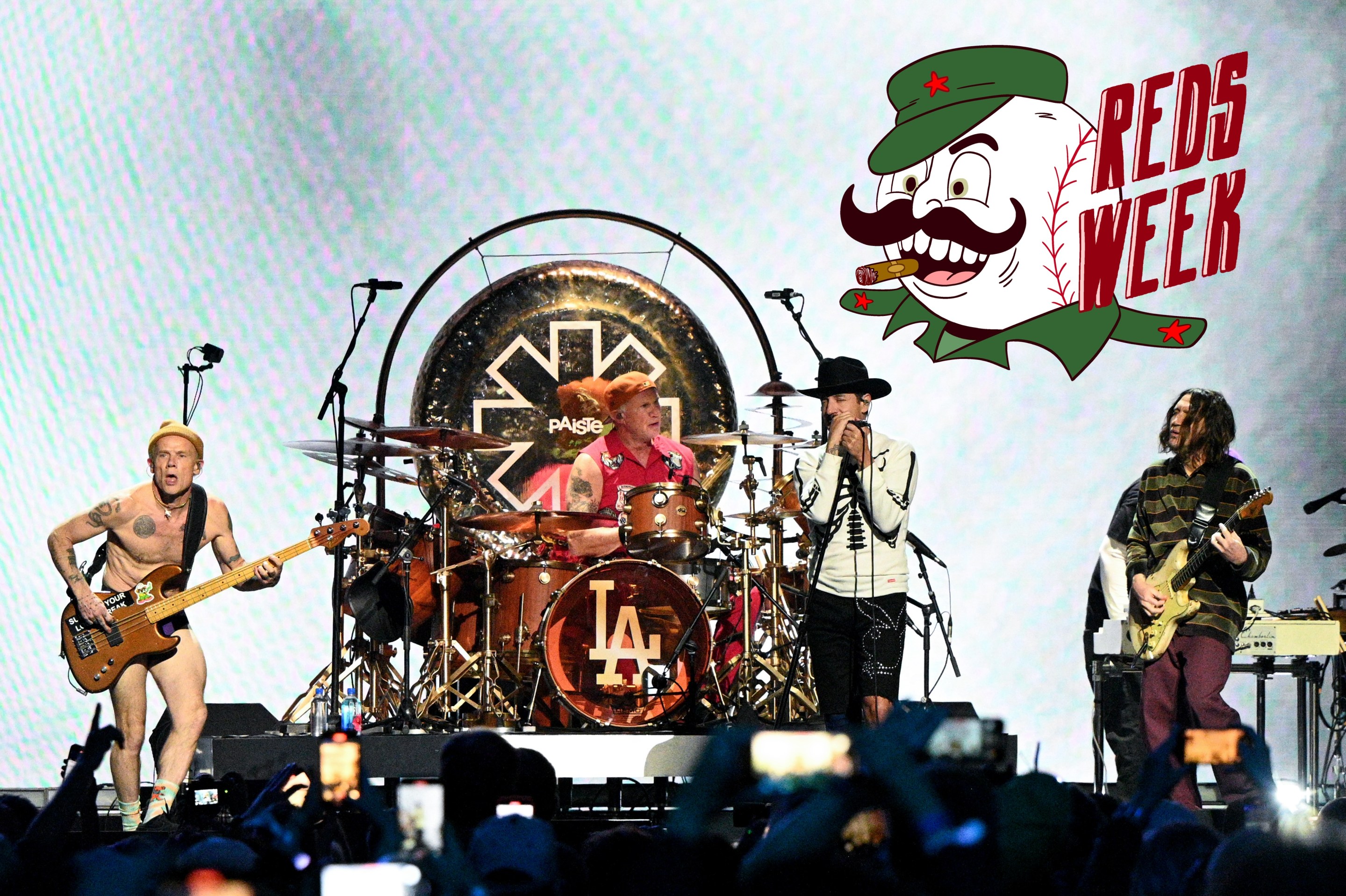
The Red Hot Chili Peppers’ music issues from this state of nature. The band takes the stage shirtless, or wearing nothing but a single sock. They jump around and flail like hyperactive children. They even look like toddlers: As one YouTube commenter puts it, “Flea looks three and 54 years old at the same time.” They babble and scream.
These anarchic outbursts happen against the backdrop of extremely regimented music. Their innovation was to unite three different modes of highly metronomic rhythm: funk, new wave, and metal. The producer most closely associated with the band is the guru-stooge Rick Rubin, who presided over their blockbuster records of the ‘90s and beyond, but it’s worth remembering and marveling at the fact that their first album was produced by Gang of Four guitarist Andy Gill and their second was produced by none other than George Clinton. From the start, they were schooled well in the arts of the machinic hi-hat and the invariant guitar riff. Against this hyper-rationalized grid, in the musical wasteland, the figures regress to fitful and inarticulate childhood.
Since modernism, regression has often paradoxically been a path to artistic progress, or at least renewal. Childishness and stupidity—beyond rock and roll’s fundamental childishness and stupidity, that is—were important values to transgressive bands of the ’60s like the Velvet Underground and the Stooges. They remained so into the ‘70s, when punk announced itself as a purifying return to first principles.
The Peppers’ idiocy was different. It did not produce anything aesthetically new, but it did prove sociologically prophetic. The modern type of the man-child, in both its horny-pubescent and scatological-prepubescent forms, finds one of its earliest musical expressions in their performances. The strung-out bro antics of Sublime, the arrested development of Blink-182, the sophomoric violence of Limp Bizkit—and going further afield, the extreme class-clowning of the Jackass cast and Jim Carrey’s machinic-organic sexless-lothario character in The Mask: All of these performances bear more than trace elements of the Peppers, or at least of the type they captured early on in its development.
The man-child occupies a different position from the causeless rebel or the true nihilist. He doesn’t want to throw off the yoke of the system; there is barely any system left. There is no paternal authority to stick it to, and there is no code of principles to bind him; even the anti-principle of believing in nothing requires too much conviction. There is no good life ahead for him, no possibility for advancement, so he lingers on the threshold of adulthood or tries to crawl back into the womb. Stewing in his filth, he gets off on his own abjection. He also gets off on regressing. On the cover of their 1989 album Mother’s Milk, the Peppers snuggle up in the arms of a giant shirtless woman.
The Peppers did experiment with other positions and personae. Some of their early music summoned unfocused bursts of political rage, often about the dispossession of indigenous peoples, drawing on family lore about Kiedis’s apparent Mohican ancestry. (He goes so far as to yell “Red power!” on the final track on Mother’s Milk.) In the mid ‘80s, there was theoretically a path available for the Peppers to develop this tendency by following the currents of militant, politically engaged hip-hop from the East Coast. But the Peppers have always been California boys—and from Kiedis’s two or three stock flows, there’s little evidence that he ever closely studied any rappers after Grandmaster Flash.
Perhaps they sensed which way the wind was blowing. At the end of the ‘80s, as Joshua Clover argued in his book 1989: Bob Dylan Didn’t Have This to Sing About, punk and hip-hop both started to turn their spirit of antagonism inward. The internecine conflicts of gangsta began to eclipse the Black-nationalist militancy of groups like Public Enemy; meanwhile, grunge took punk’s ethos of collective struggle and shrunk its scale, reducing it to the depressed individual’s battle with his own demons. The Peppers, fans of punk and hip-hop alike, were caught up in this moment, but they managed its contradictions in a different way.
“Well, I got tapes, I got CDs / I got my Public Enemy,” Kiedis raps on “The Power of Equality,” the opening track on their world-dominating 1991 album Blood Sugar Sex Magik. And yet despite the name drop, and despite its impressionistic inventory of the failed promises of the Civil Rights movement, the song doesn’t throw its lot in with the Black Power politics that found an especially trenchant expression in the previous year’s Fear of a Black Planet. Instead, everything oppositional is defused into a stale hippie musk of peace, love, and understanding. The song ends with a limp, murmured rhetorical question: “Whatever happened to humanity?”—and then the funk rolls on, with Frusciante’s scratchy guitar riff kicking off the next track, leaving humanity in the dust.
On Blood Sugar, the California-talk of peace and love is not simply a screen for horny man-children acting out, as in lines like the title track’s “Every woman has a piece of Aphrodite / Copulate to create a state of sexual light.” The peace-speak itself is also man-childish. The social-issue songs on Blood Sugar confront social antagonism with a false bravado that crumbles into childish petulance: Why is everyone fighting? Geopolitically, history was supposed to be over; the adults in the room had everything under control. But in culture, the man-child was having his day. Despite all the Peppers’ love-your-neighbor talk, this was a lonely figure: impotently punishing himself for his immaturity on “Breaking the Girl,” cruising the streets alone and trying to stave off oblivion on “Under the Bridge.”
If the great achievement of Nevermind, 1991’s other marquee rock album by a West Coast band from the extended punk universe, was to make all this introjection of violent antagonism sound dangerous and transgressive, Blood Sugar’s achievement was to make it sound like big, dumb fun. It is a huge-sounding album, thanks in large part to Rubin and engineer Brendan O’Brien. The drums thunder; the bass growls; the guitars cover every frequency. And let’s be honest: The vocals sound incredible. While we’re at it, let’s be honest about something else: “Give It Away” is an all-time great rock song, a masterwork of difference through repetition. (Listen again and notice how the instrumentation on the chorus is just a little bit different each time, and how the guitar riff evolves slowly over the course of the song.)
On the whole, Blood Sugar is a monumental album; it stands apart from its time, even as it is inevitably a product of it. With its big stylistic tent—but with rock still as the central pole —with its residual interest in the ‘60s counterculture, even as it scrambles the terms of that moment and gives them new meanings, and with its swaggering desire to reach the broadest possible audience, seeming to say with every second of every song that billions must listen, it’s tempting to call it the last-ever classic rock album.
And yet all the regressive shriveling that Blood Sugar overcame or at least held at bay with its massive songs and world-beating production would eventually become a problem in the Peppers’ music. Eight years later—we will skip over 1995’s One Hot Minute—by the time Californication arrived, it was clear that the band was working with dead materials. They could still create paint-by-numbers funk rock, and they followed “Under the Bridge” with mellow addiction songs like “Scar Tissue” and “Otherside.” But what had felt effortlessly universal on Blood Sugar, perhaps as an artifact of the brief expansion of musical possibilities across the board in 1991, felt curiously small and labored on Californication.
Nowhere was this more apparent than in the mastering. As if to compensate for the extreme sparseness of many of the arrangements (and the weediness of the cleaner guitar sounds; never has a Gretsch White Falcon, the fabled “Cadillac of electric guitars,” sounded worse), the album was compressed within an inch of its life, aggressively cranking up soft moments and strangling loud moments. It is a small-sounding album trying to puff itself up to sound big. The childish energy that fueled their music up through Blood Sugar was somehow diminished, petering out into something like the extinction burst at the end of a tantrum.
Another way of saying this is: Californication was an album in an idiom that was about to become marginal, trying to present itself as dominant. Writing for Pitchfork at the time, Brent DiCrescenzo argued, right after decrying the poor spelling (?) of hip-hop artists:
“Basicially [sic], the Chili Peppers are the closest thing we have to a Led Zepplin [sic] today. If you want quality, commercial, Jeep- stereo, headphone, stadium- filling, champion Rock that you can get behind, where else are you going to turn?”
Where else indeed? DiCrescenzo was right. As it turned out, the Red Hot Chili Peppers are the last rock band to achieve their level of iconicity and cultural dominance. They are the last to achieve the inverse of the Dead or Black Flag phenomenon and become the default normie consensus pick. They are the last to carry forward the love-spirit of the counterculture and actually kind of believe in it rather than simply using it as stylistic window-dressing. Their music is beyond cringe and transcendent, beyond good and evil. It is simply force. They are the man-children at the end of history, at the end of rock history, riding paisley dragons into the Hollywood Hills as the city burns.