
The most awe-inspiring thing in music is when an artist takes over the world. At least back when there was a monoculture, it was possible for a single person to dominate collective attention, at least for awhile. And 1998 should always be remembered as the year DMX did just that.
Throughout the '90s, Earl Simmons, a.k.a. DMX, had been making waves that steadily grew into real, earth-shaking tremors over the back half of the decade. Prominent guest spots on songs like Mic Geronimo's 1995 track "Time to Build," where X traded verses with fellow burgeoning acts Jay-Z and Ja Rule, the LL Cool J–led posse cut "4, 3, 2, 1" in 1997, and the Lox's single "Money, Power, Respect" in early 1998 indicated that he was on the cusp of a full breakout. While 1998 marked a definitive before and after, his ascent that year was the culmination of a long, hard struggle to break into the industry.
The Yonkers native's potential for pop stardom wasn't always obvious, due to his extremely raw and aggressive style and penchant for literally barking like a dog on tracks. But the rap community itself had long respected his talent. As early as 1991, the 20-year-old X was making his name on NYC's underground circuit, getting named in the Source's Unsigned Hype column and appearing on the Stretch and Bobbito radio show. Despite those bona fides, record labels considered him too street, too gritty for where rap was headed in the Bad Boy days of pop-rap success and excess. By 1998, even Jay was making his own glossy Puff Daddy-inspired records. As the turn of the millennium neared, X and the music industry seemed to be moving in opposite directions. Already deep into his 20s at that point and still without a debut album, DMX's career was at a crossroads.
But he had his champions. Namely, Joaquin (better known as "Waah"), Darrin ("Dee"), and Chivon Dean, the three brothers who founded Ruff Ryders Entertainment in 1988. The brothers had a relationship with producer Chad "Dr. Ceuss" Elliott, who introduced X to the circle. It was there that X met his biggest believer, Irving Lorenzo a.k.a. Irv Gotti, a nascent producer and Elliott's roommate at the time. According to Gotti, he first met DMX in a bombed-out Yonkers building; X stuck his head out of a broken window, sharp glass all around him, to let Irv know he'd be out in a second. X was the first serious rapper Gotti worked with as a producer. His first beat, made on a drum machine he'd convinced Waah to buy for him, was for the DMX single "Make A Move."
Ruff Ryders' biggest early success was getting Jadakiss, Styles P, and Sheek Louch a deal at Bad Boy as The Lox. Puff, though, did not see a star in DMX for all the same reasons no one else did, and so X stayed on the shelf. His break would eventually come when Def Jam made Gotti an A&R off the strength of bringing the likes of Jay-Z and Ja Rule to the label. His first order of business was to try to bring DMX on board, much to the chagrin of his bosses. Gotti was so dead set on signing X that he even quit the gig after only a couple weeks because of the resistance he faced from the suits. Gotti was gone for a week before Def Jam president Lyor Cohen personally sent for him and asked what the issue was. Cohen and Gotti eventually made the trip to Yonkers, to the Ruff Ryders home base at Powerhouse Studios, for an audition of sorts. At the time, X had his jaw wired shut because of an injury; the legend about the audition was that he rapped so hard that you could hear the wires snapping off. Cohen loved it, and DMX got his deal in 1997. He spent the rest of the year working on his debut album.
DMX's 1998 is unlike any other rapper's biggest year, but you can forgive people for not necessarily seeing it. Coming out of the era dominated by 2Pac and Biggie, rap was about big-game fishing at that time. What the industry wanted was big, obvious stars. That wasn't exactly X, at least not right away. He was dark, traumatized, and off-kilter; again, he literally barked like an angry dog on songs. He didn't fit those jiggy shiny suits, or into the formal wear of a slick mafioso type. He was gutter. Gotti and the Ruff Ryders understood that, and also understood the massive potential inside that abrasive image. That's why Gotti would walk around Def Jam offices, crowing about how X's debut was going to sell five million records. "Let's take it back to the streets, motherfucker!" goes the opening line of "Get at Me Dog," X's first Def Jam single. Gotti knew X would do just that, and believed that he'd reap enormous rewards for doing so. He was right.
"Get at Me Dog" is a good record, a gold record, and Gotti liked to claim that it and its video put an end to the shiny suit era. But it's not the song that made DMX a superstar. The record that did that was one X originally didn't even want to make. He thought the beat was too simple, probably because it was one of the first beats made by Waah's 17-year-old nephew, Swizz Beatz. Waah decided the way to get X to do the record was to play cards for it, because he knew X was a bad gambler. When X eventually lost, he decided to rap just as simplistically as he found the beat. But that simplicity was what made "Ruff Ryders' Anthem" the smash of the summer, which in turn helped X's debut album It's Dark and Hell Is Hot, released in May of 1998, go quadruple platinum in the U.S.
"Ruff Ryders' Anthem," both the song and the video, sells you on DMX in less than five minutes. He is as menacing and rough as the labels feared, but he's also extremely cool, which makes him alluring. He can rap and craft a good hook and, as on "Ruff Ryders' Anthem," knows not to get in the way of a good pop record by doing too much. The final single from It's Dark, "How's It Goin' Down," was meant to be the "for the girls" record, the one that would cement X as a 2Pac-like sex symbol, but his shirtless look in the "Ruff Ryders' Anthem" video had already accomplished that on its own. ("How's It Goin' Down" is still a great song, though.)
It's Dark and Hell Is Hot debuted at No. 1 on the Billboard 200. The singles were huge and fun, but on the whole, the album painted the portrait of a tortured soul—full of pain, depression, rage, trauma, and suicidal ideation, all of which spoke to his harsh upbringing. The dog persona, and all that barking, spoke to X's love for and identification with his pet dogs, loyal creatures that move on their own accord. "Damien" is a succinct encapsulation of the X experience. On it, he voices both himself and the devil as a corrupting force instructing him to rob, steal, and kill in order to survive.
If X had only put out that one album in 1998, it would've made for an all-time year. But his celebrity was about to hit yet another level. Gotti's friend Hype Williams cast X as the star of his directorial debut, the cinematic classic (if you play it on mute) Belly, which premiered in the fall of 1998. Belly did not exactly light the box office on fire—though its visual genius is now belatedly appreciated—but it did showcase X as a potential movie star, and opened up a sideline that would pay dividends in the years to come. If that wasn't enough, the release of the film was soon followed by DMX's sophomore album right before 1998 came to a close.
It's Dark and Belly combined to make X the hottest rapper in the game. Cohen, looking to strike while the iron was hot, promised DMX a million-dollar bonus if he could finish another album before the year ended. The result of that wager was Flesh of My Flesh, Blood of My Blood, an appropriately spiritual title for a spiritual album. Its blood-drenched cover art is one of the most memorable in rap history. Flesh of My Flesh toggled between the rapper savoring the success he'd chased for so long, fearing what that success might mean for his soul, and discovering that money and fame don't magically fix what's broken. While it may not be quite at the tier of the first album, Flesh of My Flesh does have one of X's best singles, the mournful "Slippin'." It also accomplished its goal, giving X a second Billboard-topping album and going triple platinum domestically. No rapper had sold more records in a year since 2Pac in 1996.
My introduction to DMX started with "Ruff Ryders' Anthem." Turns out, it's a lot of fun to be a child when a song like that comes out—running through the halls screaming "STOP. DROP. SHUT 'EM DOWN, OPEN UP SHOP." Luckily, I could depend on my big cousin to have any popular album I wasn't allowed to have myself (which was most of them). I spent a lot of time in his room listening to both of DMX's 1998 albums on my CD player, simultaneously drawn to and terrified by X's gruff delivery and sinister lyrics. X combined 2Pac's passionate anger at the circumstances of poverty in America with the shocking "I can't believe he just said that" effrontery that would make Eminem a superstar the following year. But where Eminem was winking and detached, X said his crazy shit in a way that made you think he actually was capable of it. Where 2Pac was political, X was more spiritual, wrestling with the devil and God inside himself. He had been dropped in the gutter and fought his way out, and now he was leading a revolution for the downtrodden. He wasn't an activist or preacher, but he captured the power of those types of leaders. It made his fan base large and fiercely loyal. Jay-Z would talk about this when he watched him perform every night on the Hard Knock Life Tour the next year.
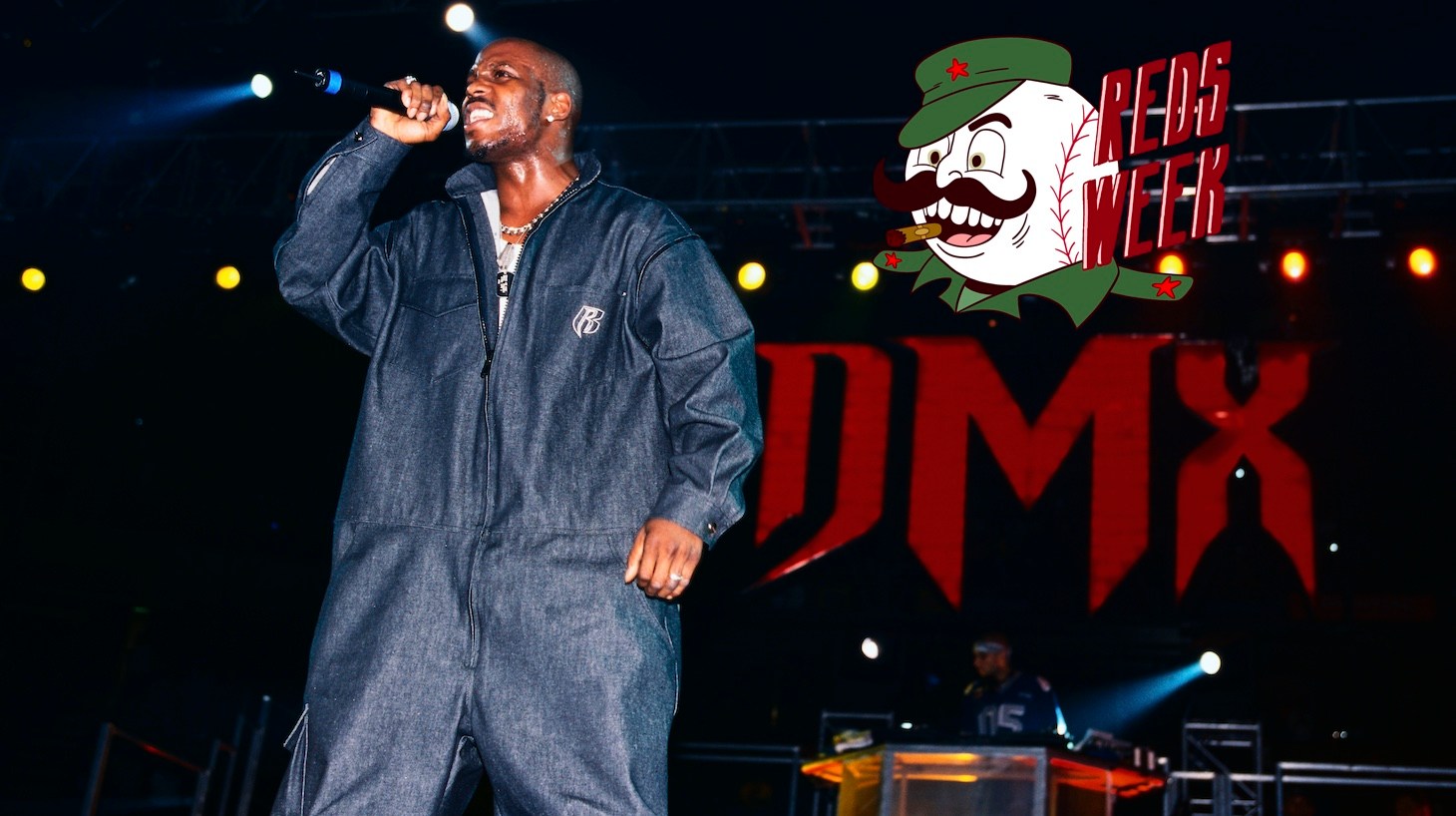
You could also see that effect X had on an audience when he performed at Woodstock '99. Without pyrotechnics or a dance routine, he captivated a sea of people with every move made and every grizzled murmur. DMX in that era is to me the definition of a rap superstar, a reflection of the beauty and the madness America produces.
X died of a heart attack at the age of 50 in 2021. He had lived hard, and despite all that success in 1998, things would never be easy for him. He struggled with drugs, fame, and faith. He fell out with Ruff Ryders, Def Jam, Jay-Z, and his wife, the mother of most of his kids. His life was always messy, and that was part of why he was so beloved; he wasn't clean-cut and never pretended to be. The world feels emptier without him, though at least we'll always have his music, and the image of him in 1998, when he soared so high it looked like he could touch God.