I was a Mystery Kid, and every Mystery Kid knows how that goes. Only stories of remarkable children—Nancy Drew, Frank and Joe Hardy, Encyclopedia Brown—could enliven my unremarkable life. Recently I was marveling to my parents that so many Encyclopedia Brown stories had stayed with me, more than two decades after I read them. At least, little fragments had. In my memory, the premises had faded, so that all that remained was this potpourri of solutions you’d find in the back of the book: that "bookkeeper" is the only word in the English language with three pairs of double letters in consecutive order; that the blind violinist’s friend scammed him with frozen cubes of ginger ale; that anyone who fought in the First Battle of Bull Run couldn't have known there’d be a second. I've read whole history books and forgotten them, but I will always know that Jason was the kidnapper because "7891011" means "July August September October November."
Ever a sucker for plucky heroines, I liked Encyclopedia’s sidekick Sally Kimball. She was pretty, athletic, always defending her friend from town bully Bugs Meany. Once she solved a mystery that stumped Encyclopedia, because she knew women’s shirts have buttons on the left. Encyclopedia couldn’t believe it. “That,” Sally said, “is because you are a boy.”
There were too few plucky heroines in The Hardy Boys for my liking. The brothers leaned less on cleverness than on disregard for their own physical safety. They were always walloping bad guys, to great success, in the “solar plexus.” I didn’t even know what the solar plexus was. Nancy Drew, though, lived a life of the mind. Her style was understated: Sweet smiles, close observation. I envied the way everyone adored her: her lawyer dad, Carson; Hannah Gruen, the housekeeper; Nancy’s boyfriend Ned Nickerson, who was tall and handsome, and crucially not around very much. He never minded when Nancy canceled plans because she had a mystery to solve.
If every Mystery Kid shared one set of obsessions, they probably shared one set of disappointments, too. My own neighborhood had no mysteries for me to solve. No one was missing anything. No one’s will was stuck in a stolen heirloom. Of greater disappointment was the way that all the eclectic and careful contrivances of literary mystery kept bumping up against the patterns and senselessness of most actual crime.
When I was nine, a woman a few towns away went missing. For weeks, I was glued to the Detroit Free Press, scrambling to the mailbox after school for the latest development until one day my mother told me, gently, that it was kind of obvious now: The husband had fled when police searched their home. You didn’t exactly have to flip to the back of the book for that one. Sometimes guys just grow resentful of their wives and kill them after an argument—nothing mysterious to it. Maybe life as a Mystery Kid explains my revulsion with “true crime,” an industry that asks you scan strangers’ lives for clues to string together in Encyclopedia Brown-style conclusions. How have these people never learned that a Mystery Childhood is something to be outgrown?
A Mystery Kid’s next stop is usually Sherlock Holmes, and so mine was. We had this fat purple collection of Holmes stories, with one of those ribbons sewn into the binding to use as a bookmark. Such a great opening line: “To Sherlock Holmes she is always the woman.” As I read, I picked at the bookmark until it frayed.
My favorite Holmes story was called “The Red-Headed League,” which Arthur Conan Doyle wrote in 1891 and later considered among his favorites for “the originality of the plot.” In it, a pawnbroker named Mr. Jabez Wilson—“nothing remarkable about the man save his blazing red head”—comes to 221B Baker Street wondering if a prank has been played on him. A few months ago, he responded to a curious newspaper advertisement:
TO THE RED-HEADED LEAGUE: On account of the bequest of the late Ezekiah Hopkins, of Lebanon, Pa., U. S. A., there is now another vacancy open which entitles a member of the League to a salary of four pounds a week for purely nominal services. All red-headed men who are sound in body and mind and above the age of twenty-one years are eligible. Apply in person on Monday, at eleven o’ clock, to Duncan Ross, at the offices of the League, 7 Pope’s Court, Fleet Street.
At the encouragement of his assistant, Mr. Jabez Wilson applied and got the job, which he learned was to copy out pages of the Encyclopedia Britannica from 10 a.m. to 2 p.m. every day. Eight weeks passed. Before he could get to the B’s, he arrived at work to find the door locked and a sign on the door:
THE RED-HEADED LEAGUE IS DISSOLVED. Oct. 9, 1890.
Doyle wasn’t wrong to admire the originality of his own plot, though it should also be pointed out that “The Red-Headed League” belongs to one awfully rich strain of Holmes stories, wherein a dumbass accepts an obviously sketchy job under equally sketchy circumstances. There’s the governess in “The Adventure of the Copper Beeches” whose new employers make her cut her hair short. In “The Adventure of the Stockbroker’s Clerk,” a guy gets a job at a brokerage firm and then, before he starts, is offered a better job at a different brokerage firm on the condition that he not tell the first brokerage firm he’s reneging on their offer. Among Doyle’s other favorites was “The Adventure of the Greek Interpreter.” The titular interpreter makes a house call to conduct some kind of emergency Greek translation job and finds paper covering the windows of the car sent to pick him up.
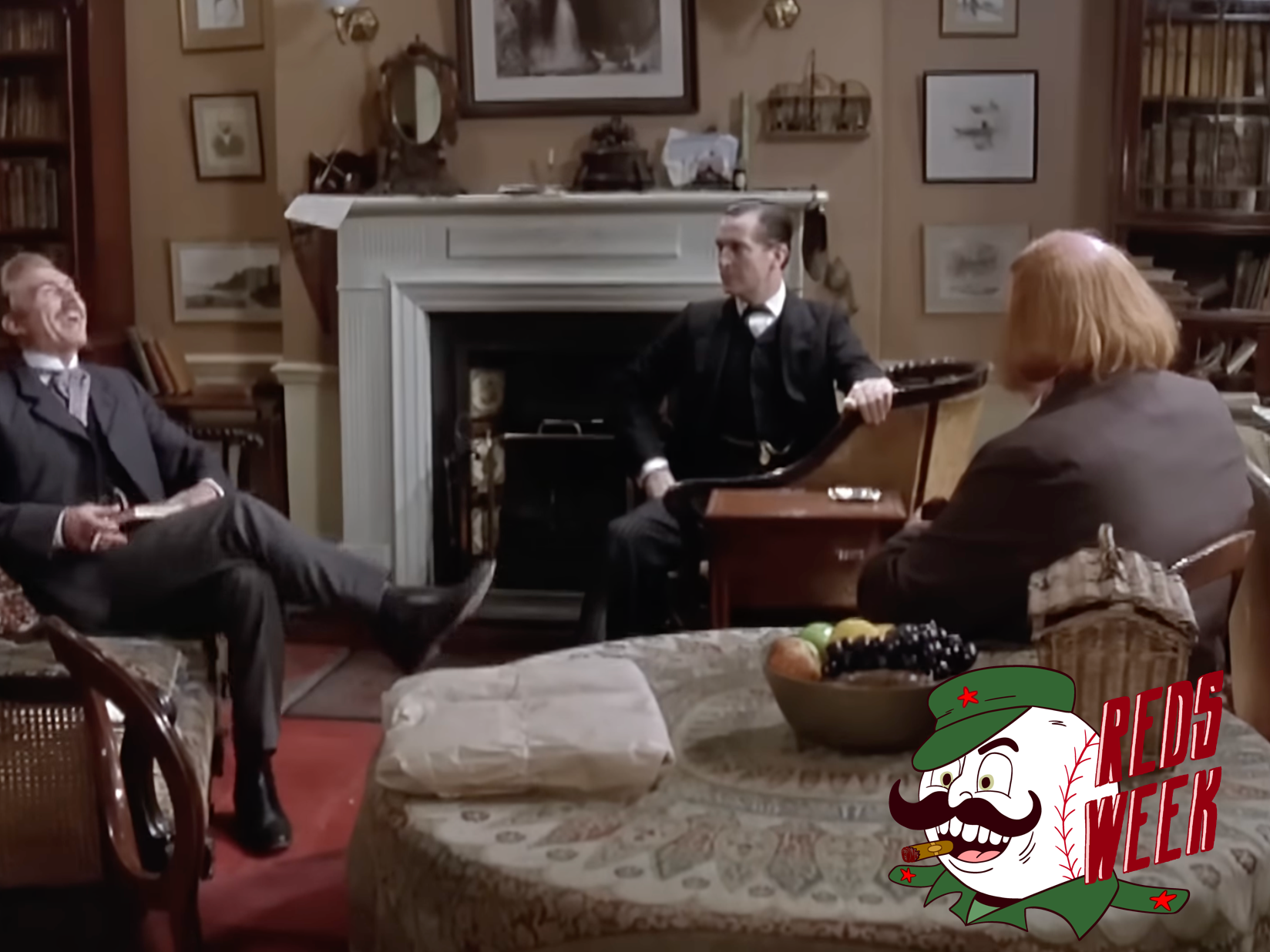
In “The Red-Headed League,” Doyle acknowledges the story’s own contrivance. After Mr. Jabez Wilson finished his story, Watson writes, “Sherlock Holmes and I surveyed this curt announcement and the rueful face behind it, until the comical side of the affair so completely overtopped every consideration that we both burst out into a roar of laughter.” Yes, the story itself announces, the premise of this mystery is really stupid. It’s rare that Holmes and Watson laugh at one of the sadsacks seeking out Holmes’s help, which makes it such a disarming scene, one that lends itself well to adaptation. The corresponding episode of the old Jeremy Brett Sherlock Holmes show changes some details, but leaves this bit in, and it’s the funniest part—maybe second to the bit of physical comedy at 4:33, where Holmes leaps over his office couch.
Mr. Jabez Wilson, already feeling vulnerable, is less entertained. However absurd the story, it’s unsettling to be a part of something whose true shape you can’t see.
The character of Sherlock Holmes often forced Doyle to stack one contrivance atop another. Holmes’s powers of deduction are so sharp that he arrives at answers too quickly for the pace of even a short story, and Doyle has to keep the true shape of every mystery from Watson (and by extension, the reader) until Holmes can debrief with Watson at the end. “A most mysterious business,” Watson calls it after Mr. Jabez Wilson leaves. But Holmes disagrees. “As a rule,” he said, “the more bizarre a thing is the less mysterious it proves to be. It is your commonplace, featureless crimes which are really puzzling, just as a commonplace face is the most difficult to identify.”
After Holmes smokes for a bit, the two set out for a walk. In front of Mr. Jabez Wilson’s pawnbroker shop, Holmes raps on the pavement with his cane. He knocks on the shop’s door and studies the trousers of the assistant who answers. They walk around the block, Holmes noting the order of all the shops and houses.
I’ve solved one Holmes story before Watson (“A Case of Identity”), the great pride of my young reading career, but this one I did not: The Red-Headed League was just a ploy to get Mr. Jabez Wilson away from his business every morning, so the assistant could dig a tunnel under his shop, which abuts a bank. When Holmes explains later, after the police stakeout, Watson is awestruck as usual. The story ends with what I could only read as the anthem of the Mystery Kid. “My life is spent in one long effort to escape from the commonplaces of existence,” Holmes tells Watson over whisky and soda back at 221B. “These little problems help me to do so.”