

There are many reasons why the Seattle Seahawks comfortably dispatched the New England Patriots in Super Bowl 60. The Seahawks offense, led by Super Bowl MVP Kenneth Walker III, was able to do enough against a very game Pats defense to never feel pressured into taking any major risks. After a turnover-free Super Bowl, Seattle finished with zero playoff giveaways, an incredible feat. Seahawks punter Michael Dickson was a machine when the offense did get stopped, putting three punts inside the 20-yard line, two of them within the 5. Kicker Jason Myers was flawless, hitting five field goals and two extra points right down the middle.
After a beating that thorough, you might imagine that it would be hard to point to one specific factor that really swung the game in Seattle's direction. But in this case, the culprit was obvious: the Battle of Cannae–style L the Pats' offensive line suffered.
Derick Hall com o primeiro sack da noite! 😤
— NFL Brasil (@NFLBrasil) February 9, 2026
📺: #SuperBowlLX 20h30 - @ESPNBrasil, @sportv, GETV e NFL Game Pass pic.twitter.com/HLXHNQY9mk
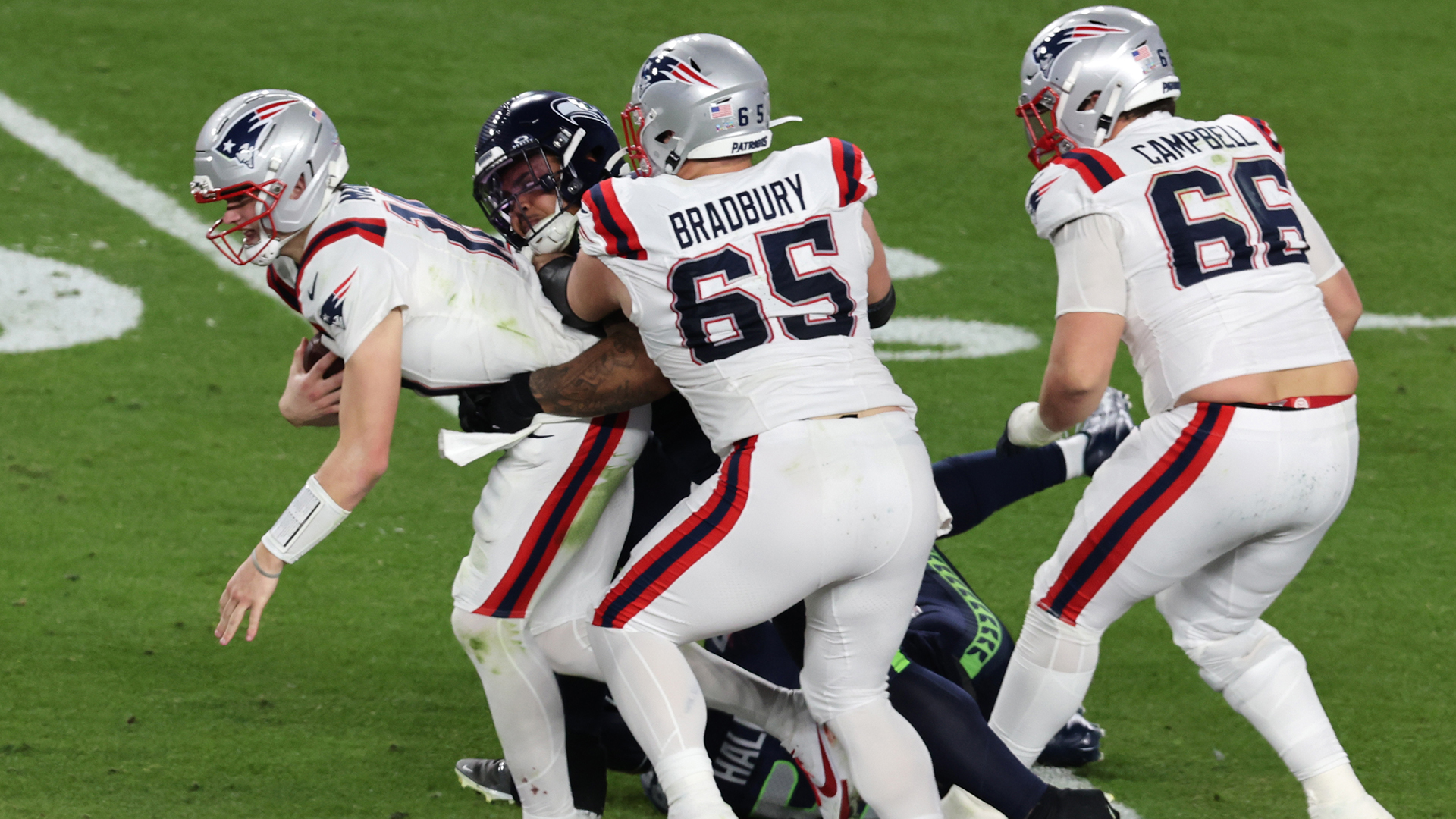
In the buildup to Da Big Game, the Pats' offensive line, and specifically the left side of that unit, which featured a pair of rookies—left tackle and short-arm haver Will Campbell, and left guard Jared Wilson—screamed "weakness," especially against a defense this fast, strong, and creatively schemed. As expected, Seattle's advantage in the trenches proved decisive, both statistically and in terms of how ugly everything looked for the Pats' attempts to protect Drake Maye.
Let's do stats first. Maye was sacked six times, just one shy of the Super Bowl record, to go with 19 pressures. Though Maye finished with 295 passing yards, those numbers were padded with lots of empty-calorie gains after the game was mostly wrapped up. When New England was still in the game (again, thanks entirely to the defense's excellent outing), Maye simply could not get enough time to build any rhythm or hit any passes downfield. The running game was also bottled up for most of the evening, killing the Pats' chances of using play-action with any effectiveness. This left Maye to fight for his life, a fight he mostly lost: The second-year QB fumbled once, got intercepted for a touchdown on something that looked like a fumble in real time, and was so jittery that he threw maybe the worst pass I've ever seen in a Super Bowl. You could tell Maye just wanted to get the ball out at any cost, and the cost of this particular throw was as easy of a pick as Julian Love will ever get:
A defesa dos Seahawks é absurdaaaa! 😳
— NFL Brasil (@NFLBrasil) February 9, 2026
JULIAN LOVE é o nome dele!!
📺: #SuperBowlLX - @ESPNBrasil, @sportv, GETV e NFL Game Pass pic.twitter.com/bNFWf6s5ZD
Campbell especially had a horrible game at left tackle, and he'll take most of the brunt of the blame here, especially after he skipped the postgame press conferences. (Maybe he really did die as promised?) The knock on the former LSU lineman coming into the draft was that his arms are too short for the NFL. That criticism didn't seem to pan out during the bulk of the season: Campbell was very good, if not exactly great, through the Pats' 14-3 stomp through an easy schedule. Once the playoffs started, though, and New England faced three defenses ranked in the top seven by DVOA, the wheels began to wobble before fully coming off on Sunday. The Seahawks targeted Campbell's weaknesses in leverage throughout the game, sending multiple bull rushes in his direction. Even though it didn't count, the most exemplary play came late in the second quarter: Campbell flinched slightly before the snap, drawing a false start, but he might have been lucky to get the flag, because he was completely knocked over by Uchenna Nwosu thanks to poor balance.
Wilson didn't fare much better beside Campbell. If one play best demonstrated Seattle's dominance, it was Rylie Mills's first career sack in the second quarter. The Seahawks' rookie end simply overpowered Wilson and dragged him backward into Maye, dropping both the quarterback and the guard.
O primeiro sack da carreira do Rylie Mills foi num Super Bowl. 😌
— NFL Brasil (@NFLBrasil) February 9, 2026
📺: #SuperBowlLX - @ESPNBrasil, @sportv, GETV e NFL Game Pass pic.twitter.com/sRj1tZEj3Z
Even when the left side wasn't faltering, Seattle's scheming made inroads on the right side. Twice, Mike Macdonald sent Devon Witherspoon on a delayed blitz from the safety spot, both times getting through cleanly for a hit on Maye, sacking him once and forcing the aforementioned pick-six. Macdonald deserves a lot of credit for the Seattle defense's stoutness, but those two play calls might have been his best work yet. Thanks to the Seahawks deploying mostly zone coverage, Macdonald trusted that his defensive backs would disrupt Maye's quick-pass rhythm for long enough to get these longer-developing blitzes to hit the mark, and it worked.
A DEFESA DE SEATTLE É INSANA.
— NFL Brasil (@NFLBrasil) February 9, 2026
📺: #SuperBowlLX 20h30 - @ESPNBrasil, @sportv, GETV e NFL Game Pass pic.twitter.com/BvsiGuZNCz
Could Maye have done better on Sunday, even in the face of relentless pressure? Almost certainly, and offensive coordinator Josh McDaniels also could have schemed more screens and even quicker passing routes to relieve some of the pressure and force Seattle to adapt. It probably wouldn't have mattered; even with four-man rushes, the Seahawks just had too much talent not to harry Maye, and on the rare occasions when he did have time, the defensive backfield took care of the rest. The one exception, and the only time the Pats looked like a real NFL offense, came in the fourth quarter, with Seattle up 19-0 and the game mostly locked up. Credit to New England for finally figuring out that they could isolate receivers on the outside for deep shots, but those were not really available for most of the game since Maye was stuttering and scrambling in the face of a relentless rush. Still, maybe some more explosive plays from the league's best explosive-play offense might have helped. We'll never know.
If the old adage is that defense wins championships, then the corollary that games are won in the trenches only compounded the Pats' misery. Stunts, blitzes, bull rushes—it was all on the menu for one of the best defenses the Super Bowl has ever seen, and the Pats did not have enough juice to block all of them. There might be calls for Campbell to move inside to the guard spot, where his shorter arms might prove less of a detriment. (Wilson could also then move into the center position.) Pats fans can also begrudge Maye's horrible postseason, or McDaniels's inability to scheme a more fitting offense on Sunday. That misses the point, though. Seattle had a championship defense going up against an offensive line that had no shot, and Macdonald is a smart enough coach to abuse that mismatch. Sometimes, this game really is as simple as mashing big guys together, comfortable in the knowledge that your big guys are better, faster, and stronger. As Maye and the Pats offensive line found out, Seattle didn't need much more than that to win its second Super Bowl title.