What’s the sickest action sequence you’ve ever witnessed on screen? I’ll give you five. There’s the tea parlor shootout at the top of John Woo’s Hard Boiled, of course, as well as Jackie Chan’s multi-level shopping mall free-for-all at the close of Police Story. William Friedkin constructed more than a few throughout his career, none better than the stalking-slashing set piece at the climax of The Hunted. I still don’t know how John Frankenheimer made Ronin’s Paris sedan chase without killing anyone. Ditto the first tanker assault in Mad Max: Fury Road, that symphony of soaring bodies and spiky, speeding metal.
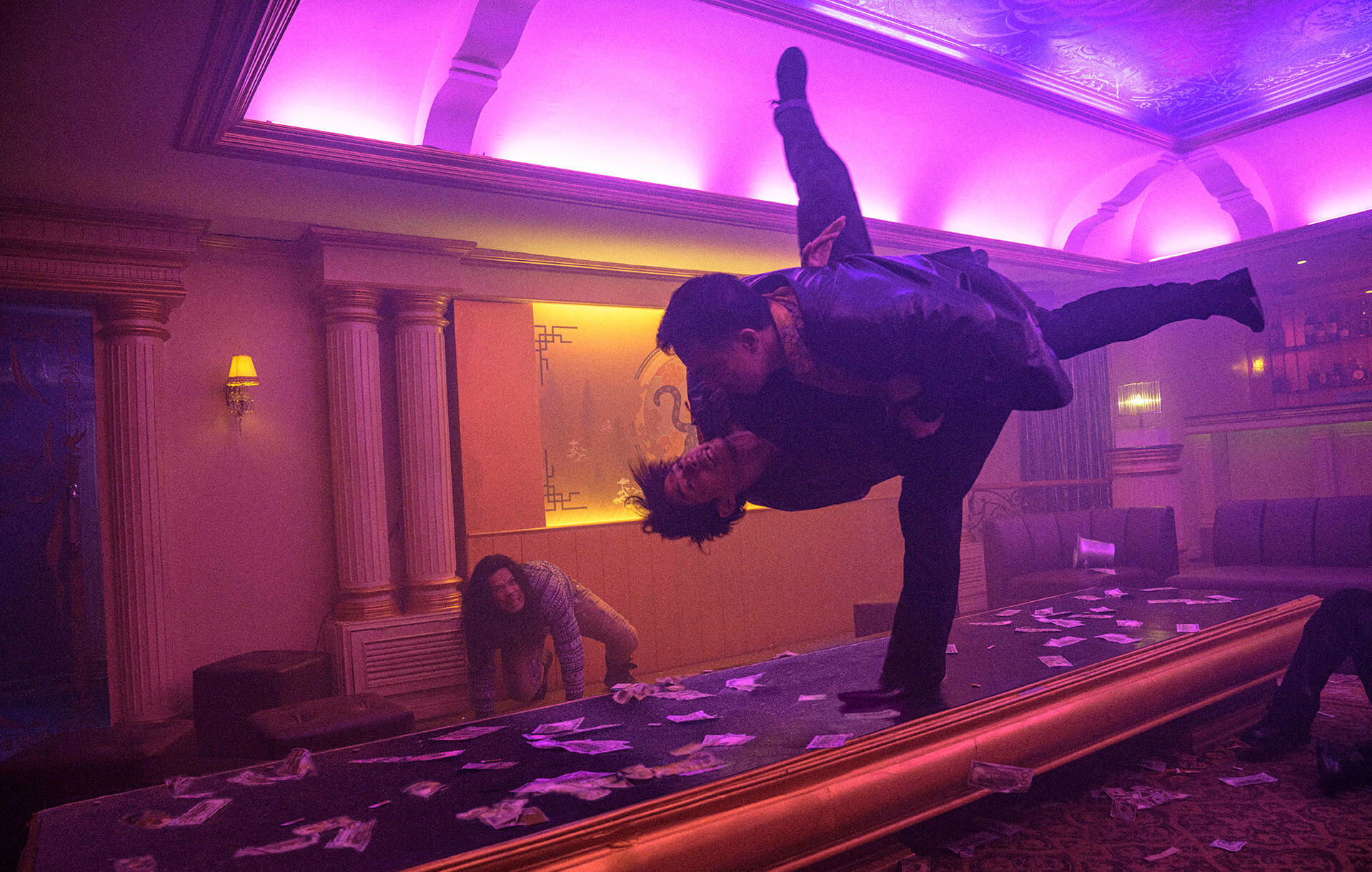
By my count, Kenji Tanigaki’s The Furious adds at least three to the canon. Filmed in Bangkok and set “somewhere in Southeast Asia,” The Furious brings together some of the greatest living martial arts actors from China, Thailand, and Indonesia for 113 minutes of nonstop bodily annihilation. People fight in nightclubs, in open-air market halls, in ice freezers, in police stations, and off the side of a truck. It quite literally kicks ass.
The setup for all this fun is typically grim. A mute plumber named Wang Wei (Chinese direct-to-video superstar Xie Mao) is about to send his young daughter Rainy (Yang Enyou) back to her grandparents in China when the girl is tricked and kidnapped by a human trafficking ring. When the police prove less than helpful, Wang goes in search of them himself, a rescue-and-revenge mission that brings him in (literal) contact with Navin (male model and judo champion Joe Taslim), an independent journalist searching for his wife, who disappeared while investigating the very same trafficking operation.
Needless to say, the men fight, then bond, then join forces to save Rainy and wreck shop. This is a broad story, told with an international audience in mind. Much of the film was shot in English, with only occasional references made (mostly in the use of subtitled Chinese) to Southeast Asia’s incredible diversity of language and ethnicity. The Furious is a story of doing, not saying, and Tanigaki and action choreographer Kensuke Sonomura have painted a portrait of the human body in all its absurd potential. They prefer close-up, hand-to-hand-to-foot-to-knife-to-hammer battles, generating maximum pressure by trapping combatants in tight spaces, and forcing them to make contact. In one standout early sequence, Wang is ambushed by an army of low-level thugs, and seemingly trapped inside of a cramped UFC ring. Two problems, one solution: With every man he beats bloody, Wang can climb higher, until he leaps off his makeshift body-pyramid and out of the cage.
Tanigaki and Sonomura structure their film in much the same way, leveraging tenderized human flesh against whatever problems narrative might throw down into their path. Wang and Navin team up not from any deep connection, but because neither can best the other in a fight. This is a movie where everyone, from journalists and beat cops to middle-aged businessmen and precocious pre-teens, are ready and able to throw down at the drop of a logo-free baseball cap. Even Rainy quickly goes from problem to protagonist, masterminding a breakout and joining her dad to beat down on some goons with a pipe. The Furious aims for total activation, eliminating downtime in order to wring maximum kinesis out of every possible moment. And thanks to what Jonah Jeng calls Sonomura’s “artful messiness,” the results are both chaotic and precise, maintaining visual clarity without ever sacrificing the manic energy at the heart of any brawl.
This commitment to masterful immediacy makes the film feel like an outlier in a cinematic action landscape weighted down by star personas and homegrown IP mythologies. This is not Nobody 2, and it’s certainly not John Wick. There aren’t even any guns, really; the deadliest weapon is a bow and arrow, wielded by Indonesian silat master Yayan Ruhian. The Furious actually marks Taslim’s second shot at the U.S. box office this year, after his supporting turn as Bi-Han in Mortal Kombat II. Needless to say, Tanigaki’s film does a much nimbler job showing off his prodigious skills, as well as his appealingly warm charisma.
I first spotted Taslim in The Raid, but he truly grabbed my attention in Timo Tjahjanto’s Indonesian crime epic The Night Comes for Us, distributed internationally by Netflix. The big N has undeniably brought some of the world’s best martial artists to much larger audiences, but, as I have noted before, they have a bad habit of larding their films up with exposition and narrative dead air. War Machine and Apex, their biggest action thrillers of the year so far, cannibalize the remains of high-toned Hollywood schlock (Predator and Cliffhanger, respectively) with pointedly anonymous results. There’s nothing in those movies as magnetic or strange as an alien with lizard dreadlocks, or Michael Rooker trying to play a good guy.
Don’t worry, this is not another rant against modern movie-making or digital modes of distribution. A decade ago, a Chinese epic like Yuen Woo-ping’s Blades of the Guardians might never even have screened in North America; depending where you live, you can stream it online right now. Niche streaming channels like HI-YAH have made available tiny films like Sonomura’s own Hydra. The biggest action story of the past year has got to be the restoration and re-distribution of The Golden Princess catalog by Shout! Studios. For actual years, a whole cache of action movie landmarks, including John Woo’s A Better Tomorrow and Ringo Lam’s City On Fire, were simply out of circulation, available only through shady means, and in truly awful quality. Today you can stream nearly the entire catalog on the Criterion Channel, a boon for neophytes and genre obsessives alike.
The Furious arrives as part of a new wave of films that pay their respects to those undimmed classics, while embarking on something very different. Like in Soi Cheang’s recent Twilight of the Warriors: Walled In, Tanigaki mixes styles and stars to reestablish the primacy of the human body (and the fight choreographer) at the center of the frame. Cheang’s film comments implicitly on the passing of an older generation of martial arts legends, as well as their replacement by impervious, impersonal CGI-superpowered creations, setting a motley crew of principled triads both young and old against a magical (and amoral) mobster. Tanigaki is attempting something closer to a refutation. Yes, he uses plenty of computer-generated effects, from burst blood vessels to shattered ice blocks, yet he is wise enough never to let them distract from the physical prowess at work in the frame.
Same, too, with the more uncomfortable elements of the plot. Like seemingly a quarter of all genre movies nowadays (Sound of Freedom, multiple Jason Statham vehicles including this summer’s Mutiny), The Furious deploys the very real problem of human trafficking for cheap dramatic effect. Perhaps it’s for the best that Tanigaki and his four credited screenwriters have no real interest in plumbing the dark depths of their subject; like the higher-ups in their film’s villainous cabal, they’re content to reap the rewards without asking too many questions.
This, of course, is not really what The Furious is about. Like the terrorists and drug lords before them, these human traffickers exist to get punched and otherwise suffer. And boy, do they, climaxing in a five-way police station brawl unlike anything I have seen onscreen in many years. If I could give one piece of advice to any action filmmakers tempted to turn out yet another human trafficking plot, it’d be this: Do the Tate brothers next.