“Autobiography,” the critic John Berger said, “begins with a sense of being alone. It’s an orphan form.” Berger wrote these words weeks after the death of his mother, but he was speaking generally, about the project of remembrance which so many artists take up over the course of their lives. That loneliness—that orphanhood—is a matter of separation, a gap between the self as subject and author. We might approach who we once were, but if we are to describe our experiences with any sense of perspective—if we are to be honest about how we have lived—then we must first leave the person we were behind.
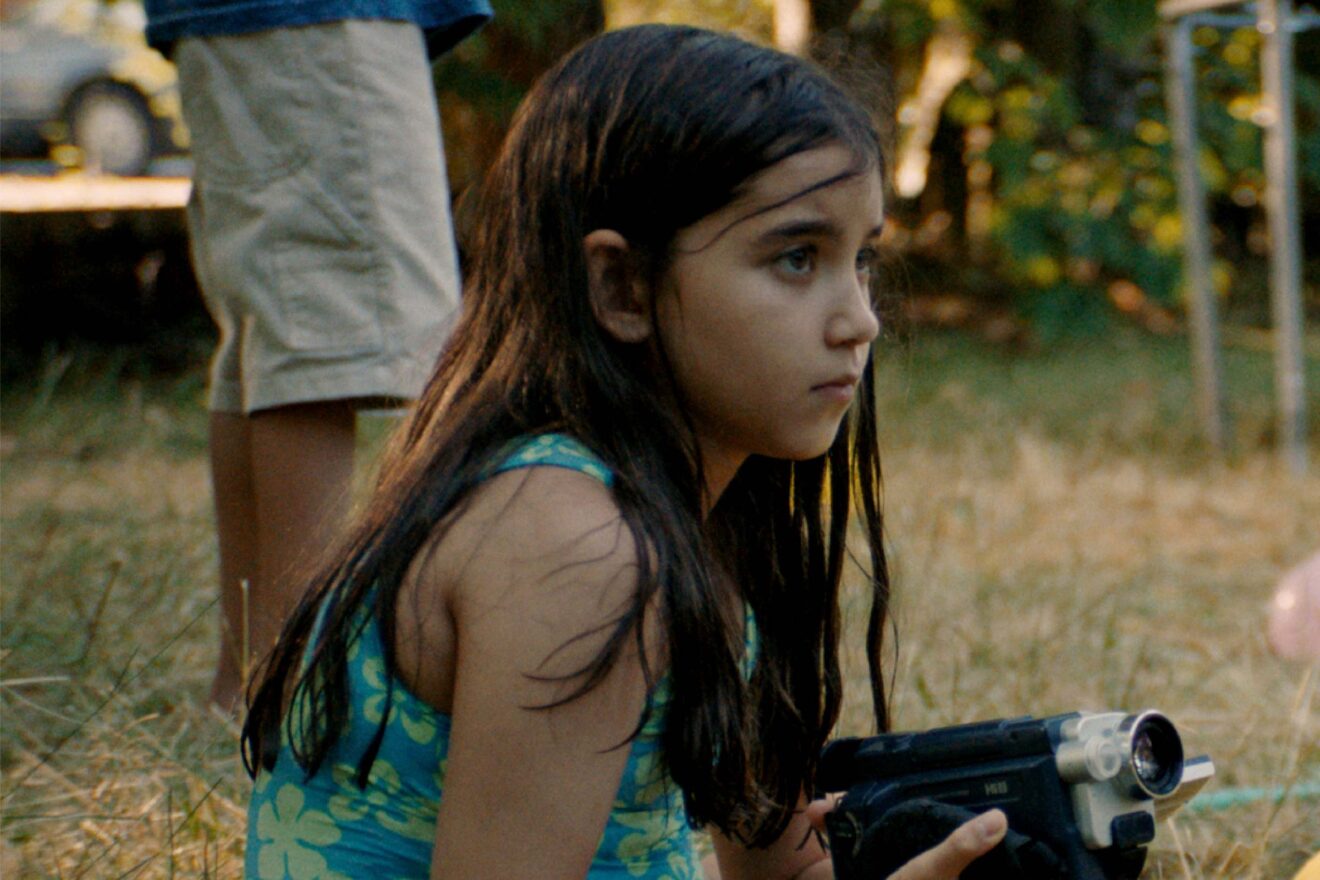
In Blue Heron, the debut film from director Sophy Romvari, these experiences belong to Sasha (Eylul Guven), a young girl who has just moved into a new home on British Columbia’s Vancouver Island. It is summer in the 1990s, and her immigrant parents are trying to assimilate into a normal Canadian existence, speaking English with Sasha and her three brothers, and only dipping into their native Hungarian when discussing eldest son Jeremy. The child of a prior marriage, Jeremy has been acting out since he was a child, and the family has made many changes large and small to accommodate his impulsive whims. Now in high school, his behavior is rapidly escalating: He steals, he plays dead on the front steps, he impulsively courts self-annihilation, and he cannot explain why.
None of this is lost on the child Sasha, existing not just alongside but actively within her daily life. Nature walks, beach trips, and backyard playdates are so regularly interrupted by Jeremy’s misbehaviors that, for the children, it has all begun to feel of a piece. Their brother can be kind or cruel, indulgent or impulsive, and often all at the same time, his shy, near-wordless demeanor concealing but never containing the violence swirling beneath the surface. As Sasha’s mother tells her, the worst thing is how normal it all seems.
Romvari captures this simultaneous normalcy and abnormality as a kind of double movement, the mix of intimacy and uncertainty that we find most often in our memories. In her 2020 short film Still Processing, the director develops a series of her father’s photographs, taken when she and her brothers were young. We see mundane domestic scenes, images of children being children. Yet once they have emerged from the solution, the director begins to juxtapose these youthful faces with their adult counterparts, and an absence emerges: Two of the children cannot be accounted for, because two of Romvari’s brothers are no longer alive.
We are in the textured loneliness of autobiography, born of the old familiar separation, the desperation to hold onto what has passed. Yet to her film’s credit, Romvari is not merely trying to recapture what has already been. “I knew that if I prioritized a perfectly faithful depiction,” she wrote last fall, “I would fail.” So she has made Blue Heron a film of probing, of searching, of the futile attempt to make sense of a life which cannot explain itself. Romvari arranges each sequence as a dense flurry of gesture and movement, dramatically compressing Jeremy’s chaotic behavior into the mesh of domestic life. Cinematographer Maya Bankovic films these scenes from a great distance, her long-lens compositions taking on the character of an observer peering in from another time, overlapping the essential and the ephemeral across a run of fluidly evolving frames. Their intense natural sensuality—wave clap, rain drip, insect hiss—is presented from a cool, observational distance. However vivid and intimate the details of memory, it must by nature come to us from ever-greater expanses. We can recreate, and recapitulate, and reach back toward the ones we love, but we cannot bring them back with us.
Children live within the adult world, and yet, if they are lucky, they are allowed to remain children awhile within the safety of their microcosmic reality. The best stories about childhood refract adult rules and behaviors through the anarchic magic-making of a child’s mind. The child world is a thoroughly animate universe, a place of secret correspondences where meaning saturates every moment and coincidence is unknown. When Satsuki and Mei come upon their new neighbor Totoro, it is both accident and not, and his goofy goblinlike presence will serve ultimately as a balm for these two girls waiting anxiously for their mother to come home from the hospital.
The magic of the child world is a form of compensation, a hedge against the fragility of childhood and its inevitable loss. The children in the stories of the Brothers Grimm might have access to the spirit of the forest, but they are nearly all orphans and outcasts, forced on the road by the machinations of princes and kings, and with no one to protect them. Imagination can provide some shelter, but death and decline, suffering and violence, all inevitably intrude. Any real story of childhood is the story of childhood lost. About two-thirds of the way through Blue Heron, we snap into present time, where an adult Sasha (Amy Zimmer) is sifting through the relics of her youth. She interviews specialists, calls her mother, and speaks with a social worker glimpsed while Sasha was still a child. At first it seems that she is working on a film about Jeremy, an unsettled figure who is described frequently and never seen.
Director and protagonist are both dealing with the struggle of recovery, that attempt to come to grips with a memory by clinging onto whatever details they happen to have on hand. Sasha turns to her father’s photographs, as well as the videos taken by a mini-camcorder previously seen during a pivotal moment in her childhood. As in Charlotte Wells’s 2022 film Aftersun, these images provide a pathway back into the past, snapshots of an ostensibly more innocent time, now inextricably bound up with the knowledge of intervening time. For Wells, these images have become totems, visual evidence of a person present only as an absence. They puncture the film at regular intervals, drawing your attention to the emotional void yawning beneath even the most ostensibly mundane moments. For the one who looks back, there is no detail, no matter how seemingly superficial, that does not point to all that has happened since.
Such documentation can fill in gaps, can call the buried and distant to mind, but it cannot actually bring us back into the world of the past, and it cannot tell us what we do not personally know. As eventually becomes clear, Sasha is not preparing for a film, but rather a performance of her own, a role that will take Sasha beyond herself and her experiences, a leap across the barrier of her own faulty memories and into a key moment from her own past. When she knocks on the door of her childhood home, Sasha appears in the guise of the social worker who counseled her parents to put Jeremy in a foster home, a figure glimpsed briefly in an earlier scene. She tours the house, speaks with her own parents, and attempts to counsel from across the gulf of time—a reassuring act which contains the admission of an inevitable failure. Nothing will work, Jeremy will not get better, and no matter what they do, they will lose him.
These final scenes vibrate with the unbearable tension of grief, the desire of the living to speak to and perhaps even rescue what once was. But we can’t, not ultimately, and in one devastating cut Romvari demolishes the wall Sasha has attempted to erect between her adult and child selves. Yet just because her goal is ultimately futile does not mean we should dismiss it. For there is so much that one cannot remember, so much that is lost in the gap, but so much more is turned up in the attempt. Blue Heron’s final gesture intermingles guilt and grace, a reaching out which is also a letting go. Art-making might be an orphan process, but if it is done right, then it is not done alone.