

The actor Eli Gelb has really found a niche for himself as "unassuming guy in a three-hour play who's able to avoid getting directly hit by the drama." Before catching him in Birthright, the new off-Broadway play from Jonathan Spector, I'd last seen Gelb as the sound engineer Grover in the Tony-winning Stereophonic. In that play, which was clearly inspired by the making of Fleetwood Mac's Rumours, he begins the job ambitious and a little naive before the bad behavior of rock stars forces him to grow some protective layers. In Birthright, Gelb's character Noah has a similar professional drive, and he too has a core earnestness that you don't want to see overridden by a more convenient posture of cynicism. A viewer might appreciate the satisfaction of an ending like the one in Stereophonic, which sees him rediscovering what gave his work meaning in the first place. But Birthright doesn’t pretend to offer any easy closure.
It would be a real writerly heat check to compare the making of Rumours to Judaism: There's all this arguing, and these wild stories, and it all leads to a beautiful, lasting thing that brings a lot of disparate folks together, and also serves as a kind of mythical ideal of what a group of inherently flawed people could be at their best. Luckily, I would never do that. But Birthright does feel like a play on an epic journey to justify the importance of the religion at a time when some of its adherents use it to justify the killing of children. For some audience members, the play will succeed in that mission, and for others I think it will fall short. Neither of those groups, in my eyes, would be wrong.
Birthright covers the evolution of a friend group who came together in their early 20s on a trip to Israel. Broken neatly into three briskly paced hour-long acts, the first part takes place a few weeks after their return to the U.S., in the middle of George W. Bush's second term. The middle section is the night before a wedding in October 2016, unknowingly on the eve of the Trump years, and then the last part takes place in the near-present, well after the events of Oct. 7, 2023. In the beginning, the characters share some misgivings about the political weirdness of the Birthright program and the way it might try to show college kids that living in Israel is just a big cool party, but those are mostly eclipsed by more pressing questions like "Am I going to hook up again with the person I hooked up with over there?" In the second act, our cast can't ignore the obvious alliance between Trump's presidential run and Israeli nationalism, but they still mostly have their own crap to deal with. In the third act, however, it's no longer possible to ignore the big questions: They're living in a time when every informed person has to have an opinion about the campaign in Gaza, and these friends are nowhere near as aligned as they once were when the topics were domestic American issues.
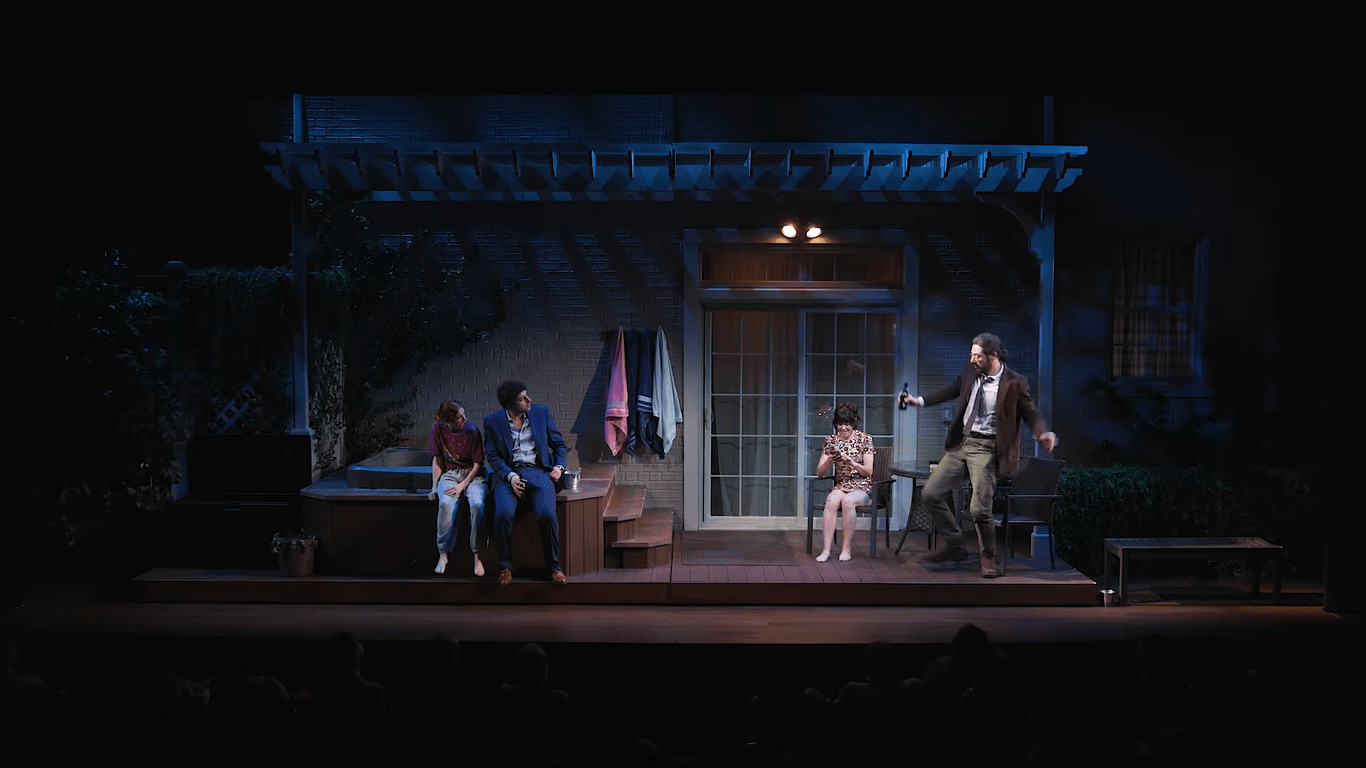
Birthright succeeds, on a technical level, at basically everything it tries to do. Its cast is extremely well-balanced, and I felt myself looking forward to learning how they changed from era to era. The naturalistic presentation is simple but effective, with a couple of really nice sets. The dialogue is energetic and doesn't drag even with a supersized runtime. The comedy is deployed at the right moments. And the theme—how the catastrophes of the 2000s and beyond affected a generation of young Americans on a personal level—is inexhaustibly fascinating to me, a 31-year-old white woman who's starting to realize what it feels like when producers cater directly to her tastes. (Bloc Party deep cuts on the intermission playlist are my Nuts and Gum.)
What makes Birthright stand out from other great Millennial/Gen Z plays that I've seen lately is that the subtext of what it has to say about the far right is less about the Republican Party and more specifically about Benjamin Netanyahu. After a period when a lot of ostensibly progressive arts organizations tried (and sometimes failed) to handle the frustrations of their mostly younger, passionately anti-Zionist workers, Spector is actually able to portray the fallout from these kinds of fights. It's a step beyond, for example, the emptiness of the Public Theater's self-congratulatory "Isn't it great that we can all have spirited debate?", when The Ally self-consciously stopped short of October 7. I'd argue that Spector still tilts the playing field by not writing any characters who would actively cheer the obliteration of Gaza (or even be directly affected by it), staging instead in his third act an argument between one side horrified by genocide and one side sympathetic to Palestinian suffering but more concerned with Israeli safety. This play is not particularly provocative, and rather than a "Fuck you" to Netanyahu it hits my ears as more of a "Come on, man." But I can't deny that Spector has created a piece that I've been thinking about since I saw it.
Something I appreciate about Birthright is that it actually responds to the rhetorical question I asked after seeing The Ally: "What comes after the argument?" That is, a confrontation with someone we respect can sharpen us into a better person, but to what end? If you can't answer that, then debate's just an empty intellectual exercise. Birthright offers a very literal reply, though I'm not sure if it's a satisfying one, in the context of Jewish life: After an argument, there will inevitably be a death, and after death, the friends and family of that person come together to sit shiva and recite the mourner's Kaddish. Switch a few nouns, and the same would be true for Christians, for Muslims, for any community. After the argument, life goes on. After the argument, the things that brought people together will continue to.
Is that sufficient, or is that sentimental bullshit?
"I was raised Catholic in an overwhelmingly Christian part of Michigan. I don't like to talk about it much, but I still pray, most mornings, the way I was taught as a kid, even if I feel revulsion at the institution it came from." I wrote that after seeing The Ally over two years ago. I don't pray anymore. It's not because of anything new—I was certainly not unaware of the horrors that had been committed in the name of Christian nationalism—but one day I just stopped being able to see what was worth salvaging from those evils.
Some people can still see those things. I don't think better or worse of them for it. It's an impossible math problem, trying to weigh the damage inflicted in the names of our faiths against the value of being connected to a community that spans generations, of together being able to see something beyond what you need to accomplish in your own life this week. There's no objective calculus, only a formula that either works for you or doesn't, and does what you think is the least amount of harm along the way. What Spector might argue, and where I might agree with him, is that while in the real world the ideal might never come to pass, that ideal is still worth reaching for.
Birthright is at The Robert W. Wilson MCC Theater Space in Hell's Kitchen through Aug. 23.