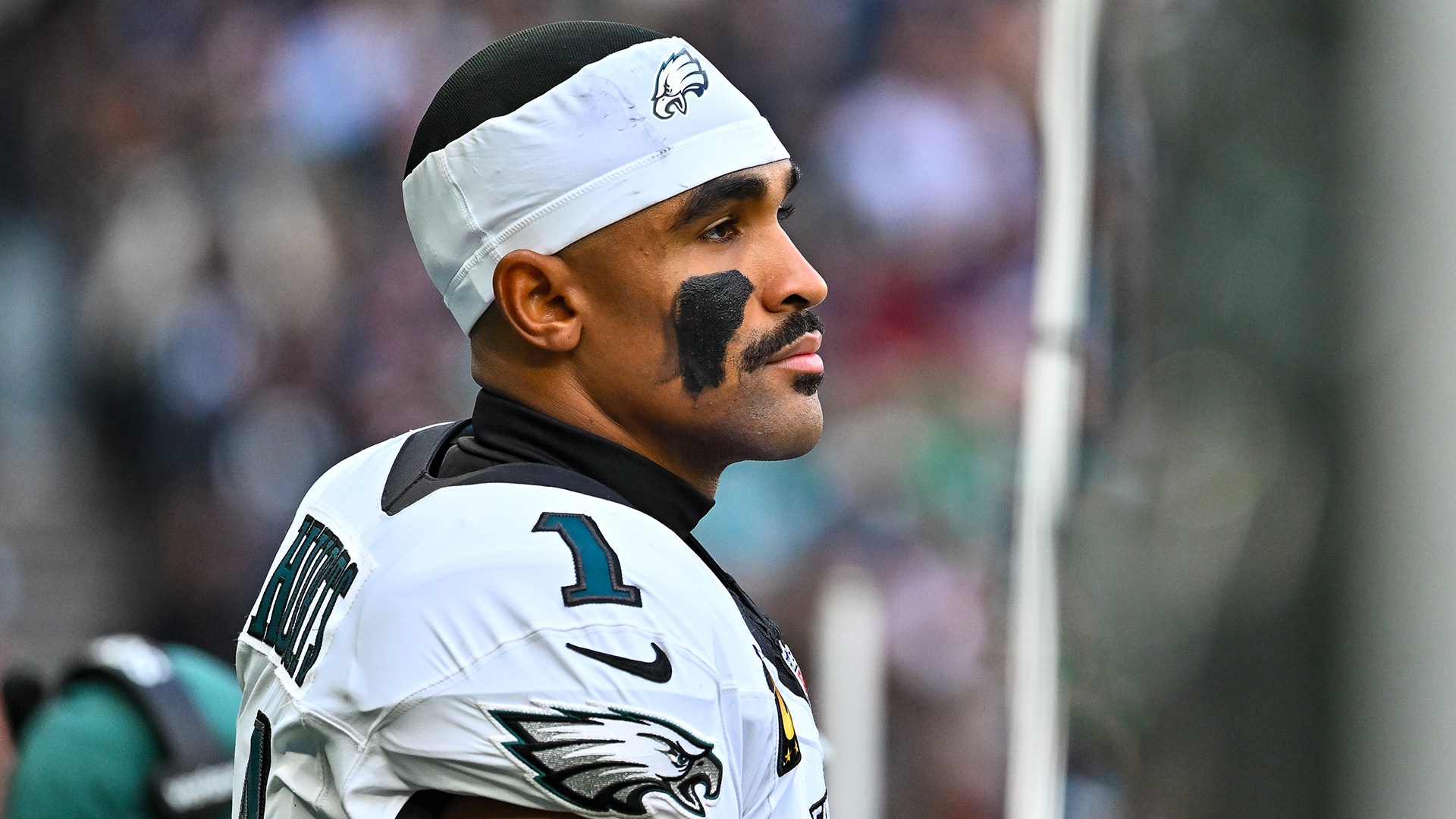
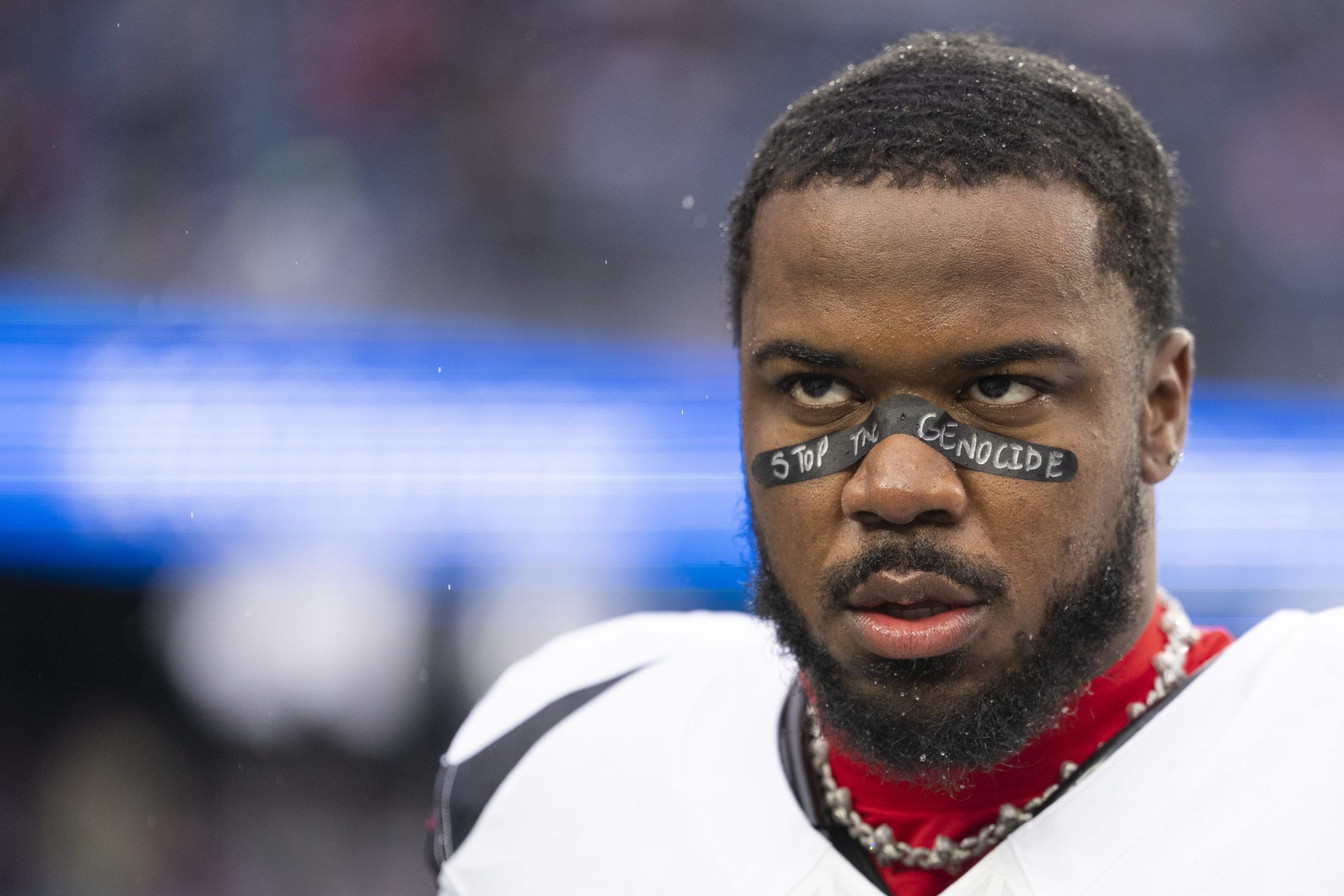
After a 30-6 playoff win over the Pittsburgh Steelers, Houston Texans linebacker Azeez Al-Shaair appeared in an ESPN postgame interview and drew national attention for the message written on his eye black: "Stop the Genocide." He had expected a fine for the customized accessory, and did receive one at the cost of $11,593. But when, willing to eat another fine, he planned to do it again for his team's divisional-round game against the New England Patriots this past Sunday, he said he was told that the consequences would be disproportionately steeper the second time around.
As seen in the photo above, Al-Shaair did wear the same message prior to facing the Patriots, but he changed it to regular eye black before kickoff. Following Houston's 28-16 loss to New England, Al-Shaair said to reporters that he was told if he didn't remove it, he wouldn't be allowed to play.
"I knew that that was a fine," Al-Shaair said, before using the example of former teammate and current Patriots receiver Stefon Diggs, who regularly puts personalized messages on his eye black. "But I was told that if I wore that in the game, I would be pulled out the game. So I think that was probably the part that I was confused about, because I understood that was a fine, but I ain't never seen Stef get pulled out of a game for having eye tape with writing on it."
Here's more from Al-Shaair's postgame remarks:
At the end of the day, it's bigger than me. The things that are going on make people uncomfortable. Imagine how those people feel. I think that's the biggest thing. I have no affiliation, no connection to these people, other than the fact that I’m a human being. If you have a heart and you’re a human being, you can see what’s going on in the world. You check yourself real quick.
Even when I’m walking off this field, that’s the type of stuff that goes through my head—that I have to check myself when I’m sitting here crying about football, when there’s people who are dying every single day.
When Al-Shaair played for the Tennessee Titans in 2023, he wore cleats that promoted the Palestine Children's Relief Fund. He donned a similar design in 2024, his first season with the Texans. "I feel like it's something that's trying to be almost silenced," Al-Shaair told the Houston Chronicle at the time. "On either side, people losing their life is not right. In no way, shape or form am I validating anything that happened, but to consistently say that because of [Oct. 7], innocent people [in Gaza] should now die, it's crazy."
The NFL has a long tradition of fining players for what it categorizes as uniform violations. Frank Gore was docked $10,500 for having his socks too low. It's been over a decade since the NFL denied DeAngelo Williams from wearing pink for the whole season to spread breast cancer awareness, even though it used his dead mother for its own brand's benefit. The stick was only slightly withdrawn from the league's ass in 2016 with the My Cause My Cleats initiative, allowing players to wear customized shoes, but only on designated weeks. That was when Al-Shaair wore his PCRF cleats. Just don't try it during the rest of the season: Jalen Hurts was recently fined for wearing mismatched shoes that weren't "constitutional team colors."
As Al-Shaair noted in his postgame remarks, league discipline for personalized eye black typically ends at a fine. It's not clear why this particular case would be an event worthy of disqualification.
So I asked the NFL. Specifically, since I already understood that custom eye black was cause for a fine, I asked the NFL whether the directive to pull Al-Shaair from the game if necessary came from the league. NFL spokesperson Brian McCarthy wrote the following:
Can confirm that Texans’ Azeez Al-Shaair was fined $11,593 for a violation of the NFL uniform and equipment rules for wearing eye black that contained a personal message.
Would refer you to the rule book.
Rule 5, Section 4, Article 8. And also Article 9 which outlines penalties.
But I hadn't asked for confirmation of the fine. The cited article in the NFL rulebook states, in part, the following:
In addition to the game day penalties described in this rule, the Commissioner may subsequently impose independent disciplinary action on the club and involved player, up to and including suspension from the team’s next game – preseason, regular season, or postseason, whichever is applicable.
I asked McCarthy follow-up questions just to make sure I had this straight, but as of publication of this article, he hasn't responded. The Texans did not reply to a request for comment. The reasonable conclusion from all the available evidence is that the NFL, at the direct behest of Roger Goodell, would have been willing to ban a player from an important playoff game over an anti-genocide message. Sometimes a thing is what it looks like.