People who think about the podcast business love to say that podcasts have a “discoverability problem,” and that the recent pivot to video is an attempt to solve it. The discoverability problem is that the medium still hasn’t figured out a reliable, easily reproducible way to capture and hold a listener’s attention. It’s easier to stumble upon video curated and served via algorithm than it is to click several buttons in a dedicated app in order to listen to a piece of audio.
In its attempt to gain a hold on YouTube’s domination of the internet’s passive viewing population, Netflix rolled out podcasts earlier this year with licensing deals with Spotify, Barstool Sports, and iHeart, but if discoverability is any part of Netflix’s objective, it has failed abjectly with its new video podcasts, which were quietly launched at the end of January.
First of all, it’s nearly impossible to stumble upon podcasts on Netflix unless you know what you’re looking for. There’s no homepage carousel, no link in the home navigation, not even a category in the show genres dropdown menu. I clicked around the homepage for several minutes looking for a podcasts homepage before finally giving up and typing “podcast” in the search bar. This search yielded something that approximated what I was hoping for: a page of every show on the platform presumably tagged with the word “podcast,” arranged in no coherent order.
In addition to the many shows it has brought on-platform through licensing agreements, Netflix also launched three new video-first shows this year, the titles of which I managed to glean only from a Tudum blog. From a production perspective, the shows are lackluster. The White House is a football show where Michael Irvin brings his wacky punditry to the small(er) screen, while the Bridgerton companion podcast offers all the insight and reportorial thrill of a press junket with the sheen of state-run media. It’s fodder for the sickos, and it makes sense that Netflix devoted resources to serving its two most ravenous and growing audience segments: sports people and romance fans.
The most interesting of the three new offerings is The Pete Davidson Show, a self-conscious attempt to wrap pathos in irony, which in many ways is Pete Davidson’s whole thing.
“I don’t know how to work your toilet,” Machine Gun Kelly says in the cold open of the first episode. He’s talking about Davidson’s Japanese toilet that “shoots water in your hole.” It’s a cold open that betrays the editorial intent of the project: Davidson, perennial kid brother, shit-stirrer, prolific dater, and fun hang, is now in his early thirties. He’s a father to a newborn and seems to be using this show as a way to work out what it means to be responsible for someone when you’re still dealing with your own trauma. Over the course of the nearly 40-minute episode, the conversation between the two pinballs between shit talk, parenting advice, EMDR therapy, rehab, manic episodes, astrology, drug-addled antics, and their thoughts on fame.
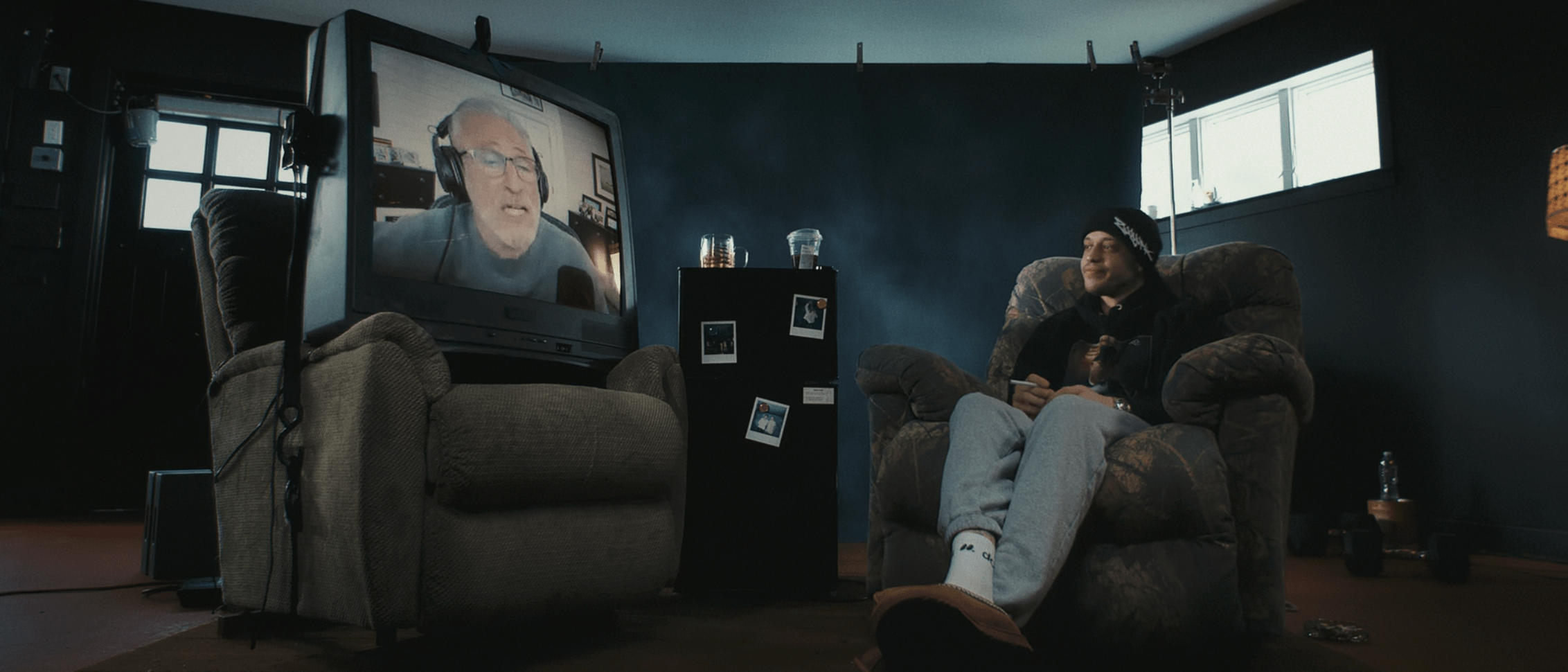
This topical aimlessness is just part of how the show postures as the chillest thing ever. It’s allegedly recorded in Davidson’s garage, is raw, maybe even unedited. It appears that to Netflix, the quality that distinguishes a podcast from other forms of media is the absence of visible effort. The set stops short of recreating the “two dudes behind mics” that has become visual cliche, but the two wear visible lavalier mics taped to their shirts, a choice that is consciously effortful when reality shows on the platform like Love Is Blind manage to conceal mics. The point is to look easy, to elide the prosaic forms of planning, writing, and editing that suck all the fun out of two dudes chilling. That intimate rawness is so much the charm of shows like this that draw from a creator economy, which has shrunken the space between “talent” and viewer to the depth of a pane of glass.
The first episode ends with a prolonged shot of a Polaroid photo of Machine Gun Kelly in a scrapbook, a conceit which will become a visual motif in subsequent episodes. Layered over the video is the audio of a recording between Davidson and what sounds like a family member. “They let me do a show in my garage so I figured I could be home with Scottie more,” Davidson says, referring to his three-month old daughter. “And also just interviewing my friends so that I could see them.”
The Pete Davidson Show is shot simply against a backdrop straight out of Lifetouch, but those shots are framed intentionally and vary in distance. The show is dimly lit but color corrected, and their cigarette smoke refracts the light moodily. In occasional wide shots, a crowd of producers is visible just off set, a peek at just how many people were necessary to make this happen. One way these shows differ from Netflix’s other TV shows: There are no credits that run at the end of an episode.
It’s a decision that emphasizes Davidson’s labor as on-camera “talent,” even as you are aware that the show is beautifully framed and shot, and, if you’ve ever been involved in a project like this, know there are few things more tiresome and laborious to edit than a chill guy who just wants to hang out with his friends. All I could think while I watched this was that there is no way the original recording was 38 minutes long, and that some poor soul was tasked with editing that down to coherence while not being credited for their work.
This affected ease defines and confines the show, and by the end of the episode, I was almost feeling sorry for Davidson, who says he finds it “really difficult to stay super relevant and constantly reinvent yourself.” The pity evaporated quickly after I remembered that the guy I’m thinking about spent more than a quarter-million dollars on an old Staten Island ferry that has turned into a logistical nightmare.
In the first few episodes, Davidson hints at professional difficulties; he high-fives Machine Gun Kelly and says their careers both took dips at the same time. A decade ago, the opportunity to helm a Netflix project was a big deal for a comedian. Back then, they were still experimenting with form, and giving people a fair amount of creative freedom. Similarly, if Davidson had started a podcast 10 years ago, he would have had the jump on many of his industry contemporaries. But in 2026, The Pete Davidson Show is late to both the form and the streaming era. At this point, he’s just another guy with a podcast.