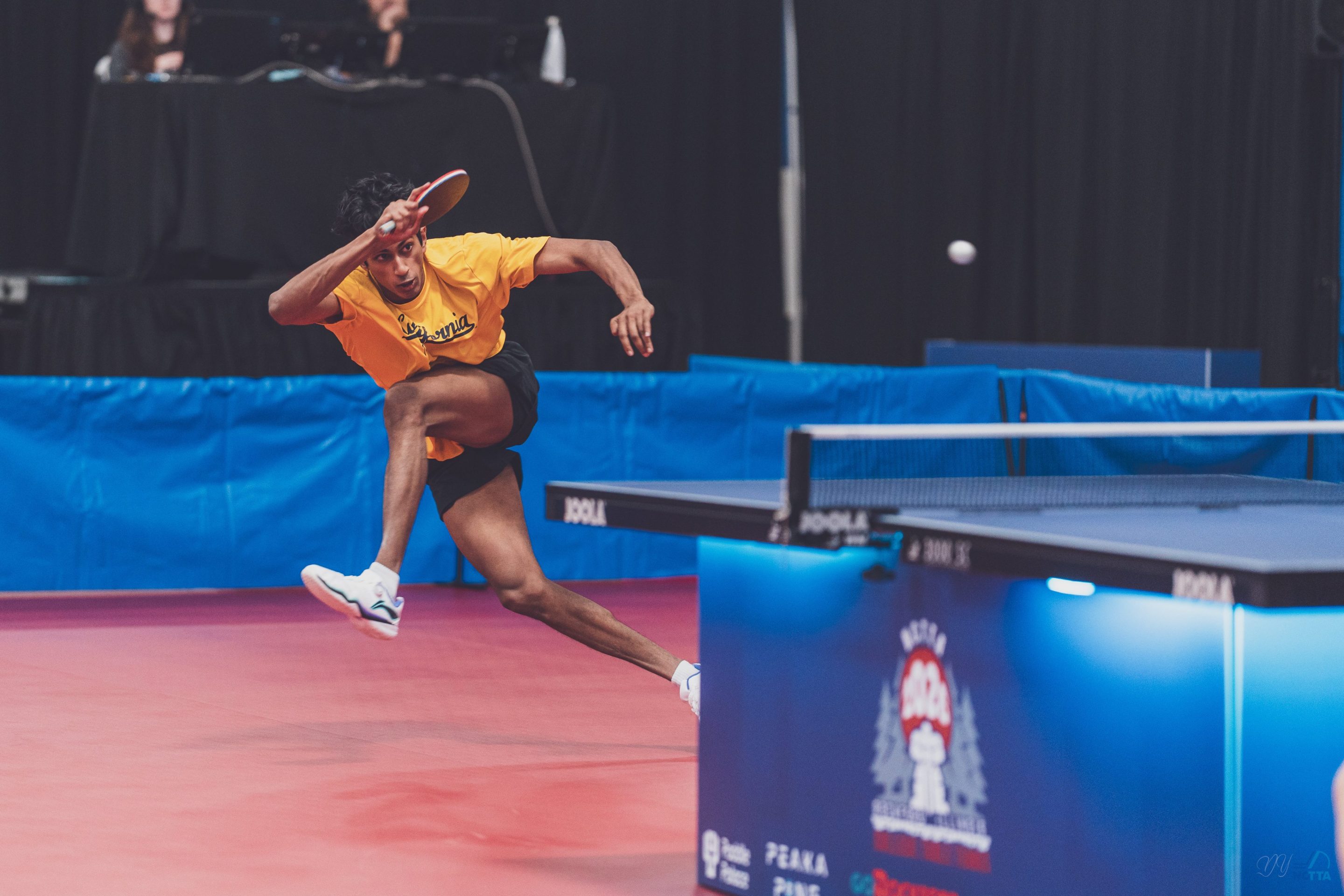
ROCKFORD, Ill. — Every April, more than 250 athletes representing over 50 schools descend on a third-tier city to play the National Collegiate Table Tennis Association (NCTTA) National Championships. This year, Nationals took place in Rockford's UW Health Sports Factory, a concrete hangar wedged between the Rock River and a lifeless train track. Inside, state-of-the-art cameras swiveled above professionally pipe-and-draped stadium courts. Wood floors gleamed beneath 40 tables, barriered into a crisp blue grid. Live draw monitors faced a table of 2025 championship photos and 3D-printed 2026 trophies. All of it was assembled by 75 gray-poloed officials, who deploy from a 500-square-foot command station to referee, umpire, and livestream. Over three days and a whopping seven events—men’s doubles, women’s doubles, coed teams, women’s teams, men’s singles, women’s singles, and a new hardbat format called PeakaPong—they would facilitate over 600 matches for one of North America’s biggest table tennis events.
Big does not mean glamorous, or most important. This tournament is not the World Championships, and it’s definitely not the Olympics, but it occupies a special place in the world of high-level table tennis in the Americas. It’s a tournament where pros and national team players can face off against enthusiasts and relative beginners, where senior citizens work side by side with children, and where alumni return to coach, network, or just soak in the atmosphere. Nobody gets paid, and nobody plays for all that much, either. Players receive neither prize money, world ranking points, nor international tournament qualifications; most teams pay their own way. The tournament organizers are also volunteers. Everyone shows up for love of the game—and they play and administrate it ferociously.
As the first of three days began, hundreds of flat-soled shoes and tacky rubbers sent the sport’s characteristic pops, clicks, stomps, and squeaks into the rafters. They were soon joined by celebratory shouts from competitors and teammates, baritone PA implorement to clear trash from the expeditiously cluttered aisles, giddy laughs as uniformed packs strolled to submit their match sheets at the control desk or buy food at concessions. The atmosphere was intent but buoyant. Something special was being manufactured here.
The average NCTTA athlete plays what William and Mary sophomore Nikhil Chawla called “washed ball,” a kind of melancholically decomposing table tennis enjoyed by former junior stars who have less time to train as they get older and enter college. Chawla’s story is classic: His father, a former player, brought Chawla to the Bay Area’s prestigious 888 Table Tennis Center as a teen. When he’s home, Chawla tries to train daily. At school, where he studies botany—“I like bryophytes, moss-type plants; they’re the only nonvascular ones”—Chawla hits twice a week and coaches his peers. W&M’s club has 30 members, eight of whom play seriously, but didn’t qualify for Nationals. Chawla traveled alone for men’s singles, making him one of several illustrious “lone rangers,” including the eventual men’s singles champion, Victor Xie of Cal Poly.
“The matches are pretty quality, given that … everyone’s form is kind of ruined,” Chawla said. “Except for the Berkeley guys.”
For Berkeley guy Sid Naresh, college ball is a key career step. A player for Major League Table Tennis (MLTT), America’s burgeoning pro league, and a multi-time Pan-American Games medalist, Naresh chose Berkeley so he could train in the Bay and play for a strong team. His younger brother, Nandan, will join him in two years when he’s done training in Germany.
“Having devoted their formative years to table tennis, they didn’t have a clear career path,” said their mother Sangita Santhanam, who volunteers as a scorekeeper. “We knew Berkeley was going to be a long shot. It's a win-win to be at Berkeley, and to be able to train with the group there, and to have the ecosystem that the Bay Area offers.”
Naresh trains four weekend sessions at 888, and once or twice at school during the week. Berkeley’s 12-person team is tight-knit, high-level, and “all really love table tennis.” (Funny qualifier for a crew that rivals the men’s national team in cumulative ranking, but in sports, it’s never guaranteed.) Naresh described Nationals as “one of the most fun tournaments I play every year, just being able to come here and see some of the kids I grew up with still playing. Even though it doesn’t qualify for anything, everyone still takes it very seriously.” I talked to Naresh the day after he played in the coed team final, and he was still buzzing. “I could feel it was the same as playing for the World Championship or something.”
Between them, the top seeds of Berkeley, Texas Wesleyan, UCLA, and NYU featured four U.S. National Team alumni and five MLTT pros. Every elite player I interviewed echoed Naresh’s sentiment that the NCTTA provides an invaluable balance of continuity, rigor, and fun. Senura Silva, an MLTT player and economics major at Texas Wesleyan, “didn’t know [the school had] a table tennis team” when he started applying to college, but recognized its formidable coach, Jasna Rather. They got in touch, and Rather filled out Silva’s application. Under her direction, he can train four times a week and travel to tournaments, but also plan for a future in finance. University of Southern California alum Kai Zhang, who grew up training with World No. 1 Wang Chuqin and won men’s singles in 2018, said the NCTTA “helps a lot of players who come from China, because they probably gave up table tennis for years, and now they … realize you can still play here. It helps a lot of players to rebuild their passion for their sport.”
That was also the case for retired U17 National Team player Faith Tung, a junior studying psychobiology at UCLA. Tung played intensely in high school, something “my dad wanted me to do more than I wanted.” She didn’t factor table tennis into her college choice and didn’t play her first year. “But then all my friends were on the team,” she said, “and I saw people playing at Nationals, so I wanted to at least go and see, which turned out to be a pretty good idea.” She trains just a few times quarterly, but can finally enjoy competing with her teammates.
It’s a unique aspect of Nationals, enabled by the team format, that these elites share brackets with “washed” guys like Chawla, and even beginners who tag along for fun. The lowest-ranked woman, Michaela Hendrickson of UNC, has 272 ranking points. Compare her to top seed Amber Liu, who has 2425. In 2023, representing the University of Michigan, I found myself facing a former Chinese national team player. She approached our game with the balanced, unpatronizing seriousness refreshingly common to such mismatches. Her Texas Wesleyan teammates still clapped for her, contributing their part to the collegial atmosphere. I lost with a face-saving score of 5-11, 6-11, 6-11; my main mistake was joking, during the second changeover, that I’d get seven points in the last set. My opponent overheard and promptly zinged two winners off my serves.
Some players are so fond of Nationals that they attend without qualifying, or even being in school. Zhang and Berkeley alum Nikhil Kumar, a two-time men’s singles champion, returned to coach for Columbia and Berkeley, respectively. Eduardo Salcedo Fuentes, University of Central Florida ‘25, tagged along with buds to spectate. UCF’s program has exploded to over 40 members these last few years. “We like to do events, fundraiser tournaments,” Fuentes reminisced. “We like to eat Burger Tuesday at Bar Louie and Jeremiah’s ice cream—our sponsor, woo-hoo! We’re pretty laidback, we don’t train that much … honestly, table tennis over school.” Now that he’s graduated, though, Fuentes sees table tennis as an exercise in persistence. The lack of university structure has motivated him more to improve. He just landed a job in Orlando as a software engineer, and “after my 9 to 5, it will just be 5 to 10, table tennis.”
The NCTTA’s diversity extends far beyond the competitors’ skill level. Table tennis and school both unite people from vastly different backgrounds; their intersection cuts a near-giddy cross-section of the world. Since 2000, the NCTTA has grown from 30 schools to 175 across the continental United States, Puerto Rico, and Canada, with players aged 17 (precocious freshmen) to 41 (a Yale master’s student). International students and women play a huge role.
NYU is a good case study. From 2021 to 2025, their top player was Chinese-Canadian Olympian Jeremy Hazin. This year, their coed team (No. 3) included Tiffany Ke, a quietly cheery junior whom I watched reverse-sweep multiple times in a day; White Bai, a Cinnamoroll-loving Chinese master's student; and Behzad Ranjbar, sanguine and middle-aged, who played Iranian pro football until he was 29. Now Ranjbar works as a project manager in Los Angeles, flies biweekly to attend NYU Stern’s Executive MBA, and studies remotely for a PhD at the University of Iowa. I caught him in the bleachers during a tense women’s team match, discreetly analyzing his own game tape. Ranjbar started table tennis when he was “completely depressed” after quitting soccer. Mostly self-taught, he’s achieved a Grandmaster-equivalent rating of 2200.
“To me, table tennis is more like life [than soccer],” Ranjbar said. “No matter how many people you have around you, there is a moment you have to figure out what you do. It’s all about the strategy, all about the up and down.” Through table tennis, he’s made friends ranging from a seven-year-old (now training in Germany) to Jarol and Leah Duerksen, an octogenarian Midwestern couple who stopped dozens of times, beaming, to greet friends all across the vast hall.
The Duerksens represent variety just as great among volunteers. They met at a ping-pong table in college and never really left. The basement in their Iowa City house features hardwood floor, two tables, a wall of tournament hardware—they are Senior Games stalwarts—and a map pinned with the hometowns of every visitor. There are over 200 pins and counting, including Ranjbar’s in Iran; China has its own breakout section. The Duerksens have overseen generations of NCTTA volunteers, many of whom join right out of school. And they are seven times as old as their youngest peer, Aadi Gulabani, a 12-year-old umpire whose sister competes for UNC. Aadi has an impressive 1800 rating; “it’s mainly just playing and having fun and meeting top players at tournaments,” he said. (His father, Sanjay, said he started umpiring partly to practice detachment; it seems to be working.) If he sticks with it, he could easily break the NCTTA record for years volunteered (25).
Many NCTTA participants have such early life connections to the sport. Growing up on a dairy farm pre-Title IX, deputy referee Linda Leaf didn’t have much chance to play sports, period. She first saw table tennis at the Wisconsin State Fair when she was working as a lawyer. At the time, matches in the fair’s Chinese Pavilion were essentially the Wisconsin State Championships.
“I was like, That’s how you play ping-pong?” Leaf said, starkly blue eyes wide with amazement decades later. She approached the players, learned that they trained weekly at UW-Milwaukee, and threw herself in. “To me it was an opportunity … to express that competitive, athletic part of my personality that I never was able to as a girl.”
Fortunately for competitive women like Leaf, Title IX opened the doors to sport, and could continue paving the way for table tennis. According to NCTTA president Willy Leparulo, the association has long looked toward participation in the NCAA’s Emerging Sports for Women program, established in 1994 to support women’s sports toward Championship recognition and help fulfill Title IX’s mandate to create equal opportunity between genders. (Just this January, the program voted to add four new sports to the NCAA Championships.) Participation in Emerging Sports would be a step toward addressing gender disparities within table tennis, where women remain underrepresented but have steadily increased in play level and enrollment at Nationals (55 teams and 40 singles players this year), and for the sport as a whole, which lacks not just a comprehensive recruitment system or material support for college players, but, in many settings, recognition as a legitimate enterprise.
Even if table tennis can join Emerging Sports for Women, though, Leparulo says the road from there to NCAA Championships will be long. They’re not necessarily counting on it. In the meantime, a few other institutions have striven to fill the gap.
One extant beacon of collegiate development is Texas Wesleyan, which has offered significant scholarships since 2002. The “Yankees of table tennis,” Texas Wesleyan holds over 16 co-ed team titles, 11 women’s teams titles, and over 60 singles and doubles titles. Their awards include a mix of $21,000 in academic scholarships and merit-based stipends, which on the upper end cover all but room and board. Unfortunately, Texas Wesleyan is singular; I’m told by several people that it rides on Coach Rather, a pro from former Yugoslavia. As a master’s student, Rather was the team’s first player in 2001. She’s played four Olympics, winning bronze in 1988, and her global recognition drives the school's successful recruitment. (“Success comes also with chemistry between teammates and passion to do well for our school,” she demurred over email.) A few other schools have one-off scholarships, but it’s hard to persuade athletic departments to fund a sport largely considered recreational, no matter how well the team performs. The only comparable program in recent history was at Lindenwood University, from 2008 to 2018; despite winning several national titles, it was shuttered for financial reasons.
The other institution for young talent is the coed MLTT, which began in 2023. This year, the league recruited 13 NCTTA players or alumni, out of 80 total players. It also donated a significant amount of equipment to Nationals, personally trucked from the Rockford warehouse by its head of logistics. MLTT is still in early stages, subsisting on venture capital rounds. Events take place six times a year—not often enough to provide a living, but making it possible for competitors like Kumar and Zhang to juggle with full-time jobs.
“For me, especially being an American,” said Kumar, “playing those matches …does help me maintain a somewhat high level, competing against many of the international players.” The monthly matches force Kumar to practice at least biweekly, even while he works at a demanding start-up. Zhang, who works as a financial analyst, similarly entered himself in MLTT’s draft to play post-grad. But something of the NCTTA ethos seems to have stuck with them: They speak of the sport with a measured fondness, almost incongruous with their decorated careers and fierce on-court demeanors.
“[Table tennis] is my hashtag, it's just my personal brand,” Zhang said. “No matter what I do, table tennis is one thing I will pitch to people, for making new friends or to interview.”
Leaf and other NCTTA affiliates are building the other end of the funnel, too. Through the Wisconsin Table Tennis Organization, Leaf established a table tennis season for three school districts, an annual tournament against Illinois, and summer camps. She also coaches after school (often personally transporting tables), in kids’ homes, and at her club. It’s a lot for one person to manage, and she hires high school trainees to help coach middle schoolers, a pay-it-back model mirroring the NCTTA’s. On the East Coast, a parallel initiative operates under Thomas Hu, who founded the NCTTA’s precursor in 1993 and now devotes himself to his American Youth Table Tennis Organization. “I think people focus on high-quality competitions,” Hu said, “but in my opinion, the more important aspect is participation.”
Of course, the point of Little League is not to churn out Major League pitchers. Beyond the hurdles of material possibility, many of which the NCTTA has miraculously cleared, the point of sport is ... sport.
“Whether you’re 8 or 80, you can play table tennis,” Leparulo said. “People quit prematurely. College table tennis is that middle part.” Leparulo emphasized community and mentorship as priorities, both within teams and between schools and the NCTTA. The association does outreach, helps students register clubs, and runs training for coaches. “It’s like herding cats or being a den mother,” Leparulo said. “Seventy percent administrative and supportive, 30 percent on the table … with college, you’re probably away from home for the first time, maybe you’re dealing with a weird naked roommate you don’t like, and you’re just trying to find your community, your people.”
Kayla Goodwin, an MLTT player at the University of Southern Florida, said she struggled with the college transition. “I’d been on the road so much, I thought I was independent, but in college it’s different, no one knows who you are.” Initially, she retreated from table tennis to adjust to school, but quickly felt the sport’s absence. “I [didn’t] know what I was doing, lowkey,” she said, “‘cause … there are so many things I do for table tennis, and now it’s like, I’m just going to the gym—for what?”
Table tennis has anchored Goodwin through many tumultuous changes. She grew up in Santa Cruz, Calif., but moved to Florida in sophomore year of high school, after the CZU Lightning Complex fires burned down her home. A year later, hurricanes flooded the Goodwins’ new house “to the doorknobs.” Kayla competed through it all. In January of 2024, driving from California to Florida with her father, she stopped in Corpus Christi to try out for the World Team Championships. She tweaked her back, but somehow persisted to upset two rivals, qualify, and represent the U.S. in Busan and Chengdu. She’s by far the best player at USF, but feels supported by her teammates. USF’s club is looking to hire a coach, and Goodwin plans to train, pursue a spot on the national team, and win even more accolades during and after her collegiate career—even L.A. 2028, perhaps, on which several other NCTTA athletes have set their sights.
“I think [table tennis] is my purpose,” she said, with the precocious, middle-distance zen of someone who explained to me, moments earlier, how disaster teaches you not to overvalue material things.
There must be dozens of stories as inspiring as Goodwin’s; I simply didn’t have the time to hear them all. Nationals is pure overload and exhilaration, especially on the first day, when four events’ preliminary rounds ran simultaneously and a spectator could swivel in the main competition area, in an aisle strewn with school-branded backpacks and haphazardly shucked hoodies, and witness several death matches, upsets, full-stand reactions, and meltdowns. Women beat men nearly twice their weight. Ke and her doubles partner avenged their doubles loss to Harvard during their women’s teams tiebreaker. On his run to the men’s singles title, Xie upset Naresh and top seed Ved Sheth back-to-back, donning a One Piece Luffy hat after each victory.
Many players left before the final match, hustling back to Monday lectures and piled-up problem sets, but the remainder packed the bleachers and sent up groans and gasps with every point of Xie’s daring, four-set reverse-sweep. I watched en route to the airport with fellow volunteers, huddled over phones in a van, listening to more than watching the lucid livestream as we jolted to a stop beside the first terminal. We sat breathless, ignoring honks, until the final shot zinged past Sheth and Xie dropped his racket in relief. A group of Southern Californians mobbed Xie’s coach’s box, which had stood empty all tournament.
“There really isn’t much [to tell],” Xie said in his post-match interview, seeming truly stunned. “I just closed my eyes and hit the ball.” An oxymoronic description, I thought, my face and fingertips buzzing against the van upholstery, but right, somehow. At their best, sports are for forgetting why—motivationally, cerebrally, aspirationally—you’re there. To close your eyes and hit the ball. And afterward, to bid wordless farewell to five strangers and return to quotidian days with the sense that something transcendent and collective abides within each of us, not so unlike the powers in a shounen, waiting only for the flight of a racket to stir.
Also, they’re an excuse to get together and party. At every Nationals, there’s a banquet on the second night, after the team events conclude. Round tables filled a conference room in the Rockford Embassy Suites. Long dresses and formal suits flowed among the hot plates in the foyer and the tightly packed white tablecloths, students dropping by each other’s groups to shout hello and take selfies. At the front, on an elevated stage, NCTTA Vice President Joe Wells presided over awards and thank-yous. Naresh and Sheth, who rock-climb together in their free time, mean-mugged shoulder to shoulder. Their teammate Raymond Zhu wore wraparound sunglasses. UCLA’s winning women’s team posed in matching black outfits, unsmiling. As the winners filed back, sponsor names daisy-chained into the intermittently squealing mic, minutes dragged on, and backtalk began to fill the room.
“We know you’re going to do what young adults do,” Wells implored near the end. “Just please be respectful and responsible.”
By that point, vomit had appeared in an elevator. Later, police cars would arrive for a noise complaint at an Airbnb (to no harm, ultimately). People still showed up the next morning to spectate matches and mess around on open tables. A valuable lesson: As in life, it’s all about balance. And fun.