Time began tormenting me in March of last year. I had been traveling for weeks to promote my book about gossip, a kind of capstone to the fastest-paced era of my life. All of it—the podcast we made, the fervent response it received, the life of deadlines, and the pressure and joy it created—flew by. I felt as if I had not really sat down or slept or relaxed in four years. Then suddenly, by my own choosing, it was over. For the first time since 2021, I did not know what the next six months held for me. My weeks were not scheduled down to the minute. The urgency of responsibility and expectations left me, and time stretched out before me like a wide, open plain: infinite and terrifying.
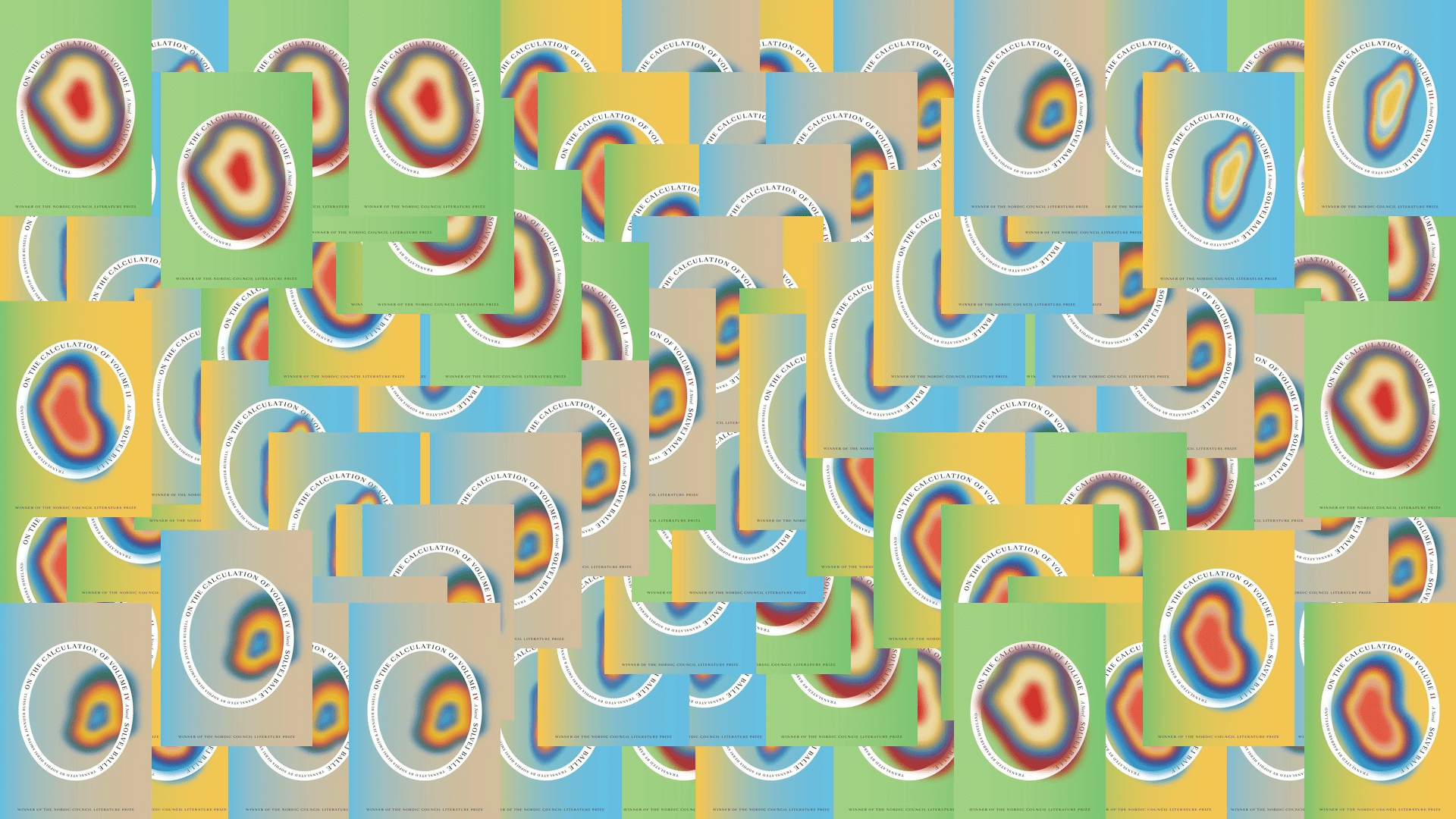
During these weeks of travel, I carried around On the Calculation of Volume (Book I) by Solvej Balle in my bag, with the hope that I might choose to open it and read instead of responding to emails or looking at my phone. The Danish novel—the first of seven in a series, four of which have now been translated into English—follows Tara Selter, an antiquarian bookseller, who is trapped inside a time loop. Every night, she goes to bed on November 18th, and every morning, she wakes up and it is November 18th again. There is no big bang, no huge mistake, no life-altering decision in Tara’s life. One night, she has dinner with some friends in Paris on a work trip. The only really remarkable thing about the day was that she touched a hot lamp and got a mild burn, but the burn isn’t even really that bad, and Tara feels certain that it will heal fine. The next morning, she goes to eat breakfast at the hotel, and as she watches the same piece of bread float to the ground, just like it did the day before, she knows in her gut that this is more than deja vu. “The moment I saw this hesitant action I knew that I was witnessing a repetition,” she writes. “I knew that something was wrong.”
One of the first things Tara learns about her new life is that not everything can or will enter the time loop in which she exists. Though her bank account automatically resets every day, so she has plenty of money, the things she buys do not necessarily remain. Some evaporate into the loop without warning. Some, like an antique coin she bought for her husband, disappear and then reappear again. The only way to try and keep an object in the loop is to keep it with her: to carry it about on her day, sleep with it in her bed and worry over it. In this way, my relationship with the first volume of Balle’s series followed the rules of Tara’s world. I carried the book around with me, accidentally slept with it in my bed, until it stuck, and one day it could no longer leave me. I opened the first volume on a cold March night in Chicago, and I began my own journey into the 18th of November just as Tara did: waking up in a hotel room in a city that is not my own, and knowing that my future would be different.
Although the first volume is only 161 pages, I read it slowly. The books are written in first person, as diary entries beginning on Day 121 after she falls through time. Tara has returned to the home she shares with her husband, Thomas, and haunts it like a ghost. She is living in their guest room, knowing that on his November 18th, he will not enter that room. She listens to his footsteps on the stairs, smells the food he makes in the kitchen. The pages we read are her notes, her way of remembering in a world that feels exactly the same every single day because it is exactly the same every single day. “This is why I began to write,” Tara explains on Day 122. “Because I can hear him in the house. Because time has fallen apart. Because I’m trying to remember. Because the paper remembers. And there may be healing in sentences.”
She tries to bring her husband into her reality, to explain to him every morning what has happened, to have him help her find a way out. They try staying up all night, but “it was as if his eighteenth of November had fallen through a crack in the night, a chasm that had suddenly opened up.” Every day it must be explained again, and every day she grows farther from him. She has lived a full week more than him, and then a full month, a full half a year. Eventually this grows unbearable, and she decides to enter her own November 18th alone.
Desperate to escape her trap, she returns to Paris without Thomas, and becomes convinced that if she can repeat her day differently on the one-year anniversary, her future can change. It makes sense that Tara would arrive at this conclusion, because this is the standard logic of the fictional time loop, after all. People trapped in them must learn some kind of lesson before they are granted a reprieve. The only way out is through some kind of personal revelation and change. Would this be it for Tara? The book doesn’t tell us. At least, not until Volume II.
Each of the translated books so far in the series ends by leaving you wondering if the next day of Tara’s life might be different than the one before it, and these cliffhangers become their own repetition. Each new volume starts in the same way, too—with Tara considering (or reconsidering) her situation, because something has changed, but not enough.
Book II opens with a pile of metaphors. Could the 18th of November be a carousel she could jump on and off? Or a stream that runs underneath her days? Or a pile of identical autumn days? Or a series of open doors? Could the nineteenth be a plank floating by that she could jump onto? Or a shore she could be tossed upon? In this repetition by Balle, we feel Tara’s desperation, her desire to understand her predicament so that she can escape it. The metaphors are the closest thing she has to a plan for the future, and even they fail her. “The only thing that comes around again is my day. There is morning and there is evening and there is night and there is morning again—same day.”
Because I read the first book so slowly, I reached Tara’s resignation with her situation just as depression—which I had kept at arm's length for more than a year as I tried to finish all of my duties, pushing it back week after week with more and more packed schedules and then the novelty of emptiness—arrived slowly around the edges of my vision, that soft vignette that warns of danger. The primary symptom of depression, in my ample experience, is boredom. Your hobbies are boring. Your work is boring. Everything is meaningless and nothing matters.
Tara, too, was bored and perhaps depressed. In Book II she tries to fill her November 18ths with novelty, a method I have often used to try and combat sorrow. She attempts to find seasons—traveling north to recreate winter, south for summer—and visits her family. She almost dies on a snow-covered road in Scandinavia. The volume stutters through this time of Tara’s life partially because even as she seeks novelty in the world, the rhythms of her observations of it churn. Day 409: “I am sitting in my room with a view of snowless roofs, but I am waiting for snow. I am waiting for winter.” Day 472: “I fall asleep quickly. I wake up in the middle of the night. If it hasn’t already started snowing I lie in my bed and wait.” “I am preparing for the end of my summer. I am thinking of autumn. I am thinking of the house in Clairon, of autumn rain, but it is not something I miss,” she writes on Day 639.
The diary, and thus the novel, exists as a kind of daily log of Tara’s activities and thoughts. She is particularly preoccupied with words: how they can be used, what manipulating them means, and how they can give power or take it. On Day 482, she writes about how difficult it is to find spring in her quest for seasons. “In the end it was words that came to my rescue, and I made for the checkout with my basket of spring names: spring greens, spring onions and a plastic tub of spring soup.” She is academic in her journeys through time: cautious, observant, and always taking notes. Her emotions are buried just beneath the surface of her descriptions. The reader knows how hard it is for her to leave Thomas, even as she insists to herself that leaving was better for her. And although the world of Book II expands out toward England, Germany, Scandinavia, and Spain, it remains cloistered and small. It contains only Tara.
Until, suddenly, she sees a man wearing a different shirt from the one he was wearing the day before. Unlike everything and everyone else Tara encounters, he has changed. Someone else is here! There is someone else to know about! His name is Henry Dale. “He knows it is autumn, but that we’re not heading into winter. That spring and summer will not follow,” she writes on Day 1144. They speak constantly, of their days since they became stuck, of what they have noticed and tried to find. If one person has a habit, two can have a shared experience, and so they begin to combine their lives. They flip the coin to determine which of their day counts is correct, and where to live, and they create a new word—centium—to denote each hundred days they are stuck.
There was a moment at the beginning of Volume III where I wondered if perhaps the introduction of Henry would turn this story into something familiar: a romance, or even a love triangle. She and Henry move in together and talk all day. They compare their experiences in the 18th. They fight over women’s history, and what they are really fighting about is that they are stuck together by circumstance. Time has made them something like siblings, thrown together not through any choice of their own but together nonetheless. Eventually Henry leaves to go and visit his ex-wife and son, and Tara returns to Thomas. He is always there in the background: the life she chose, the life she wanted, the man she loves.
Her return to him though, is temporary. Soon Olga, a teen also in the loop, appears at Tara’s window and whisks her away, and in the second half of Book III, the number of people in the loop is doubled again. Olga is searching for her friend Ralf, with whom she has been quarreling about how they should spend their time out of time. Ralf obsesses over the idea that they should use their knowledge of the day to prevent as much harm as possible—stopping car accidents and reporting house fires and diverting people from danger. Olga thinks there is no point in saving individuals, and that what has to be changed are the systems of the world. They each believe they are trapped together to make the world a better place, but they can’t agree on how to do it. But the one thing they do have is time to talk it over. All four move into an abandoned house on the outskirts of Bremen, where they store cans of food, drink wine from an abandoned cellar, and discuss how to keep the objects they need with them. “The zone of indecisiveness, the field of hesitation, the margin of vagueness,” as Tara writes on Day 1845. They are attempting not only to build a community but to understand their lives as outsiders in a bigger world. The possibility of politics emerges. What do they owe themselves? What do they owe the others who are not stuck in time? To whom are they responsible? And then, just as Book III ends, there is a buzz at the gate and suddenly there are even more of them.
In Book IV, Tara begins to create a new life within her circumstances. The house, and thus the novel, is filled with new characters with new experiences of November 18th. They have fallen in love or noticed one another in a town square or travelled together for months. As they fill the house in Bremen, the rhythms of community, and a sense of belonging start to take shape:
It is this intertwining that makes it feel as though we are a group. The voices in the room, the eyes sweeping the table and the objects migrating from the kitchen to the conservatory. Then someone asks whether Olga is up yet, or if anyone has seen Peter. Someone answers, or throws out a guess across the table. More questions follow, another scan of the table. Would anyone like more tea, are there more oranges, and is there anything else I should bring up from the basement? Sentences floating, a voice replying, sometimes several at once. Yes, on the table in the kitchen, or no, she’s still sleeping, or he was here just a moment ago, and then the coffee’s ready, are there enough cups? And new questions come up, followed by comments on the questions and an answer from the other end of the table. We speak into the air over the table and answer on behalf of one another.
The introduction of “we,” of movement and conversation and a maelstrom of different ideas feels exuberant,reckless, and vulnerable. Underneath it all there is a current of fear. These people have all had the same experience, but can they understand each other? “I measure every Grief I meet/ With narrow, probing, eyes – /I wonder if It weighs like Mine – / Or has an Easier size,” Emily Dickinson once wrote, and this measuring accounts for many conversations between them. Sonia and Peter, for example, have found love with one another within the 18th. For Karna Jari, though, the rift in time has brought only unrelenting sorrow, an unhappiness she cannot move on from, but for Anton Janas, it offered a chance to spend more time with his ailing father, without having to watch his Parkinson’s symptoms progress. New characters are introduced, each with their own experiences of the 16ths, 17ths, and thousands of 18ths of November.
More and more people appear at the gates, introduce themselves, and tell their stories. Some stay to live, like Tara; others come and go. The Bremen house becomes the seat of ideology for the people who are stuck in time, a place to gather for meetings to try and create a cooperative community. They have long discussions about what they should call themselves, and how they should measure time, and how they can build a future in this world that none of them asked for. At the core of these conversations are the words they use to describe themselves. Should they refer to their own "bio-ages"? Should they continue to use the word "centium" for 100 days, or do they need new words for every 10 days, or every individual day? And who are they, anyway? Loopers? Repeaters? Returners? Erasers?
These discussions are surrounded by the chores of daily life: upholstering the old sofas, mending clothes that have been worn for years, scavenging food to eat for the Bremen house. Tara’s entries become less and less frequent. Book IV begins on Day 892. It ends on Day 3637, covering the same number of days as the first three books combined. Unlike the miserable days alone, Tara’s days fly by in Book IV. There are hundreds of days glossed over while the people stuck in the 18th build a life for themselves with clothes and furniture, and even some potatoes they have coaxed to grow. But at the end of the book, Tara gets a surprise phone call from her husband. It has been almost 10 years since they have inhabited the same timeline, and suddenly he called, something he had never done because it was not a part of his pattern in which he was stuck. “There must have been a variation. A breach, a crack, a nudge,” and Tara abandons it all: the community and the house she’s so lovingly maintained, the planning and the meetings and the fights over words. He was her love and she lost him. Maybe if he is not found, he is at least lost, too.
And so, for the fourth time, a repetition. I have once again turned the final page on a volume of Balle’s series, and I am once again desperate for the next one. Just as Tara yearns to escape her cycle, I yearn to return to it. The simplicity of the style and the premise allows for spaces to expand within the narrative where I see glimpses of the world that I live in, remember the things and people I love. Balle’s books are not an escape from reality but a romantic endorsement of it, a reminder that even in our own emotional or personal November 18ths, we are alive.