

Watching an all-time great athlete fade into anonymity comes with a perverse sadness: a slow death on a public stage, with stakes that only matter because people have decided to lend it some fictive narrative purpose. In baseball, a sport that worships statistics if there were any, the feeling is at its worst while gritting through negative-WAR seasons and watching career batting averages tick below .300. Sometimes this comes with schadenfreude, with an athlete who was a particular terror back in her day, but surely nobody, really, can manufacture such resentment toward Mike Trout, a slam-dunk Hall of Famer who, by nature of baseball and signing a 12-year contract with the Los Angeles Angels, was never given the opportunity to terrorize anyone, at least not in a game that really, truly mattered.
Trout is now 34. He has played two-or-so full seasons, depending on how you count, since he was named the American League MVP in 2019. One of those seasons took place last year, in which he posted an OPS under .800 and did not play a single game in center field. Judging by the general history of the Angels, the most important singular moment of Trout's career will likely be his at-bat against Shohei Ohtani during the 2023 World Baseball Classic.
Which all made Mike Trout's start to this season feel a bit like a unicorn reappearing after a four-year-long hiatus. The most enjoyable part of early-season baseball is ignoring the wailing child crying about sample size and pretending that everything is meaningful. For those who crave a Trout resurgence, if just to see again what made him so great, he has put on a brilliant early showing. Even adjusting for Trout's lofty walking standards, he has been walking a lot because, even now, give Trout something to hit and he will hit it. Pitchers have barely been pitching to Trout, which has resulted in a pretty funny early heat map for the year, in which Trout's wOBA is precisely .000 for a third of the strike zone, including right down the middle of the plate.
The flip side is that if pitchers do not want to pitch to Mike Trout, they will usually pitch him up in the zone, where he performs the worst, and specifically up and inside. When the Seattle Mariners played the Angels this weekend, the gameplan was obvious: On top of not hitting the ball to Jordon "Joseph" Adell, pitch Mike Trout up and inside. Unfortunately, Bryan Woo set an early example of what this can look like, first with a four-seamer, nearly to the dome—
—and then with a two-seamer, that thankfully clipped Trout on the shoulder rather than the head.
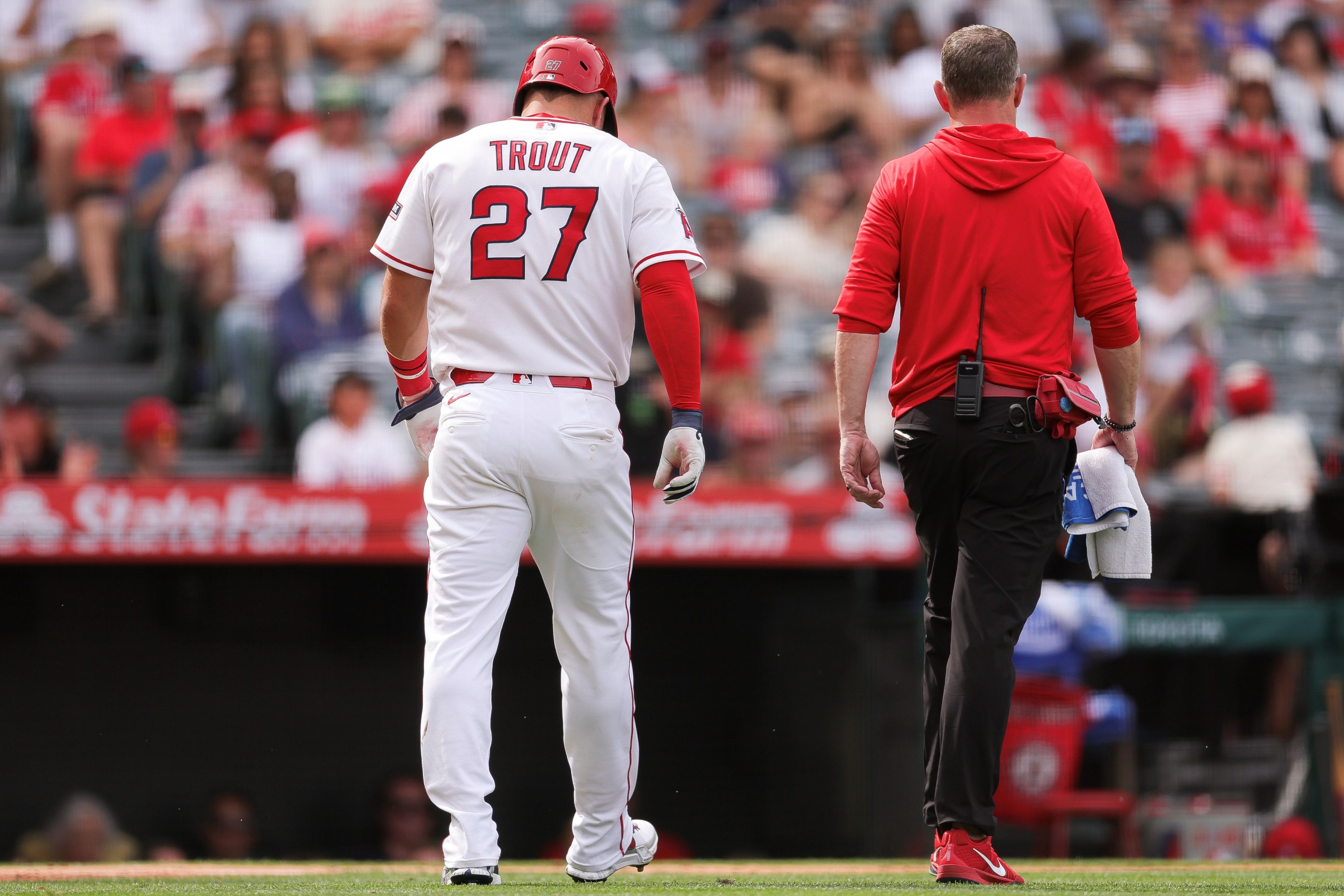
This turned out to be foreshadowing for the final game in the series, when Mariners relief pitcher Casey Legumina hit Trout in the hand with yet another 94-mph up-and-in fastball. Trout originally went to first on the pitch, before he was pulled from the game.
After the game, Trout sang the traditional lament of the smacked slugger: "We know where they're trying to get me out, fastballs up and in, so it's just frustrating. You know, if you can't control it up there, you shouldn't do it. So it is what it is." But maybe everything is turning up Angels, because the Jo Adell Game nearly pales in comparison to the miracle the Angels experienced Sunday night: Latter-day Trout dodging the IL. The X-rays on Trout's hand came back negative, and he is only day-to-day with a contusion.
This is fudging over some of the finer details of it all, like the fact that, hit-by-pitches aside, Trout's offense largely dried up during the series against the Mariners. Ah, April. But you can't help but hope that the Angels—who took their first series win of the year against the Mariners—have, with these two consecutive wonders, rid themselves of the Angels stink of it all and made room for something better to regrow. It has been some time since the last real Mike Trout season. So long as it doesn't come back to hit him, it's not so bad to get a reminder of why pitchers pitch Mike Trout up and in.