

Marty Supreme’s title card is a stream of sperm swimming up a vaginal canal. They fertilize an egg, which becomes a white Marty Supreme ping-pong ball and soars down toward a primordial green table. Ball is life, indeed!
The progenitor of said sperm, 23-year-old Marty Mauser (Timothée Chalamet), has just slept with his childhood friend Rachel (Odessa A’zion) in the storeroom of his uncle’s shoe store. Marty is already an international ping-pong star, but ping-pong doesn’t pay the bills, so meanwhile he lives rent-free with his mother (Fran Drescher) and Uncle Murray (Larry Sloman), slings wingtips, and has an affair with the married Rachel. He’s slated to compete in the 1952 British Open, but Murray owes him $700 in pay that will get him to London. To secure it, he stages an armed robbery of his coworker Lloyd (Ralph Colucci), the first of many escalating schemes to fund his table tennis career and, more immediately, his bid for the 1952 World Championship in Tokyo.
In broad strokes, Marty Supreme follows Marty as he loses the British Open to a Japanese player named Koto Endo (Koto Kawaguchi) and woos actress Kay Stone (Gwyneth Paltrow), tours with the Harlem Globetrotters for eight months, returns to New York, and then—over the course of five feverish days—evades arrest for armed robbery, takes charge of and loses a mafioso’s (Abel Ferrara) German shepherd, hustles ping-pong players in Jersey, solicits Kay for money, tries to reclaim and ransom the German shepherd, rescues Rachel from the mafioso, and finally, in exchange for a ride to Tokyo and cash to pay off a bad behavior fine from the IATT, agrees to throw an exhibition match against Endo which Kay’s businessman husband Milton Rockwell (Kevin O’Leary) has arranged to sell pens. This feels as hectic onscreen as it sounds. Faces swim across tracking shots down packed rooms and narrow passageways. Dialogue overlaps, a notable amount of it over the phone. Every advance Marty makes is instantly erased by hubris and bad luck. Constant doubt from family and acquaintances further muddles the viewer’s attempts to remember his objective. How much does he need, again? Why does he need it so badly (for ping-pong, really)?
In its focus on ugly ways and means, Marty Supreme shares a blueprint (as well as cinematographer and composer) with director Josh Safdie’s previous films, Good Time and Uncut Gems; here, the Safdie rollercoaster hits terminal velocity, rails polished by lush production and futuristic soundtracking. It took me a few viewings to nail down the chronology, but from the first watch, Marty Supreme’s energy centrifuged me to the ride. Chalamet’s face is a rictus of determination and selective self-awareness, lips poised around their next regrettable repartee, myopic eyes fixed on a grand self-image. Sharp, outsize performances across the supporting cast conspire to produce 150 minutes of nauseating, exhausting, undeniable entertainment.
Like other Safdie protagonists, Marty thinks he’s a genius and everyone else is a dumb phony. This cockiness belies a double consciousness that winning is rarely just about results—you also need the fucking money. As if to stonewall against this ugly truth, he raises his standards to delusional heights. It’s not just that he hates wage work (same) and hates the idea he should “settle down” because he impregnated Rachel (not sympathetic, but legible). He hates the IATT’s white ball: You can’t wear classy white shirts to play with it. He hates that chichi IATT officials stay at the London Ritz while he lodges in bunks with inferior competitors, so he buys himself the Royal Suite. But as he tells Kay, “I’m something of a performer too,” and on a dime he’ll swing from belittling the Globetrotters to touring with them for cash (and to delay his ignominious homecoming); from mocking Rockwell’s dead son and ideas to begging for a gig and accepting a public spanking. Despite and because of his sociopathy, he is inspiring. Like all good cons and performances, his machine-gun patter clips innermost truths and reflects an alluring glimmer of grandiosity. He starts out surrounded by people who support him unconditionally, and then—in a flurry of sometimes gasp-inducing one-liners, e.g., “I plan to do to Kletzki what Auschwitz couldn’t”—alienates them all. He’s a classic American individualist, blind to support he receives, scornful of anyone he perceives as “needing help” or being tied to others, which, it turns out, is everyone.
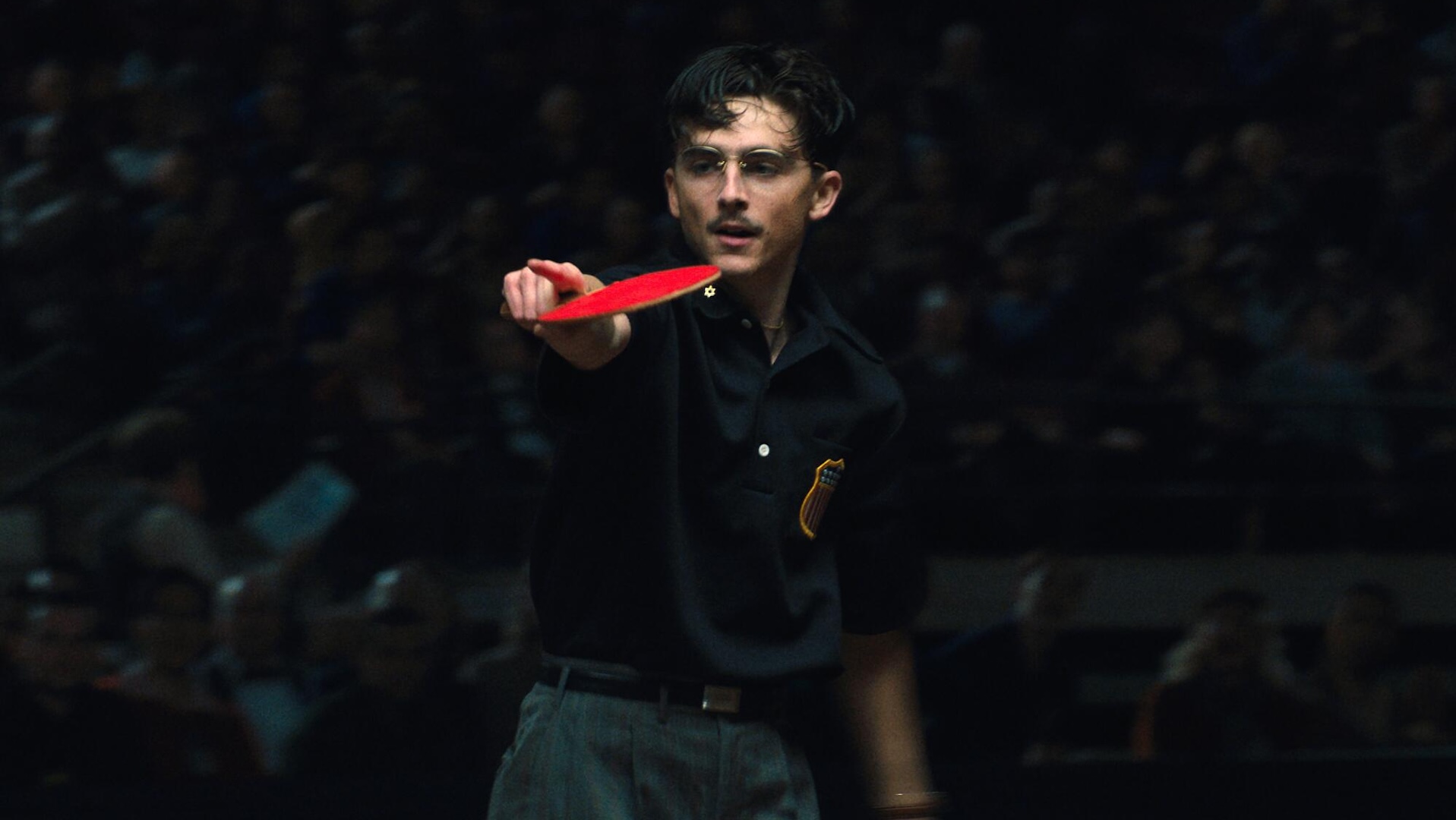
Safdie could probably make a similarly riveting film about Beanie Baby speculators, or alcoholic submarine repairmen. But table tennis perfectly encapsulates post-war geopolitics, the struggles of underdogs, and the whiplash of Marty’s life. In 1952, the sport is crucial to Japan’s diplomatic and imagistic rehabilitation. Endo, deafened in the Tokyo Air Raids, is a national hero, featured in Japanese propaganda that smash-cuts Marty’s loss at the British Open. Though cruelly demanding in its highest echelons, the sport is leveler across physicalities than most. A wiry, myopic Jewish-American boy and hearing-impaired Japanese war survivor could be world champions. This both grants table tennis universal appeal—socialites playing with diamond-studded nets at a U.S. Open party, paddle presentations to the Pope—and keeps it relegated to the purview of senior citizens and uncool immigrant subcultures. Darius Khondji’s cinematography captures this range, from the British Open at Wembley, vast but dimly lit and packed in early stages, to the scrappy midtown club where Marty trains. Vertiginous wide shots show scale; three-quarter views capture technique; shaky zooms on Marty’s reactions at the table replicate the claustrophobia of a stacked match, which also reflects the desultory limitations of Marty’s life. Spectator heads swivel, Challengers-style, to capture the sport’s intimate anxiety. (A deft touch: Béla Kletzki, Marty’s fellow pro, tracks rallies with his eyes only.) At one point, we follow the ball into a dusty corner of Wembley’s court, where Marty must bend to retrieve it while down 0-5. Abjection and glory coexist in every frame.
Marty is of the senseless underworlds table tennis abuts, even if he hates to admit so. A poor American Jewish boy, he is simultaneously defined by and alienated from the Holocaust, its horror and survivor’s guilt. As German-Jewish philosopher Max Horkheimer wrote: “I’m supposed to feel satisfaction and peace of mind in my own life, considering that … this life is the consequence of a meaningless and undeserved happenstance, the product of the blindness which life produces, to the point that I feel ashamed to be amongst the living at all?” Shame piles on from the outside, too: When Rockwell learns that Kletzki survived Auschwitz, he says, “My son died liberating you,” as if Kletzki is personally responsible. From that perspective we can place Marty’s ruthlessness, operating as if there is no justice in this world or the next, only the cold hard gold of a trophy. He riffs to reporters: “Look at me, I’m here, I’m on top, I’m the ultimate product of Hitler’s defeat.” Asked about his background, he pretends to fall asleep. And there is a sick, imperial freedom to such willed pastlessness. It means nothing to Marty that his friend and hustle partner Wally, a black taxicab driver, has to support his kids. It means nothing that his widowed mother depends on his uncle. It means nothing that Endo represents the hopes of a beaten nation, even if Marty shares more with Endo than he ever will with the suits pushing them across exhibition tables. Any details about Marty’s origin and conscience reach us as murmurs in a telephone, muffled complaints (“I got my ass kicked last time!”) that Marty talks right over.
Marty believes that he’s unique, but the film smartly surrounds him with equally hardy, determined people. Kay, an early Hollywood megastar, sees herself in Marty but throws his cause when her comeback play is panned. Wally, an outstanding amateur actor in his own right, tells Marty he won’t let him “fuck me like you do everyone else.” Rachel attempts a series of dizzying long-shot ploys and nearly dies trying to get Marty his money, and as his foil and the literal bearer of his legacy, she receives his greatest vitriol. “I have a purpose and you don’t,” he seethes, her face wan and disbelieving above an eight-month-pregnant belly. He can’t bear to see his monomania reflected in her, or that his fulfillment is also her existential purpose. Barring a miraculous change in material circumstance, she can’t choose to dream bigger. Yet each of these characters has clawed their way in the world from a low place; each gives Marty chances out of curiosity, love, and experience he lacks. He finds their lives petty—“You cashed out,” he sneers at Kay—but one can imagine their travails and the lessons they might have for him.
The supporting character who unlocks the movie, and renders it a distinctive historical reading of the themes in Uncut Gems and Good Time, is Kletzki. As played by Géza Röhrig, the Auschwitz survivor brings an ethereal, timeless gentleness to a movie otherwise obsessed with rapacious advancement. Early on, seated in the Ritz restaurant, Marty brusquely urges Kletzki to “tell [Rockwell] the story you told me, about the bees.” Kletzki then recounts finding a beehive on the Auschwitz grounds, where he was allowed to defuse bombs instead of doing hard labor because an S.S. officer admired his table tennis. He smokes out the bees, cracks the hive, and slathers himself in honey so his bunkmates can lick it off for nourishment. The flashback cuts directly to Kay arriving at Marty’s suite, the haunting electronic arpeggios and choral chants that scored Auschwitz swelling over their lovemaking. Above Kay’s disembodied back, Marty meets his own eyes in the Ritz mirror, alone in intimacy. Though he never appears as relaxed and genuine as he does around Kletzki, he disowns what Kletzki stands for. Lopatin’s music literally underscores that: The chants and drones from “Holocaust Honey” recur, in turns sinister and triumphant, at key moments along Marty’s misguided journey.
No matter his skill, an athlete can only go alone and repress his demons for so long. After his scripted loss to Endo, Marty must kiss a pig. He just found out he won’t compete in the World Championship; he hasn’t paid his fine and the IATT president (a delightfully patrician Pico Iyer) hates him. He’s already set aside his ego and thrown the game. In the face of this final racial insult, though, Marty bucks his deal with Rockwell, forfeits his last chance at payment, and demands a real rematch. He’s tried every gamble and low blow. All that’s left is the game, which the Japanese audience wants, too. In the game there remains an illusion of meritocracy and equality—which, Marty probably tells himself, is what he chased all along.
Defeated, Endo clasps Marty’s hand and tries to face his crestfallen people. Somewhere behind him hangs a poster of Marty drawn with ratlike incisors and slitted visage, like American propaganda of Japanese soldiers. Tears wet Endo’s eyes.
So it’s a bit ironic that Marty Supreme’s motto, DREAM BIG, has been taken up as inspiration, scrawled across baby photos and shouted from atop the Las Vegas Sphere. A movie about a showman does beg metafictional performance, and for months Chalamet has cultivated a Marty-adjacent persona as a homegrown hero, diminutive but mighty, unafraid to aspire. The commentators chatter: Is it a viable Oscar ploy? Is it embarrassing, deserving, etc.? For this viewer, the stunts are simply amusing. An orange blimp, a collab with British rapper EsDeeKid, a cameo where Chalamet does the Soulja Boy: These are vintage YouTube shenanigans teenagers would have memed in 2012, before the internet dirty-bombed our consciousnesses. “This is a movie about sacrifice in pursuit of a dream,” Chalamet says on Fallon. Innocuous enough. Compared to Marty Mauser, he’s a saint. To me, the least savory aspect of the campaign has been its commercial miasma. Its merch drops included a $25 Wheaties box and CashApp credit card stamps. The headliner Marty Supreme jacket resells for up to $7,000. Its reach among Zillennial tastemakers cements the conflation of attention, expenditure, and art: willed scarcity as our greatest commodity while spending power plummets and billionaires try to defibrillate our soulless consumer economies. A lifelong table tennis player, I was excited for the movie to help “grow the sport”—but toward what? To be cursed with the Rolex ads and Saudi exhibition matches now part and parcel of tennis, for example? My every fiber screamed No. There must be a way to attract people and fund recreational clubs without shilling CashApp cards. I do want more people to understand and love the sport. That’s what Marty finds with the Japanese audience and Endo, too: love and understanding. It paid him zero dollars.
In 1952, average Americans had just begun to dream postwar capitalistic dreams. Today, the idea that a young man would aspire to win a sports tournament outright (as opposed to, say, stage-boxing Mike Tyson for $40 million) or sell tangible products like ping-pong balls is kind of quaint. So is the aspiration to win an Oscar, even as Hollywood, a prime launderer of American exceptionalist propaganda, collapses around Chalamet’s ears.
The film ends with Marty tearfully beholding his newborn to a needle drop of “Everybody Wants to Rule the World.” It suggests Marty has a chance to forge a new way through life, with and through his son. Too often, though, cruelty is the inheritance of victors. We already occupy the world this child will inherit. Like Marty’s overbearing mother, I am very, very worried for him.